All-in-One COB LED TV
 Flexible LED Displays
 Transparent LED Displays
 Led Poster
 Circular LED Displays
 Column LED Screens
 Creative & Custom LED Displays
TN, IPS, VA and FFS control liquid crystals in different ways. Their operating principles help explain viewing angle, contrast and motion behavior, but model specifications still matter.
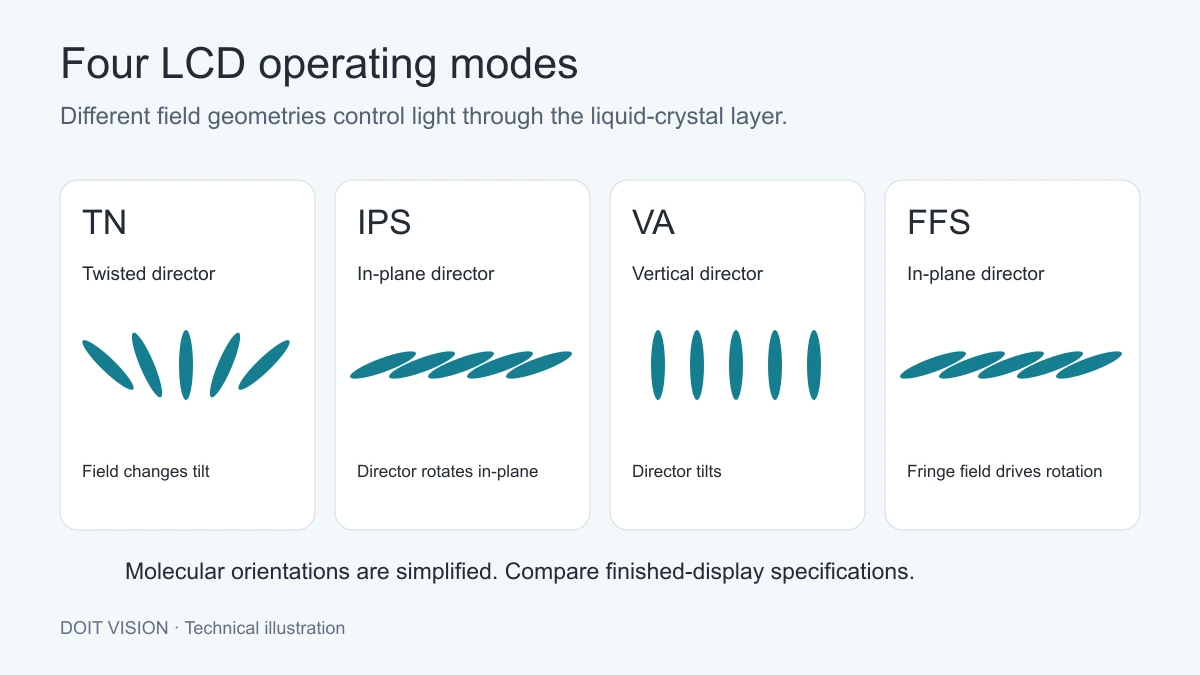
LCD technology is based on the birefringence effect of liquid crystal molecules. Depending on the molecular motion state, LCDs are categorized into four main modes:
TN (Twisted Nematic)
IPS (In-Plane Switching)
VA (Vertical Alignment)
FFS (Fringe Field Switching)
Do you know the display principles and key characteristics? DOIT VISION will guide you these details.
Related: LCD wall upgrade to LED wall cost.
4 Common LCD Display Modes:
TN Mode (Twisted Nematic)
TN is an established LCD mode using a twisted liquid-crystal layer. Descriptions such as “soft screen” are informal and should not be treated as mechanical-durability ratings.
Display Principle:
No Voltage Applied: Natural light from the backlight passes through the lower polarizer, becoming linearly polarized light. This light enters the liquid crystal cell. Due to the alignment layers (PI) on the inner surfaces of the upper and lower glass substrates, the liquid crystal molecules twist by 90 degrees from bottom to top.
As the polarized light propagates through the cell, its polarization direction rotates synchronously with the molecules. When this polarized light reaches the upper polarizer, its direction has rotated 90 degrees, aligning parallel to the optical axis of the upper polarizer. Consequently, the light transmits, and the LCD appears bright (ON state).
Voltage Applied (Vertical Electric Field): The interaction between the dielectric anisotropy of the liquid crystals and the applied electric field disrupts the twisted structure. The long axes of the liquid crystal molecules align parallel to the electric field direction. The polarization direction of the incoming linearly polarized light no longer rotates. When this light reaches the upper polarizer, its polarization direction is perpendicular to the polarizer’s optical axis, preventing light transmission. Consequently, the LCD appears dark .
In summary, TN mode panels are bright (ON) when no voltage is applied and dark (OFF) when voltage is applied. Because the display is normally bright without voltage, it’s termed a Normally White (NW) mode.
Viewing Angle Limitation:
The TN mode relies on a vertical electric field, causing the long axes of the liquid crystal molecules to tilt vertically. So, it creates significant differences in optical path length when viewed from different angles. Consequently, the display appearance varies greatly depending on the viewer’s position, with the most accurate image only seen directly head-on. While viewing angle compensation films can partially mitigate this issue, TN panels always have an optimal viewing direction, typically described as the 6 o’clock or 12 o’clock position.
Pros:
Fast Response Time: TN designs can offer fast transitions and remain relevant where motion performance and cost are priorities. Response depends on the panel, transition and drive settings; it is not a direct consequence of having fewer color levels.
Lower Cost: The manufacturing process is relatively simple, mature, and cost-effective. Therefore, TN is suitable for prioritizing cost over ultimate image quality application.
Power Consumption: Compare the finished display at equal luminance. Backlight efficiency, screen size, refresh rate and electronics can outweigh any simple power ranking by LCD mode.
Cons:
Limited Viewing Angles: TN panels suffer from narrow viewing angles, especially in the vertical direction. Color shifts, contrast reduction, brightness changes, and image distortion are common when viewed off-axis.
Color Reproduction: Some TN panels use 6-bit driving with temporal dithering to represent additional shades. Native 6-bit RGB has 262,144 combinations, but the complete display may accept an 8-bit signal. Panel mode alone does not determine color accuracy, gamut or bit depth; check these separately.
Contrast Ratio: TN often offers less native contrast than VA. The actual ratio depends on the panel and measurement conditions. Compare static contrast separately from dynamic-backlight claims, and inspect black level in the intended room.
Market Position:
TN remains an option in cost-sensitive and speed-focused applications. Its off-axis limitations can make it a weaker fit for shared viewing or color-critical work. Select from current model specifications instead of assuming that all TN products belong to one price or quality tier.
IPS Mode (In-Plane Switching)
IPS means In-Plane Switching. It rotates the liquid-crystal director largely within the plane of the substrates and is widely used where stable off-axis images matter. The informal term “hard panel” does not establish impact resistance or service life. IPS has multiple implementations, so contrast, response time and color capability still need model-level comparison.
Display Principle:
No Voltage Applied: Natural light from the backlight passes through the lower polarizer, becoming linearly polarized light aligned with the polarizer’s axis. In the absence of voltage, the liquid crystal molecules remain in their initial state and do not rotate the light’s polarization plane. Consequently, when this polarized light reaches the upper polarizer, its polarization direction is perpendicular to the optical axis of the upper polarizer. The upper polarizer blocks the light, resulting in the LCD appearing dark (OFF state).
Voltage Applied: An in-plane electric field rotates the liquid-crystal molecules within the substrate plane. This changes the layer’s optical retardation and the light transmitted through the polarizers. The action is more accurately described this way than as a fixed 90-degree rotation of every light ray.
The changing retardation allows different amounts of light to pass through the analyzer. By varying the applied voltage, IPS panels regulate transmission to produce gray levels; color filters form the RGB subpixels.
In summary, IPS panels are dark (OFF) when no voltage is applied and bright (ON) when voltage is applied. Because the display is normally dark without voltage, it’s termed a Normally Black (NB) mode.
Viewing Angle Performance:
The predominantly in-plane molecular motion helps IPS maintain more consistent color and contrast at oblique angles than many TN implementations. Off-axis changes can still occur, especially with dark content. A broad quoted angle is not a promise that every color remains identical throughout that range.
Pros:
Exceptional Viewing Angles: IPS panels maintain clear images and accurate color reproduction across wide viewing angles, both horizontally and vertically.
Color Capability: An 8-bit RGB signal has 256 values per channel, or about 16.77 million combinations. IPS panels are available with different native depths and dithering approaches. The LCD mode helps explain viewing behavior, while calibration, gamut and signal processing determine the actual color result.
Commercial Operation: Check operating-hour ratings, static-content guidance, cooling and warranty for the finished display. Neither IPS nor another panel label guarantees service life or resistance to physical damage. This matters for reception displays and monitoring walls used for long periods.
Cons:
Lower Native Contrast Ratio: Many IPS panels have lower native contrast than VA designs. Compare measured model data; there is no single contrast ratio shared by every IPS panel. Local dimming can change the complete display’s behavior independently of the underlying LCD mode.
IPS Glow and Backlight Bleed: IPS glow is an angle-dependent brightening most noticeable in dark scenes. Backlight bleed is unwanted light leakage or nonuniformity and is a different issue. Inspect dark imagery from the planned seats at a realistic brightness setting.
Higher Cost: Due to more complex manufacturing processes, IPS panels typically command higher prices than TN panels.
VA Mode (Vertical Alignment)
VA can provide strong native contrast because its vertically aligned off-state helps block light between crossed polarizers. It still uses alignment structures; its contrast advantage is not caused by having no alignment layer. Actual contrast depends on the cell, optical films and complete backlight design.
VA mode panels represent another major mainstream display technology. It is primarily used in large-size televisions and curved screens. The VA category can be further subdivided into types like MVA, PVA, PSVA, and UV2A.
Display Principle:
No Voltage Applied: In the absence of voltage, liquid crystal molecules align vertically. Natural light from the backlight passes through the lower polarizer, becoming linearly polarized light. Due to the vertical molecular alignment, the polarization direction of this light remains unchanged. When it reaches the upper polarizer, its polarization direction is perpendicular to the polarizer’s optical axis, blocking light transmission. Consequently, the LCD appears dark (OFF state).
Voltage Applied: The electric field causes the molecules to tilt away from their initial vertical alignment. The degree and direction of tilt change the optical retardation and transmission through the crossed polarizers. The molecules need not become perfectly horizontal, nor does every operating state correspond to a fixed 90-degree light rotation.
Changing the voltage changes the amount of transmitted light, producing different gray levels. Multi-domain designs arrange the tilt directions to improve viewing behavior. Color filters and the control electronics complete the color image.
In summary, VA panels are dark (OFF) when no voltage is applied and bright (ON) when voltage is applied. Because the display is normally dark without voltage, it’s termed a Normally Black (NB) mode.
Viewing Angle Performance:
VA implementations can use multiple domains to balance viewing behavior in different directions. Their number and structure vary by design. This improves performance compared with a simple single-domain arrangement, but off-axis gamma and color shifts still need inspection in a wide seating layout.
Pros:
High Contrast Ratio: VA designs often produce deeper native blacks than conventional IPS or TN at comparable settings. This can help dark-room imagery. Check measured contrast and bright-scene behavior for the particular display rather than adopting a universal 3000:1 threshold.
Wide Viewing Angles: While viewing angles are generally slightly narrower than those of IPS panels, VA technology still offers significantly wider and more stable viewing angles than TN panels.
Color Reproduction: VA displays can offer rich colors, but their native bit depth, gamut and accuracy are separate specifications. As with IPS, an 8-bit RGB signal provides about 16.77 million code combinations. Check calibration and off-axis color as well as the accepted signal format.
Cons:
Slower Response Times: Compared to TN panels and some fast-response IPS panels , VA panels generally exhibit slower pixel response times, particularly in gray-to-gray transitions. This can lead to motion blur or ghosting artifacts in fast-moving content.
Power Consumption: Whole-display power depends heavily on the backlight, brightness, area and electronics. Molecular drive voltage alone is not a reliable basis for ranking the energy use of TN, IPS and VA monitors.
Potential Uniformity Issues: Achieving perfect screen uniformity can be challenging with VA panels. You may encounter Issues like color shift. It be more noticeable compared to other technologies, especially off-axis.
FFS Mode (Fringe Field Switching)
FFS, or Fringe Field Switching, developed from the family of in-plane LCD approaches. In a typical FFS structure, patterned electrodes and an underlying common electrode are separated by an insulating layer. The resulting fringe field can control molecules above the electrodes as well as between them, improving use of the available pixel area.
FFS is designed to improve light transmission while retaining wide-angle behavior. Higher transmission can help a display reach a given luminance with less backlight output, although total power depends on the complete product. FFS does not inherently eliminate mura or guarantee perfect uniformity and color accuracy. See E Ink’s technical account of FFS development.
Key Difference from IPS:
In conventional IPS, applying voltage primarily rotates liquid crystal molecules located between the electrodes. In FFS mode, applying voltage rotates liquid crystal molecules both between the electrodes AND directly above the electrodes due to the generated fringe field.
Pros:
High Transmittance/Aperture Ratio: FFS utilizes transparent electrodes, maximizing the pixel aperture ratio. This significantly increases panel transmittance compared to standard IPS.
Wide Viewing Angles: Fringe-field control supports stable off-axis performance. Compare the actual implementation with other wide-angle LCD designs; FFS does not guarantee a wider usable angle than every IPS model.
Lower Power Consumption: The higher transmittance directly translates to lower required backlight brightness for achieving the same on-screen luminance, reducing overall power consumption.
Cons:
Higher Production Costs: FFS manufacturing involves relatively complex processes requiring high-precision equipment and strict process control. So it needs higher production costs compared to basic IPS or TN.
Response Time Trade-off: While excelling in transmittance and viewing angles, FFS panels can sometimes exhibit slightly slower response times than optimized TN or some advanced IPS variants. This may impact the clarity of fast-moving images, potentially causing subtle motion blur.
Summary comparison of TN, IPS, VA and FFS
The table describes common tendencies, not guaranteed specifications. Normally white or black refers to the simplified constructions explained above; optical variants exist.
Scroll horizontally to see all columns on a small screen.
| Feature | TN | IPS | VA | FFS |
|---|---|---|---|---|
| Viewing behavior | Often more angle-sensitive | Generally stable off-axis | Check off-axis gamma | Generally stable off-axis |
| Native contrast | Model-dependent | Often below VA | Often a strength | Model-dependent |
| Color depth | Check native depth and dithering | Check native depth and dithering | Check native depth and dithering | Check native depth and dithering |
| Response time | Often fast | Fast variants available | Some dark transitions can be slow | Model and transition dependent |
| Black appearance | Check from actual seats | Inspect glow in dark scenes | Often strong head-on | Check from actual seats |
| Transmission | Design-dependent | Design-dependent | Design-dependent | Improved transmission is a design aim |
| Power | Compare at equal luminance | Compare at equal luminance | Compare at equal luminance | Transmission can reduce backlight load |
| Cost | Often cost-oriented | Broad price range | Broad price range | Depends on implementation |
| Common uses | Monitors and embedded displays | Monitors, tablets and shared displays | TVs and monitors | Mobile and other wide-angle displays |
| Key strength | Speed and cost | Viewing consistency | Native contrast | Transmission and viewing behavior |
| Key check | Off-axis image changes | Contrast and glow | Dark transitions and off-axis gamma | Uniformity and response |
| Typical off-state | Normally white example | Normally black example | Normally black example | Normally black example |
| Field approach | Predominantly vertical | In-plane | Predominantly vertical | Fringe field |
Conclusion:
TN, IPS, VA and FFS describe how an LCD modulates a backlight. Choose among them using viewing geometry, contrast, motion and color requirements. When a project grows into a multi-panel wall, also compare bezel visibility, total canvas size, service access and content resolution. These system questions are where a direct-view LED alternative becomes relevant.
When to compare an LCD wall with direct-view LED
The four LCD modes explain panel behavior; they do not by themselves decide the best technology for a whole wall. For a larger installation, compare bezel interruptions, nearest viewing distance, small-text readability, total pixel count and access for maintenance. A single LCD and a modular LED wall solve different size and installation problems.
With LED, match pixel pitch and module layout to the physical canvas and content. With an LCD wall, account for panel borders and the resulting content layout. In both cases, evaluate brightness, reflections and off-axis viewing in the real room.
Use the LED video wall guide to review the system choice, and the LCD-to-LED upgrade cost guide to organize the budget. Bring existing panel dimensions, source resolution and a site photo to a project discussion.
Bring the screen dimensions, viewing distances, content and installation conditions to the next step.