 All-in-One COB LED TV
  Flexible LED Displays
  Transparent LED Displays
  Led Poster
  Circular LED Displays
  Column LED Screens
  Creative & Custom LED Displays
 A continuous arc
Provide the arc width, height and radius. Identify a concave or convex curve, then define the nearest
viewer and available installation depth.
Turn a curved wall, column or sculptural form into a display. Plan the shape, pixel layout, structure and service access as one complete project.

From module to display
A flexible LED display uses bendable circuit boards and a soft module housing to follow a curved support. Modules join into a larger pixel canvas, with the frame controlling the final shape and alignment.
For an installed screen, the important decisions extend to the structure, power distribution, control system and maintenance access. Choose a component package or a framed display around the work your team will handle.
For P2.5 and finer pitches, we recommend GOB protection to help protect the LED surface from knocks and handling, especially on columns, retail displays and other installations within public reach.

Choose the geometry
The surface determines the module layout, frame and content canvas.
Provide the arc width, height and radius. Identify a concave or convex curve, then define the nearest
viewer and available installation depth.
Provide the existing column size and the maximum finished diameter. Allow for the frame and service
space; set the closing joint and the main viewing positions.
Send a section drawing or 3D model. A flare, taper or compound curve can need contoured modules, a custom structure and a dedicated pixel map.
Structure, curvature & protection
Bendable modules, distributed magnetic supports and a matched frame work together to create a continuous curved picture.
240 × 120 mm moduleØ764 mm
Minimum cylindrical bend diameter
24 magnets per module
320 × 160 mm moduleØ509 mm
Minimum cylindrical bend diameter
28 magnets per module
These are minimum cylindrical bend diameters for the listed base modules. The finished screen also needs a frame and service space. Confirm the bend direction and GOB configuration with the selected module.

Two module sizes give different bend limits. A 320 × 160 mm module can form a tighter cylindrical profile than the 240 × 120 mm family.
Specify the radius or diameter at the LED surface and identify a concave or convex curve. For a column wrap, include the existing column size and space for the supporting structure.
A screen’s total arc angle describes how far it wraps. The bend across each module follows its width and the chosen radius.
The 240 × 120 mm module uses 24 magnets; the 320 × 160 mm module uses 28
magnets. Distributed fixing points hold the soft housing against the shaped support.
Adjustable magnetic mounting points help align neighbouring modules. Keeping the edges at the same level reduces steps, lifted corners and visible joint lines.
Compatible steel mounting points connect the flexible module to the custom structure. The frame establishes the shape; the magnets hold the module to that surface.


Seamless-looking curves start with the structure. A frame shaped to the required radius supports the full module, while aligned magnetic points keep adjacent pixel surfaces flush.
GOB is our recommended configuration for P2.5 and finer pitches. The protective surface helps reduce LED damage from accidental knocks and handling.
It is especially relevant for pedestrian-accessible columns, retail displays, LED cans and low-level installations. Include GOB in the initial module selection so the protection and bend requirement are considered together.
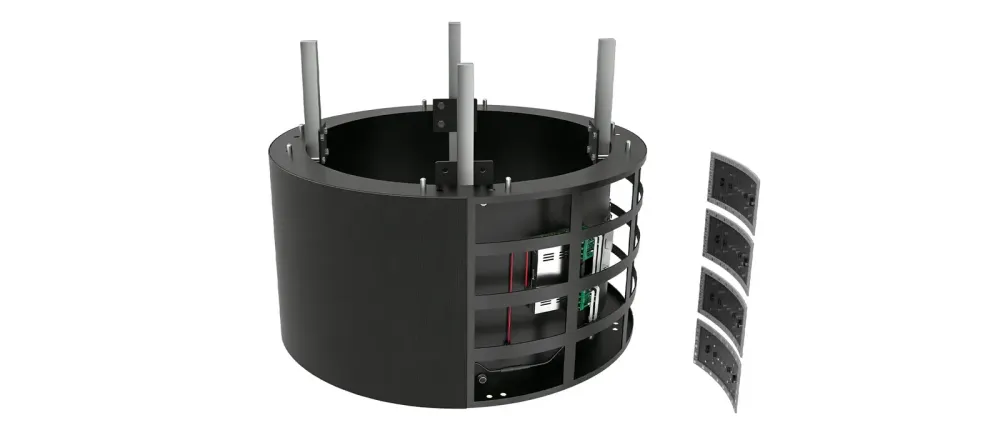
Front module removal makes the display surface accessible. The structure must also provide a route to power supplies, receiving cards and cable connections.
A cylinder uses a canvas around its full circumference. Position key messages for the main viewing directions and prepare the content transition at the closing seam.
Curved-wall configurations use Novastar or Colorlight. Cylinder systems use Mooncell, with the controller and pixel map selected for the project.
Indoor & outdoor modules
Compare indoor 240 × 120 mm and 320 × 160 mm modules, or choose the dedicated
outdoor P4 configuration.
| Pitch | Pixels / module | Brightness · nits | Refresh · Hz | LED package | GOB option |
|---|---|---|---|---|---|
| P1.25 | 256 × 128 | 450–800 | 3,000–3,840 | SMD1010 | Recommended |
| P1.538 | 208 × 104 | 450–800 | 3,000–3,840 | SMD1212 | Recommended |
| P1.568 | 204 × 102 | 450–800 | 3,000–3,840 | SMD1212 | Recommended |
| P1.667 | 192 × 96 | 450–800 | 3,000–3,840 | SMD1212 | Recommended |
| P1.86 | 172 × 86 | 450–800 | 3,000–3,840 | SMD1212 | Recommended |
| P2 | 160 × 80 | 650–800 | 3,000–3,840 | SMD1515 | Recommended |
| P2.5 | 128 × 64 | 650–800 | ≥1,920 | SMD1515 | Recommended |
| P3.076 | 104 × 52 | 650–800 | ≥1,920 | SMD1515 | By application |
| P4 | 80 × 40 | 650–800 | ≥1,920 | SMD2121 | By application |
| Pitch | Pixels / module | Brightness · nits | Refresh · Hz | LED package | GOB option |
|---|---|---|---|---|---|
| P0.9375 | 256 × 128 | 500–650 | 3,840 | MIP0606 | Recommended |
| P1.25 | 192 × 96 | 500–650 | 3,840 | SMD1010 | Recommended |
| P1.579 | 152 × 76 | 500–650 | 3,840 | SMD1212 | Recommended |
| P1.667 | 144 × 72 | 500–650 | 3,840 | SMD1212 | Recommended |
| P1.875 | 128 × 64 | 500–650 | ≥2,880 | SMD1515 | Recommended |
| P2 | 120 × 60 | 500–650 | ≥2,880 | SMD1515 | Recommended |
| P2.5 | 96 × 48 | 500–650 | ≥1,920 | SMD1515 | Recommended |
| P3 | 80 × 40 | 500–650 | ≥1,920 | SMD2121 | By application |
| P4 | 60 × 30 | 500–650 | ≥1,920 | SMD2121 | By application |
| Pitch | Pixels / module | Brightness · nits | Refresh · Hz | Module protection | Mounting |
|---|---|---|---|---|---|
| P4 | 120 × 40 | 3,500–4,500 | 3,840 | IP54 | 20 magnets + 4 latches |
Outdoor P4
480 × 160 mm · 120 × 40 pixels · 3,500–4,500 nits · IP54 module protection. Specify the complete
enclosure and mounting for the installation environment.
LED can applications
Can-shaped displays bring a brand’s packaging into the physical space, with moving
content around the cylindrical body.

Combine a flexible LED wrap with a custom body and top profile to create a can or bottle-shaped display.The structure, diameter and opening details follow the intended product form.
Specify the viewing distance, graphics and how close people will stand. For P2.5 and finer pitches in public reach, include GOB protection in the configuration.

Cylinder planning
Explore a full cylinder using standard rectangular modules. Change the size or
pitch to see the effect on its pixel canvas.
Enter the target diameter of the LED surface. Module width runs around the cylinder; module height runs vertically. The calculation rounds up to whole modules.
Full pixel canvas
2560 × 960 px
Geometric estimate. Frame clearance, joint tolerances, permitted bending and controller capacity require project review. This is the full circumference, not a single viewer’s field of view.
Example: for a 2 m diameter × 2.4 m target using 320 × 160 mm modules, P2
produces 3200 × 1200 pixels; P2.5 produces 2560 × 960. The display area stays the same.
Portugal & Japan
Explore a cylindrical GOB display or a horn with a changing diameter. Each project
takes a different route from structure to finished screen.


Scope & pricing
Flexible LED display prices make sense when the screen dimensions and supply scope
are the same.
Define the modules, power supplies, receiving cards, cables and spares needed for your team’s structure
and assembly plan.
Specify the custom frame, module layout, service access and control equipment, with transport sections suited to site access.
Agree who handles the supporting structure, power feeds, lifting, screen assembly and commissioning.
Confirm the support arrangement for your destination.
Request the module specification and included items with the quote. Agree drawings, spares, packing and the installation schedule before production.
Practical answers on price, resolution, curvature and installation.
Yes. A flexible LED project can be supplied as modules and matched components for your own structure, or as a display package with a custom frame. Define who supplies the frame, power distribution, control equipment, spares and installation work before comparing prices. Send the intended shape and overall dimensions so the quotation can describe a complete, agreed scope.
Price depends on the selected module, total display area, frame geometry, control equipment and delivery scope. A cylinder adds a closing seam and a full circumference of pixels; a horn can require custom circuit board shapes. Compare quotations using the same dimensions, pixel pitch, structure, spare parts and shipping terms. Installation and content production should each have a clearly defined scope.
Choose pixel pitch around the nearest viewers and the smallest text or image detail that matters. A smaller pitch puts more pixels into the same display area. For example, a 320 × 160 mm P2 module has 160 × 80 pixels, while P2.5 has 128 × 64 pixels. Evaluate representative content at the intended viewing distance before fixing the specification.
The listed minimum cylindrical bend diameter is 764 mm for the 240 × 120 mm module and 509 mm for the 320 × 160 mm module. These are module bend references, not the diameter of the building column underneath. Confirm the bend direction, surface protection and frame clearance for the selected configuration. Radius is half the diameter.
A horn with a changing diameter needs a surface layout designed for that geometry. Rectangular flexible modules work well along suitable curved sections, while changing widths can require contoured circuit boards and a custom frame. The Tokyo horn project combined flexible sections with custom contour modules. Send a section drawing or three-dimensional model to establish the module arrangement and pixel map.
Magnetic modules attach to compatible steel mounting points on a supporting frame. The frame establishes the curve and joint alignment, while power and data cables connect the module groups. Plan an access route for modules, power supplies and receiving cards. Front module removal is useful, but the complete structure must also provide working space for reaching, disconnecting and replacing internal components.
Plan the circumference using an integer number of modules, then coordinate the frame diameter, alignment and closing joint with that layout. Check joint spacing and surface alignment in the assembled curve, and align the content at the image wrap point. Mechanical fit and media preparation both affect the result. Review the closing joint with representative content before approving the finished display.
The full pixel canvas equals the pixels around the circumference multiplied by the pixels across its height. With twenty 320 × 160 mm P2.5 modules around and fifteen rows vertically, the canvas is 2560 × 960 pixels. This describes the whole cylinder; one viewer sees only part of its surface. Place key messages for the intended viewing positions and prepare a suitable content layout.
Start with the shape, approximate dimensions, installation location, intended content and nearest viewing distance. A sketch or site photograph is enough to begin discussing the layout. For a column wrap, include the existing column diameter and the maximum permitted finished diameter. Add the target installation date, destination and whether your team needs modules, a framed display package or installation assistance.
DOIT VISION has a representative office in California, USA, with technical personnel who can assist with installation and provide technical guidance. Share the site location, display design and installation schedule so the support arrangement can be discussed for your project. Agree the responsibilities for structure, electrical work, screen assembly and commissioning as part of the project scope before installation begins.
We recommend GOB for P2.5 and finer pitches, especially when pedestrians can touch the display. Its protective surface helps reduce LED damage from accidental knocks and module handling. Retail columns, LED cans and low-level feature displays are common applications. Specify GOB when choosing the module so the surface protection, desired bend and mounting arrangement can be reviewed together.
Yes. The outdoor P4 configuration uses a 480 × 160 mm module with 120 × 40 pixels, 3,500–4,500 nits brightness and 3,840 Hz refresh. The module specification lists IP54 protection. Plan the complete outdoor screen around its exposure, including the rear enclosure, cable entries, drainage, heat management and supporting structure. Confirm these details for the intended site before ordering.
Practical guides to pricing, curved-screen installation and surface protection.

A transparent pricing breakdown — what you pay per module, per square metre of hardware, and for ...
Read guide
Walk into a high-end hotel lobby, a modern shopping mall, or a real estate sales center these day...
Read guide
GOB (Glue on Board) encapsulation adds a transparent protective layer over the entire LED surface...
Read guide
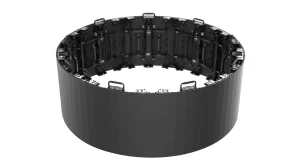
Start with a sketch
Send the space, approximate dimensions and the effect you want to create. We can work through the module layout, structure and quotation scope with your team.
A drawing, a site photo or an early idea. Tell us what you are planning and work through the details with our engineering team.