All-in-One COB LED TV
 Flexible LED Displays
 Transparent LED Displays
 Led Poster
 Circular LED Displays
 Column LED Screens
 Creative & Custom LED Displays
P0.9 is a market class, not a promise that every product measures exactly 0.9000 mm. DOIT VISION’s COB Pro and MIP models in this class use a verified 0.9375 mm pitch. With a 600 × 337.5 mm cabinet and 640 × 360 pixels, a native 4K wall is exactly 6 × 6 cabinets: 3.60 × 2.025 m, about 163 inches. This guide shows the cabinet math, COB-versus-MIP choice, working viewing distance, specifications and current EXW panel budget.

- Check the exact SKU. In this range, DOIT VISION’s COB Pro and MIP models are 0.9375 mm, with 1,137,777 pixels/m².
- Native 4K is 36 cabinets. A 6 × 6 grid produces 3,840 × 2,160 pixels on a 3.60 × 2.025 m canvas.
- COB Pro is the priced baseline. The September 2026 EXW panel band is $2,250–2,500/m²; MIP is quoted separately.
- Do not buy pitch alone. Brightness, refresh rate, processor, structure and service scope can explain a large quote gap.
What “P0.9” Means—and Why This SKU Is 0.9375 mm
P0.9 describes a commercial pitch class. It does not guarantee that every manufacturer’s physical centre-to-centre LED spacing is exactly 0.9000 mm. The purchase order, tender schedule and pixel calculation should use the precise value from the selected SKU.
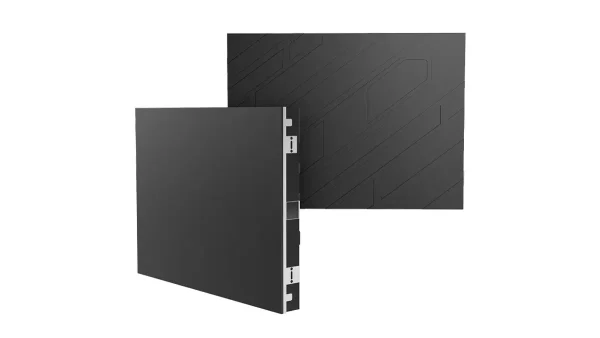
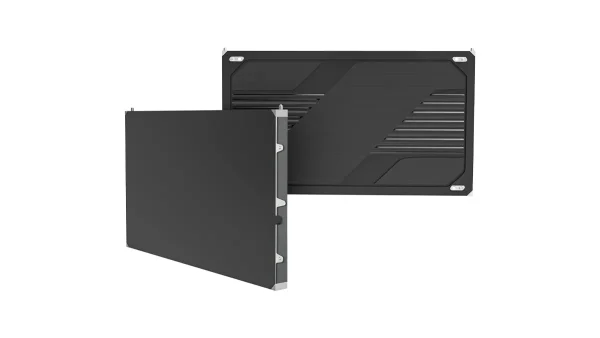
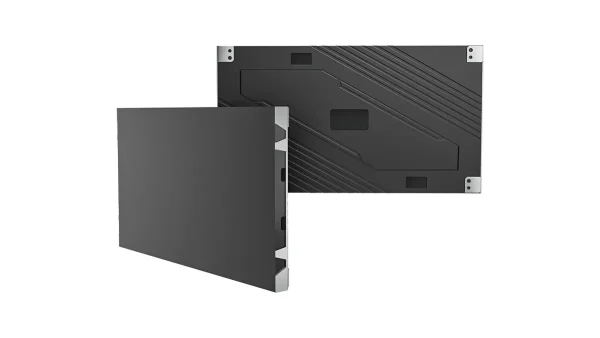
For DOIT VISION COB Pro P0.9375 (CP-I-P093) and MIP P0.9375 (MP-I-P093), the physical pitch is 0.9375 mm. That produces a specified density of 1,137,777 pixels/m². Each 600 × 337.5 mm cabinet contains 640 × 360 pixels, so its aspect ratio and pixel grid are both native 16:9.
This distinction matters in tenders. Writing only “P0.9” can create a mismatch between the consultant’s pixel schedule and the manufacturer’s cabinet drawing. Write 0.9375 mm nominal pitch, 640 × 360 pixels per cabinet, then attach the cabinet layout. That gives every bidder the same geometry to price.
P0.9375 indoor direct-view LED; 600 × 337.5 mm cabinet; 640 × 360 pixels; front service; cabinet matrix and total native resolution shown on the shop drawing.
COB Pro vs MIP at P0.9375: Two Lines, Two Jobs
The two models share pitch, cabinet footprint, pixel grid, weight and front-service access. Their useful differences are packaging, contrast, refresh configuration, power profile and repair workflow—not the number printed after “P”.
| Decision line | COB Pro P0.9375 | MIP P0.9375 |
|---|---|---|
| Contrast | 10,000:1 | 100,000:1 |
| Refresh | 3,840 / 7,680 Hz | 7,680 Hz |
| Brightness | 600 / 1,000 cd/m² configurations | 800–1,000 cd/m² |
| Typical power | 120 W/m² | 200 W/m² |
| Best starting point | Boardrooms, control rooms, premium fixed walls | Camera-facing, high-contrast and specialist pixel-repair workflows |
Start with COB Pro when the brief needs a sealed, touch-safe surface and a predictable fixed-install budget. Start with MIP when 7,680 Hz, deeper specified contrast or package-level repair is central to the acceptance test. Ask for both only when the consultant has defined how those differences will be scored.

Exact 4K and 8K Cabinet Math
A P0.9375 cabinet carries 640 × 360 pixels. Divide 3,840 × 2,160 by that cabinet grid and both dimensions resolve to six. Native 4K therefore needs 6 × 6 = 36 cabinets. The physical canvas is 6 × 600 mm by 6 × 337.5 mm: 3.60 × 2.025 m, 7.29 m² and approximately 163 inches diagonal.
| Pitch / cabinet pixels | Native 4K grid | 4K canvas | Native 8K grid | 8K canvas |
|---|---|---|---|---|
| P0.62 · 960×540 | 4×4 · 16 | 2.40×1.35 m · 108″ | 8×8 · 64 | 4.80×2.70 m |
| COB Pro P0.78 · 768×432 | 5×5 · 25 | 3.00×1.6875 m · 136″ | 10×10 · 100 | 6.00×3.375 m |
| P0.9375 · 640×360 | 6×6 · 36 | 3.60×2.025 m · 163″ | 12×12 · 144 | 7.20×4.05 m |
| P1.25 · 480×270 | 8×8 · 64 | 4.80×2.70 m · 217″ | 16×16 · 256 | 9.60×5.40 m |

Dimensions are active LED canvas before trim and installation tolerance. A 4K input can be scaled to other cabinet matrices, but “accepts 4K” is not the same as “native 3,840 × 2,160 pixels.”
Send the target resolution, maximum wall opening and closest seat. An engineer will return the cabinet count and active canvas within 24 hours.
When P0.9 Earns Its Cost over P1.2
The familiar rule—minimum viewing distance in metres roughly equals pitch in millimetres—is a planning shortcut, not a visual-acuity law. At 0.9375 mm it points to a roughly one-metre close-view zone. Text size, contrast, motion, eyesight and content resolution still affect what viewers notice.
P0.9 earns its premium when operators or visitors regularly stand near the wall, small UI labels must remain clean, or a 4K canvas must fit inside about 3.6 m width. If the closest meaningful viewing position is beyond roughly 1.5 m and the wall opening is generous, P1.2 can preserve the viewing result with fewer pixels and a lower processor load.
Do not choose P0.9 because a tender copied the smallest number from a brochure. Put the closest seat, smallest text height, target resolution and wall opening on one drawing. The correct pitch usually becomes obvious.

Where P0.9 Belongs—and Where P1.2 Is Usually Enough
Close, detailed, fixed viewing
- Control-room operator walls with dense dashboards
- Broadcast sets and camera-facing backdrops
- Executive rooms with close front-row seats
- Museums and premium retail with arm’s-length viewing
Distance or budget changes the answer
- Meeting rooms with the first seat beyond 1.5–2 m
- Large atriums where most viewers are farther away
- Video-first content with little small text
- Projects where native 4K can use a wider canvas
For the second group, compare P1.2 and P1.5 before cutting cabinet quality, spares or commissioning to protect the P0.9 label. A coarser pitch specified well is a better system than an ultra-fine wall stripped of the components that keep it stable.
2026 P0.9 Panel Price: What the Band Includes
For COB Pro P0.9375, the September 2026 factory reference is $2,250–2,500/m², EXW Shenzhen, panel-only. The lower end corresponds to a 600 cd/m², 3,840 Hz configuration; the upper end reaches 1,000 cd/m² and 7,680 Hz. Quantity, delivery date, configuration and trade terms can move a real quotation by approximately ±10–15%.
A native 4K P0.9375 wall has 7.29 m² of active area. Panel-only planning therefore lands at approximately $16,400–18,225. A full system commonly adds about 20–40% for processor, structure, cabling, freight, commissioning and spares, taking a rough planning range to $19,700–25,500 before destination-specific duty and site conditions.
MIP P0.9375 uses the same cabinet math but is quoted separately; do not copy the COB price across. Likewise, P0.78 COB is currently $4,650–4,800/m² and P0.62 is $10,350–10,450/m². The finer jump is not linear because yield, chip count and processing requirements change quickly below one millimetre. See the full COB cost breakdown.
COB Pro and MIP P0.9375 Specifications
| Specification | COB Pro | MIP |
|---|---|---|
| Model | CP-I-P093 | MP-I-P093 |
| Pitch / density | 0.9375 mm / 1,137,777 px/m² | 0.9375 mm / 1,137,777 px/m² |
| Cabinet / pixels | 600×337.5×33 mm / 640×360 | 600×337.5×34 mm / 640×360 |
| Weight / service | 4 kg / front | 4 kg / front |
| Brightness | 600 / 1,000 cd/m² | 800–1,000 cd/m² |
| Refresh / grayscale | 3,840 / 7,680 Hz · 16 bit | 7,680 Hz · 16 bit |
| IP / operating range | IP54 front / IP31 rear · −10 to +40°C | IP54 front / IP31 rear · −10 to +45°C |
| Control | Novastar | Novastar |
Specifications are from DOIT VISION Product Database V1, reviewed 22 September 2026. Confirm the final BOM and receiving-card configuration on the quotation.
Which P0.9 Series Should You Quote?
- Quote COB Pro first for a conventional boardroom, control room or exhibition wall where sealed surface, low typical power and a published factory price band matter.
- Quote MIP first for camera-facing work, specified 7,680 Hz operation, very high contrast targets or a service plan built around package-level pixel repair.
- Move to P0.78 when native 4K must fit near 3.0 m width. The resulting 5 × 5 cabinet wall is about 136 inches.
- Move to P1.2 when the nearest viewer is farther away and the available wall width can grow. Spend the saved budget on the processor, calibration and spares.
The fastest way to compare is one cabinet-layout sheet with the same brightness, refresh, processor, structure and delivery scope. That turns “P0.9” from a marketing label into a system an AV integrator can price and accept.
Send the wall opening, native resolution, closest seat and destination. You will get a pitch recommendation, cabinet matrix and line-item quotation.