All-in-One COB LED TV
 Flexible LED Displays
 Transparent LED Displays
 Led Poster
 Circular LED Displays
 Creative & Custom LED Displays
Cube LED projects fail the surface decision more often than they fail pitch. SMD Block and Brick cabinets are the volume path for elevated pillars and booth walls. COB — especially fine-pitch headers and tickers — is the touch-safe path when hands, bags, or children can reach the face. This guide compares durability, seam behaviour, pitch options, and cost so integrators specify the right technology per face. Part of our Cube LED Buying Guide cluster.

- SMD on Block / Brick cabinets is the default for 4-face cubes from 0.5m side — pitches P1.25 / P1.56 / P1.9 / P2.5 / P2.6 / P3.9. Fastest lead time; module-level repair.
- COB encapsulates the LED surface. Prefer it when the cube sits at audience reach — museums, gaming wraps, bar headers, reception tickers.
- COB headers commonly reach P1.2 with seam gaps around ~0.3mm — useful for close-up tickers and touch-adjacent bands.
- When comparing touch-safe options, COB typically costs 30–50% more than comparable SMD. Do not pay COB premiums for elevated faces nobody can touch.
- You can mix technologies: SMD walls + COB header on the same volume when only the top band is within reach.
- Basic 4-sided SMD cubes start from $1,800 EXW. Confirm surface technology before CAD — module thickness and corner details change.
What SMD and COB Mean on a Cube
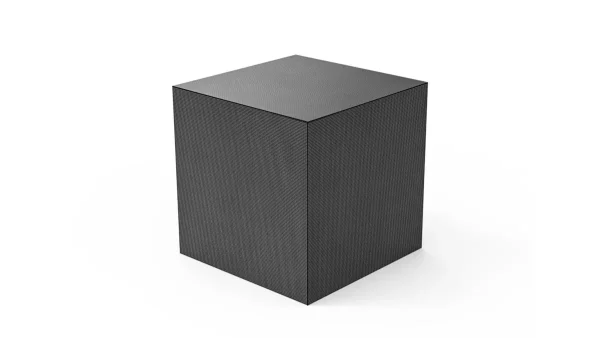
On Magic Cube builds, “SMD” usually means discrete LED packages on Block or Brick series cabinets locked into a CNC 90° frame. “COB” means chip-on-board LEDs under an encapsulated surface — often used as full faces on close-range cubes or as shallow header / ticker bands.
- → Discrete LED packages on cabinet modules
- → Field repair by module swap
- → Standard path for square 4-face, cuboid, and column wrap
- → Specs: Cube LED product page →
- → Encapsulated surface — higher impact resistance
- → Finer close-up appearance; tighter seam control
- → Preferred for touch-adjacent and gaming / museum work
- → Often specified as header / ticker even when walls stay SMD
Neither technology replaces the need for correct pitch. Surface choice answers “what happens when someone touches or bumps the face?” Pitch answers “how close do people stand?”
Pitch Options and Seam Behaviour
Common Block / Brick SMD pitches for cubes: P1.25 / P1.56 / P1.9 / P2.5 / P2.6 / P3.9. Match pitch in mm to minimum viewing distance in metres on the closest face.
COB LED headers and tickers commonly reach P1.2 with seam gaps around ~0.3mm. That combination is why bar tops and reception tickers often migrate to COB even when the vertical walls of a cuboid stay SMD.
Cube corners are 90° mechanical joints. Fine pitch makes seams more visible if cabinet flatness or lock torque is wrong. COB does not eliminate alignment discipline — it reduces the visual penalty of minor package damage and improves touch tolerance. Installation sequence: Cube LED Installation Guide.
Touch Risk and Durability
Ask one question: can a visitor’s hand, luggage, or cleaning staff reach the LED face during normal use?
- Out of reach (elevated pillar, high booth wall): SMD is usually correct. Save budget for larger area or finer pitch if needed.
- Within reach (floor cube, counter header, gaming wrap): COB is the safer default. Encapsulated surfaces tolerate incidental contact better than exposed SMD packages.
Close-range custom wraps that need sealed surfaces and tight corners often land on COB — see the casino gaming machine COB wrap case. For fine-pitch immersive rooms with hard corners, see the immersive P0.9 COB showroom case.
Cost Comparison
Basic 4-sided SMD cubes start from $1,800 EXW Shenzhen. When you compare touch-safe options at similar viewing distances, COB typically costs 30–50% more than SMD — not a free upgrade.
| Scenario | Surface | Cost Note |
|---|---|---|
| Elevated 4-face pillar | SMD Block/Brick | Volume path; from $1,800 starter sizes |
| Floor museum cube | COB faces | +30–50% vs touch-safe SMD compare |
| Cuboid + bar ticker | SMD walls + COB header | Pay COB only where hands reach |
CAD within 72 hours of locked dimensions and surface mix. Line-by-line quote within 24 hours once pitch and face count are confirmed.
Mixed Builds: SMD Walls + COB Header
Many cuboids and counters only need COB on the shallow top band. Specifying COB on all four vertical faces when only the ticker is touchable wastes budget.
- State which faces are SMD and which are COB in the RFQ.
- Confirm processor zoning — header often runs a separate content channel.
- Match brightness targets so the header does not overpower the walls in ambient light.
Face-count implications (4 / 5 / 6): 4 vs 5 vs 6 Face Cube LED.
Decision Framework
| Scenario | Recommendation |
|---|---|
| Mall / telecom elevated pillar | SMD — see AT&T pillar case |
| Exhibition island above hand height | SMD |
| Museum / science floor cube | COB |
| Gaming machine / kiosk wrap | COB |
| Reception / bar ticker on cuboid | COB header + SMD walls if walls are out of reach |
Full specification path: Cube LED Buying Guide. Related shapes: Cylinder, Ring, Creative hub.
Send side length, face count, closest viewing distance, and whether hands can reach each face. We return a surface recommendation with CAD within 72 hours and a line-by-line quote within 24 hours.