All-in-One COB LED TV
  Flexible LED Displays
  Transparent LED Displays
  Led Poster
  Circular LED Displays
  Creative & Custom LED Displays
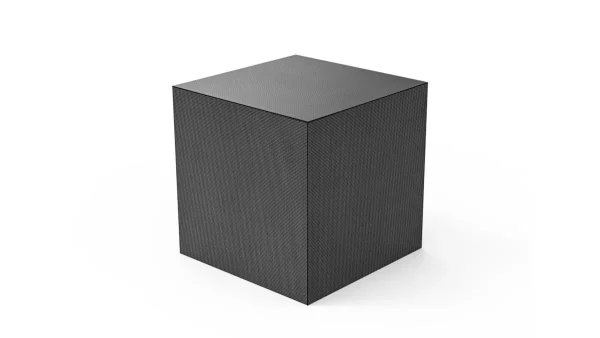
 Four-face cubes are the volume configuration for Magic Cube LED — Block or Brick cabinets locked at 90° corners. Five-face and six-face builds add top and/or bottom LED surfaces and usually need custom frame engineering with possible NRE. This guide compares structure, content channels, service access, and cost so AV integrators specify the right face count. Part of our Cube LED Buying Guide cluster.

- 4-face is the standard build — four vertical sides from Block/Brick cabinets starting at 0.5m side length. Fastest lead time, lowest cost, covers most retail pillars and exhibition islands.
- 5-face adds a top or bottom LED surface. Useful when mezzanines or overhead cameras view the cube. Usually custom frame engineering; possible NRE.
- 6-face wraps all six sides. Highest content complexity and service-access design. Typical for museum / science-centre immersive volumes.
- Do not pay for faces nobody sees. A floor-standing cube with no overhead viewing rarely needs a top LED face.
- Each LED face can run independent content — more faces means more receiving-card chains and processor zones.
- Basic 4-sided cubes start from $1,800 EXW. 5- and 6-face pricing is project-quoted and may include NRE for custom corners and internal structure.
What “Face Count” Means on a Cube LED
Face count is the number of independent LED surfaces on the volume. A 4-face cube has four vertical walls. A 5-face cube adds a fifth surface — usually the top, sometimes the bottom. A 6-face cube pixelates all six sides of a rectangular prism.
This is different from a cylinder LED (continuous curved wrap) and different from a ring LED (flat hollow band). Cube faces meet at hard 90° corners — CNC frames and corner locks keep seams tight.
Related configurations on the same engineering platform: square 4-face, rectangular cuboid, column wrap (4-sided pillar), and COB LED header/ticker bands. Product overview: Cube LED product page.
4-Face: The Volume Standard
Four vertical faces cover walk-around viewing for exhibition islands, retail brand cubes, and most 4-sided pillar wraps. Top and bottom can be closed with non-LED panels, open for service, or finished with brand fascia.
- → Uses standard Block / Brick cabinets from 0.5m side
- → Corner locks and power/data paths are production-standard
- → Fastest CAD → production cycle; no NRE for typical sizes
- → Mall / telecom 4-sided pillars (see AT&T pillar case)
- → Exhibition booth islands viewed from aisles
- → Rectangular cuboids along counters and façades
If every viewer approaches from standing height and never looks down onto the cube, stop at 4-face.
5-Face: When Top or Bottom Matters
Add a fifth LED face when another vantage point is real — a mezzanine overlooking a brand cube, an atrium camera shot looking down, or a raised stage where the top of a short cube is in the audience sightline.
- Top face: Most common fifth face. Requires structural ribs that support modules against gravity and keep flatness across the plan.
- Bottom face: Rare — used when the cube hangs and viewers look up, or when a floating volume needs downward branding.
5-face builds usually leave the standard 4-face BOM. Expect custom internal frames, revised cable routing, and possible NRE for corner/edge tooling. Confirm viewing angles in writing before approving NRE — a decorative top panel is cheaper than a full LED face nobody watches.
6-Face: Full-Volume Immersion
Six-face cubes pixelate every side. They read as true 3D volumes in museums, science centres, and high-end brand installations where visitors walk around and cameras capture from above and below.
Engineering challenges compound:
- Service access: At least one face or hatch must open for module and PSU service without dismantling the entire volume.
- Thermal path: Enclosed six-sided volumes need designed airflow; do not treat them like open 4-face frames.
- Content sync: Six canvases — mirrored, continuous wrap, or fully independent — must be specified before processor selection.
For close-range immersive surfaces with fine pitch, COB is often the safer touch path — see SMD vs COB for Cube LED and the immersive P0.9 COB showroom case for fine-pitch corner behaviour.
Engineering and NRE Implications
| Face Count | Frame Path | NRE Likelihood |
|---|---|---|
| 4-face | Standard Block/Brick corner locks | Low — size variants only |
| 5-face | Custom top/bottom sub-frame | Medium — often required |
| 6-face | Fully custom volume chassis | High — expect NRE discussion |
CAD mockups still land within 72 hours of locked dimensions. Formal quotes within 24 hours once face count and pitch are confirmed. Installation sequence for any face count: Cube LED Installation Guide.
Content and Processor Load
Each LED face is a rectangular canvas. Designers need exact pixel dimensions per face before producing assets.
Four canvases — mirrored brand loop, continuous walk-around story, or four independent campaigns. One or multi-zone processor.
Four walls + top (or bottom). Top face often runs a simplified graphic — logos and slow motion — because viewing angle is steep.
Six channels or a mapped cube net. Higher GPU / processor demand. Specify sync vs independent at order.
Cost Framework
Face count scales LED area, receiving cards, and frame complexity — not a clean linear multiplier, because shared corners and one chassis offset some duplication.
- 4-face basic: from $1,800 EXW Shenzhen (SMD Block/Brick starter sizes).
- 5-face: project quote — additional face area + custom sub-frame; NRE if tooling is new.
- 6-face: project quote — full custom chassis, thermal design, and service hatch; NRE common.
- COB surfaces: typically 30–50% more than comparable touch-safe SMD options when audience can reach the face.
Decision Table
| Scenario | Recommendation |
|---|---|
| Retail / mall 4-sided pillar | 4-face |
| Exhibition island, aisle viewing only | 4-face |
| Brand cube under mezzanine / atrium overlook | 5-face (add top) |
| Museum immersive volume, walk-around + overhead | 6-face |
| Ceiling-hung cube viewed from below | 5-face (bottom) or 6-face if sides also lit |
Full buying sequence: Cube LED Display Buying Guide. Creative lineup: Creative LED hub.
Send plan footprint, height, viewing angles, and whether top/bottom must be LED. We return CAD within 72 hours and a line-by-line quote within 24 hours once face count is locked.