 All-in-One COB LED TV
  Flexible LED Displays
  Transparent LED Displays
  Led Poster
  Circular LED Displays
  Creative & Custom LED Displays
 Ring LED Displays
P1.25 – P4 · Hollow Halo · Single or Double-Sided
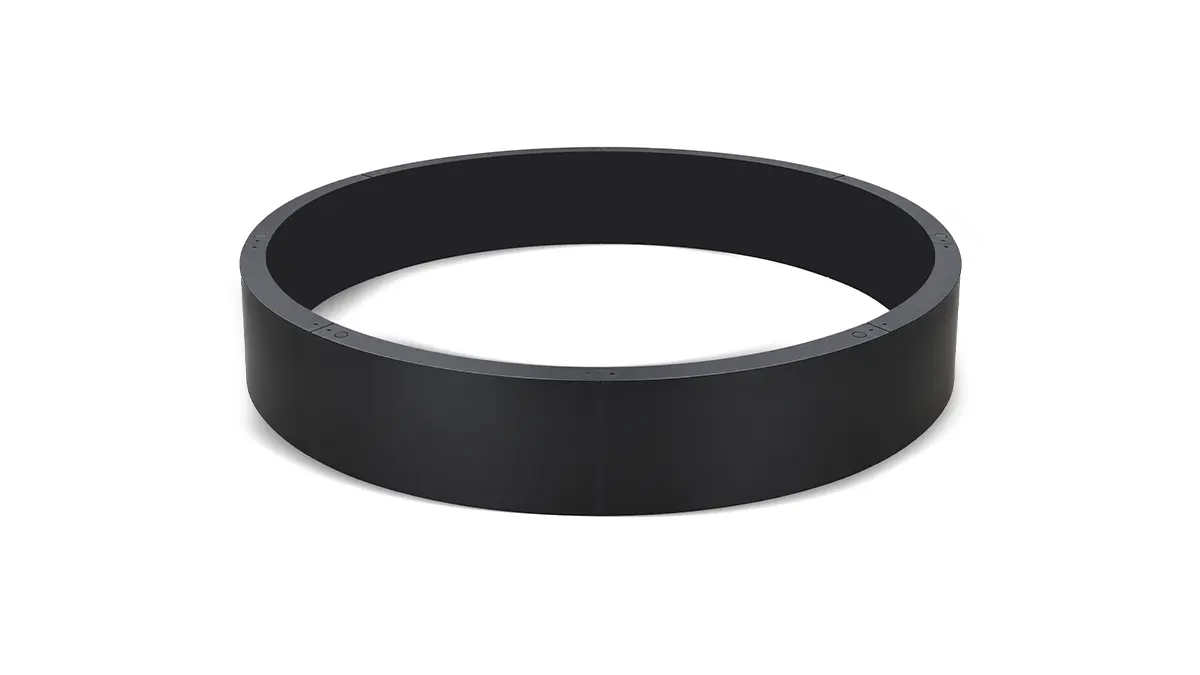


Ring LED Display — Physical Overview
Ceiling-suspended halo, module arc detail, and structural ring frame. The hollow centre is the defining feature — content runs on the band only.
 Ceiling-Suspended Halo — Hollow Centre
 Module — Ring Arc Detail
 Structure — Ring Frame & Rigging
How Ring LED Displays Are Engineered
A ring LED display is not a solid circle with a hole cut out — the ring band, open centre, and content mapping are engineered as one system.
Mall atriums, nightclub ceilings, brand experience zones, and stage designs often need a visual focal point that does not block the space behind it. A hollow ring or halo LED display puts pixels on the circumference only — viewers see content on the band and sight lines pass through the open centre.
Each ring starts with your outer diameter, inner opening (or band width), pixel pitch, and sided configuration. Framed rings use flexible modules on a precision-machined aluminium ring chassis. Frameless borderless rings use custom fan-shaped PCB sectors — the same technology deployed in our Bangkok 3m suspended halo array case study.
Custom CAD design is delivered within 72 hours of inquiry. Framed rings ship in 15–25 business days; frameless borderless rings require 35–45 days including custom PCB tooling. Minimum order quantity is 1 piece at any diameter.
At a Glance
- ✓ Shape:Hollow ring / halo (open centre)
- ✓ Pixel Pitch:P1.25 – P4
- ✓ Outer Diameter:0.3m – 6m
- ✓ Sided:Single + Double-sided
- ✓ Frame:Framed + Frameless
- ✓ Environment:Indoor + Semi-outdoor
- ✓ Refresh Rate:3,840Hz
- ✓ Warranty:2 Years
Framed or Frameless Borderless?
Framed rings use standard flexible modules on a visible aluminium chassis — faster and more economical. Frameless rings use custom fan-shaped PCB sectors with no visible bezel — the halo appears to float in space.
Single-Sided or Double-Sided?
The first decision for every ring project. Single-sided rings are lighter and lower cost. Double-sided rings put independent LED faces on both sides of the band — the standard choice for ceiling-suspended atrium halos.
Give suggestions on selection, point to the alternative series (inner chain), and conclude with a 24-hour response from the engineer.
Six Engineering Decisions That Define Our Ring Displays
Design and manufacturing choices that matter to AV integrators — hollow-centre geometry, sided configuration, and content mapping included.
Open Centre — Sight Lines Preserved
Unlike a solid circular disc, a ring display puts pixels only on the band circumference. The centre stays open — viewers see through the halo to the space behind. Structural design balances ring rigidity against weight for ceiling suspension. Outer and inner diameters are engineered to your specification with ±1mm frame tolerance.
Frameless Rings — Sector PCB Design
Frameless borderless rings use custom-designed fan-shaped PCB boards — each board is a sector of the ring band. Boards are physically disjointed but content plays seamlessly via Mooncell circular pixel mapping. Pre-configured RCFG files map each sector to the correct position on the ring canvas. Same technology as our Bangkok 3m halo array deployment.
N52 Magnets + Steel Cable Suspension
Ceiling-suspended rings require reinforced magnetic modules with mechanical lock backup to prevent gravity failure in inverted orientation. High-strength steel cables anchor to ceiling structure through a load-spreading plate at 4–8 mounting points. Wind load and seismic calculations included for public atrium installations.
Two Faces, One Ring Chassis
Double-sided rings mount independent LED module faces on both sides of the band on a shared ring chassis. Each face has its own receiving card — different content on top and bottom faces simultaneously. Single-sided rings reduce weight and cost when viewers approach from one direction only. Double-sided adds roughly 60–80% weight over single-sided at the same outer diameter.
Concentric Halos — Unified or Independent Playback
Multi-ring arrays — concentric halos at different diameters or clustered rings at varying heights — synchronize via Mooncell controllers. Each ring can display independent content, or the entire array plays as one synchronized composition. Genlock-ready for broadcast and live-event environments.
Full Ring Assembly Test Before Shipment
Every ring display undergoes complete assembly test in our Shenzhen factory: mounted on its ring frame, powered on, circular mapping verified, content played for a minimum of 4 continuous hours. Roundness and band continuity verified against engineering CAD. QC photos and video provided before dispatch.
Where Ring & Halo Displays Create Impact
Six environments where the hollow ring form outperforms a solid circular disc — the open centre is the design feature, not a compromise.
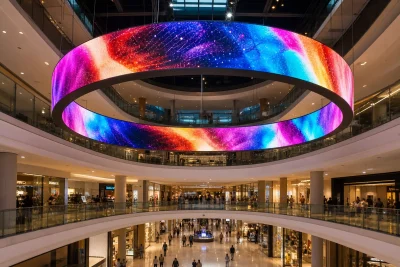
Shopping Mall Atrium Halos
Double-sided rings suspended in mall atriums capture attention from every floor without blocking the vertical space. Standard installations: 2–4m outer diameter, P1.57–P2.5. Content visible from ground floor and upper galleries simultaneously.
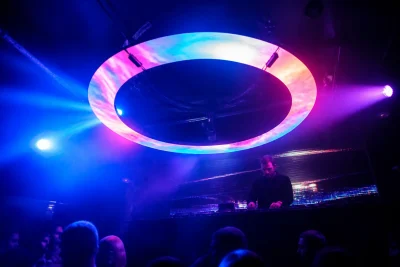
DJ Booths & Nightclub Halos
Ceiling-mounted ring behind the DJ booth creates an immersive halo without blocking sight lines to the performer. DMX-synchronised content with lighting rigs. Single-sided framed rings from 1–3m outer diameter typical. P2.5 standard.
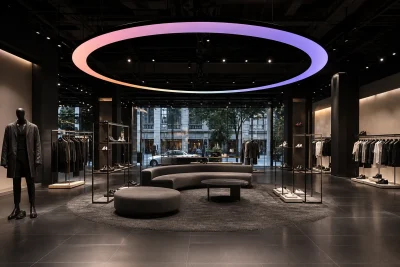
Brand Experience Centerpieces
Frameless borderless rings above brand activation zones. Logo animation mapped to the ring band. Often paired with floor projection for immersive storytelling. 2–4m outer diameter, P1.25–P1.57 for close-up viewing.
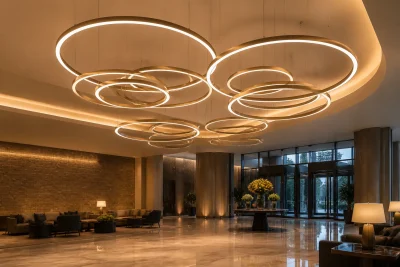
Concentric Halo Arrays
Multiple rings at different diameters clustered at varying heights — casino ceilings, hotel lobbies, corporate HQ atriums. Content synchronized or independent per ring. Frameless recommended for floating-halo aesthetic.

Retail Storefront Window Rings
Wall-mounted single-sided ring inside retail windows. The hollow centre frames merchandise displayed behind the ring. Front-service for maintenance without removing window display. 0.5–1.5m outer diameter typical.

Stage Backdrops & Live Events
Large-diameter ring behind performers or keynote speakers. LED content on the band with performers visible through the hollow centre creates depth. 4–6m outer diameter. Touring-ready flight-case packaging available on request.
Send us your room dimensions, operator-to-screen distance, and ambient light conditions (lux measurements preferred). Our engineers respond with a pitch-and-brightness recommendation within 24 hours — no charge, no commitment. Submit your project specs →
Ring LED Display — 4 Models, Full Specifications
All share the same engineering workflow, QC standards, and 15-person engineering team. Specifications below are per ring band module — outer diameter and inner opening are custom per project.
Recommended Viewing Distance by Pixel Pitch
| Model | Pixel Pitch | Min. Viewing Distance | Optimal Viewing Distance | Typical Application | Relative Resolution |
|---|---|---|---|---|---|
| 型号 1 | 间距 | 最小视距 | 最佳视距 | 典型应用 | |
| 型号 2 | 间距 | 最小视距 | 最佳视距 | 典型应用 |
Ring LED Case Studies
One documented halo installation — the client brief, the engineering challenge, the solution, and the on-site fix we learned from.

Engineering a 3m Suspended Borderless Ring & Halo Array
A client wanted a borderless 3m-diameter ring suspended from the ceiling, surrounded by concentric halo arcs in a “stars orbiting a moon” composition. Hollow-centre ring geometry requires custom fan-shaped PCBs — standard square modules cannot form a seamless borderless band. The combined processor canvas exceeded 3,840×3,840px.
Heavy-duty internal aluminium ring framework with dedicated rigging points, P2.5 modules upgraded to N52 neodymium magnets for inverted ceiling mount, 100% custom fan-shaped PCBs for the central ring and halo sectors, and a flagship processor slicing the oversized canvas into circular and fan-shaped regions. Delivered in 45 days.
“A borderless ring means zero off-the-shelf modules — every PCB is custom-drawn, and pixels follow radial lines on the band, not a rectangular grid. When the client’s pre-installed ceiling points turned out reversed, we adapted the frame on-site and re-calibrated pixel-by-pixel so video flowed seamlessly across the ring and its halos.” — Ye, Senior Structural Engineer
Ring — Engineered, Validated, Awaiting Its First Field Installation
Is your project the first Ring deployment?
Contact Kris Liang directly to chat about verification data + factory video connection.
WhatsApp Kris Liang — Discuss Ring →Ring Wall Calculator
Enter your wall dimensions to calculate cabinet count, total resolution, and power requirements — instantly, with no signup.
Results are estimates based on cabinet count rounding. Contact our engineers for a confirmed cabinet count and structural load calculation.
Common Questions from Integrators
Ring LED Deep Dives
Technical guides and comparison articles to help you specify the right hollow ring or halo display.