 All-in-One COB LED TV
  Flexible LED Displays
  Transparent LED Displays
  Led Poster
  Circular LED Displays
  Creative & Custom LED Displays
 An LED display panel is quite a common term for most of us since they’re widely found in our streets, malls, and even inside our home. However, even with the knowledge of the wondrous of uses conducted by these LED displays, you can’t be sure to buy one for your business promotions or personal use. A simple reason to that can be the lack of complete knowledge of how an LED panel is created, and what features perform in serving you with their specific task.
Specifically, one of the major technical units is a pixel pitch of an LED display. This unit simply determines the measurement for the manufacturers and allows the buyers to determine the resolution and image quality of the display they buy. Briefly, a pixel pitch helps you to consider options like the display size, the viewing distance, the resolution, and the cost of your LED display screen.
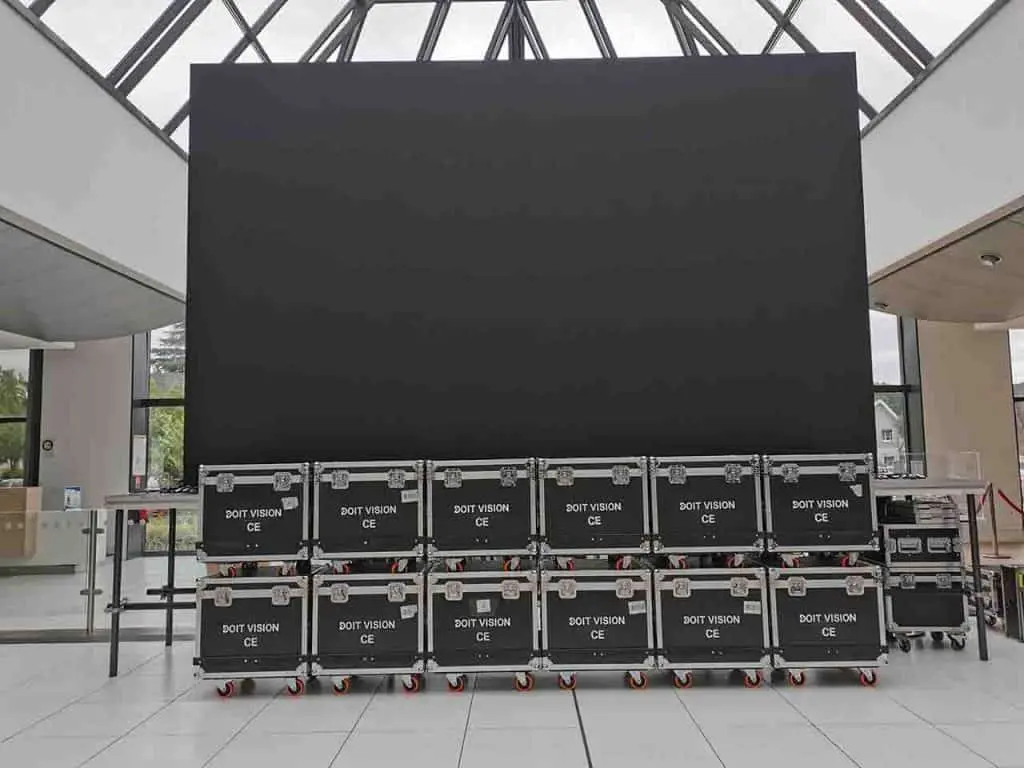
Now to clear up your views and help you gain a better understanding of the pixels of an LED display panel, let’s discuss the term and some of the common pixels like p2.6 led screen, p3.91 led screen, p4.81 led screen.
What is a Pixel Pitch?
Pixel pitch is a highly important aspect of your LED panel because it determines the optimal viewing distance of the display. Concisely, a pixel or a pixel pitch is the distance covered from the center of an LED cluster or package, towards the center of the next LED cluster or package. This distance is measured in millimeters (mm) and can be measured below, beside or above the next LED package.
Now for a more detailed overview of what a pixel pitch is and how it serves in the performance of an LED display, let’s discuss some of the key aspects below.
- These LED packages are mounted on backplates or circuit boards that are named as LED modules. As a result, they help enhance or decrease the viewing distance of an LED display. Additionally, this viewing distance determines whether an LED module consisting of a specific pixel pitch can be used only indoors or even outdoor usage.
- Now when it comes to determining the viewing distance of an LED module, the basic rule is to finalize a small pixel pitch for a closer viewing distance. While on the other hand, a higher pixel pitch is determined to have a larger viewing distance.
- However, that’s certainly not all to what a pixel pitch serves us with, as these LED packages mounted in a module also determine the cost of the LED display. Since these LED packages simply enhance the quality and performance of an LED display, they are, undoubtedly, what takes up most of the manufacturing costs. This simply means that the more LED packages you demand, the more the cost would increase.
Different Pixel Pitches and Their Features:
But wait! This certainly isn’t all to a pixel pitch. That’s because other than the viewing distance and the cost that is enhanced or decreased according to the amount of LED packages present in an LED display module; the different pixel pitches, their sizes, and view distance; all matter here. So let’s discuss them below.
P2.6 LED display Basic parameters
- Product type: indoor fixed installation
- Color type: full color: LED display
- LED type (packaging method): 3-in-1SMD1515
- Black light pixel pitch: 2.6 (mm)
- Pixel density: 147,456 (dots/㎡)
- Display parameter brightness: ≥800cd/㎡
- Display color: 16.77 million
- Horizontal viewing angle: 110 (degrees)
- Vertical viewing angle: 100 (degrees)
- Maximum power: 720 (W/㎡)
- Average power: 90 (W/㎡)
- Working voltage: AC110 ~ 240V (50 ~ 60Hz)
- Module size: 250x250mm
- Unit cabinet size: 500x500x80mm
- Unit cabinet weight: 8 (kg/㎡)
- Service life: ≥100,000 (hours)

This pixel pitch has a 2m optimal viewing distance. As a result, if you’re investing in a p2.6 LED screen, you must install it somewhere people can view it at a distance of 2 meters.
P2.97 LED display Basic parameters
- Display base color: full-color LED display
- Pixel pitch: 2.97
- Pixel density 113367 points/㎡
- Brightness ≥1200 cd/m3
- Refresh frequency: 3840HZ
- LED module size 250×250×14mm
- Screen resolution 84*84
- Pixel composition: 1R1G1B
- Level grayscale: 14-bit
- Contrast 1:5000
- Average power: about 350
- Drive mode 1/16 scan (dynamic)
- Service life: ≥100,000 (hours)
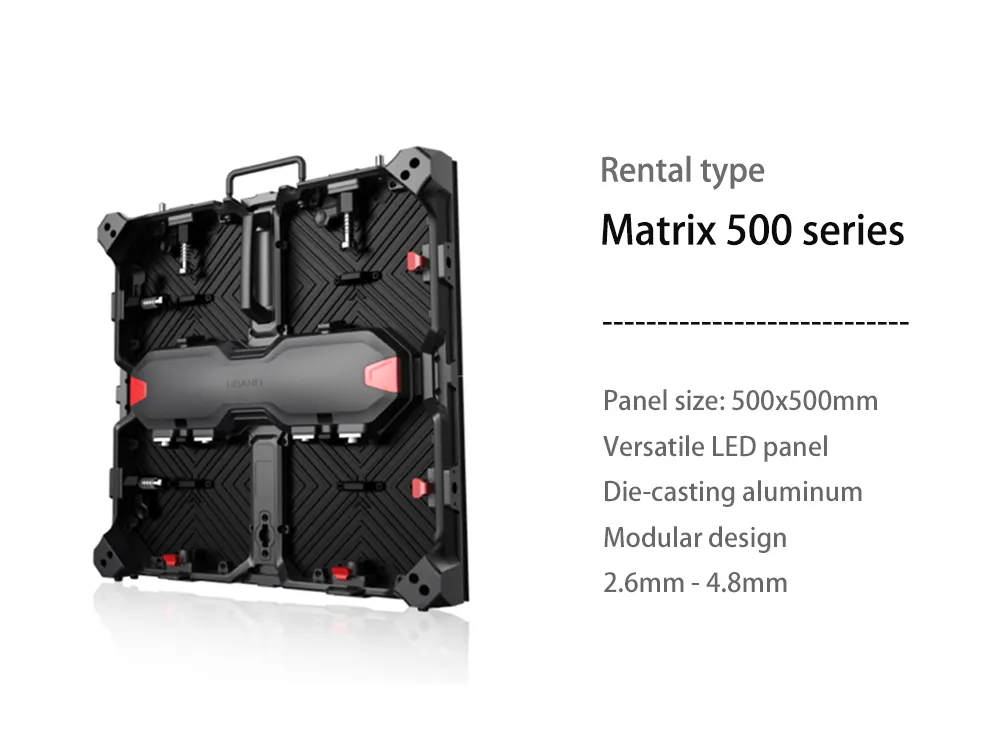
This pixel pitch has a 3m optimal viewing distance. Now, this simply means that similar to the previous pixel module; a p2.97 LED screen has to be installed somewhere people can view it at a distance of 3 meters.
P3.91 LED display parameters:
- Pixel pitch: 3.91mm
- Physical density: 65536 points/㎡
- Luminous point color: 1R1G1B
- Module resolution: (W) 64 points * 64 points (H)
- Module size: (W)250mm*250mm (H)
- Light lamp: SMD1921
- Brightness: 4000-4500mcd/㎡
- Refresh frequency: 1920/3840HZ/S
- Average module power: 45W
- Module weight: 0.45KG
- Best viewing angle: Horizontal>170 Vertical>120
- Best viewing distance: 3-30m
- Working temperature: -20-+60
- Module power supply: 5V60A*PC
- Maximum power: 800W/㎡
- Average power: 400W/㎡
- Scanning method: 1/16s
- Service life: 100000Hours
- Communication distance: <100m
- Control mode: synchronous/asynchronous control

This pixel pitch has a 4m optimal viewing distance. Hence, installing a p3.91 LED screen at a distance of 4 meters can ensure that the customers gain appropriate viewing quality from the LED display.
P4.81 LED Display Specifications
- Display base color full color LED display
- Pixel pitch: 4.81mm
- Pixel density 43264 points/㎡
- Unit board size 250×250mm
- Screen resolution 104×208
- Pixel composition 1R1G1B
- Display color: 16.77 million colors
- Level grayscale 8192 levels
- Viewing angle Horizontal: 160° Vertical: 160°
- Visual distance 4.81-100m
- Color temperature 6500k-9500k adjustable
- Unit flatness: ≤1.5mm between adjacent pixels
- LED module splicing gap <1mm
- Maximum power ≤800W/㎡
- Average power 280W/㎡
- Working voltage AC 220V±10% 47-64HZ
- Transmission method Synchronous control
- Refresh frequency ≥1920HZ
- Drive mode 1/13 scan (dynamic)
- Transmission distance ≤120m (no relay)
- Storage temperature: -40-85℃
- Working temperature: -20-60℃
- Service life:≥ 100000 hours

This pixel pitch has a 5m optimal viewing distance. So like we mentioned in the previous pixel pitches, a p4.81 LED screen should be installed anywhere people can view it at a distance of 5m or more (not lesser than that.
Which One is Better?
With all the above discussion, it’s obvious for anyone to stop and think of what can be the better or best pixel option here, right? Well, as long as you’re viewing an LED display at a distance that is suitable according to its pixel pitch; all of them serve with an equal quality display resolution. However, determining the indoor or outdoor usage of an LED display mainly depends upon the size of the cabinet of the display screen.
Other than that, if our LED display screen’s need is to be installed at a larger scale or a huge distance from the audience, you might only be investing more in lower pixel pitches. Simply put, a lower viewing distance is only preferable for those who are looking for indoor and personal LED display usage.
As for P2.6 and P3(P2.97) LED display, both LED displays belong to the HD full-color indoor LED display series products. They have many similarities. For example, they are both made of SMD black light. The refresh rate is 3840HZ, but there are also many differences between them.
Different pixel: the pixel pitch of the P2.6 LED screen is 2.6mm, while the pixel pitch of the P3(2.97) is 2.97mm.
Different pixel density: the pixel density of LED display P2.6 is 147,456 oints/㎡, while the pixel density of LED display P3 is 111111 points/㎡.
Different SMD Light: Both the indoor LED display is SMD1515, while the outdoor P2.97 led display is SMD1415.
Different viewing distance. The simple calculation of the viewing distance of LED display P2.6 is ≥2.5M, while the viewing distance of P3 is ≥3M.
With the same area and the same viewing conditions, the P2.6 LED display has a closer viewing distance and higher definition, but the price is more expensive.
Many customers are learning about HD LED display for the first time, and they don’t even know which product they need.
First you need to clarify your purpose: e.g.
- Is the LED screen to be installed permanently or rental stage?
- Indoor or outdoor?
- LED screen visual distance?
- Your budget?
If you have enough budget.
- a) For high-definition fixed installation, you can refer to DOITVISION’s Brick series, fine pixle series and COB series.
- B) For indoor stage, you can refer to DOITVISION’s Matrix series, R500 series.


If you have a limited budget and want to find a cost-effective stage LED screen, you can refer to Doivision’s Lite series.
More:
How to Calculate the LED Stage Background Screen Size?
1. What is the main difference between P2.6, P2.97, P3.91, and P4.81 LED panels?
The main difference is pixel pitch. Smaller pitches like P2.6 offer higher resolution for close viewing, while larger pitches like P4.81 suit long-distance viewing and lower budgets.
2. Which pixel pitch is best for close-range indoor viewing?
P2.6 is ideal for close-range indoor viewing because its tight pixel spacing produces excellent clarity for conference rooms, studios, and retail displays.
3. Which option offers the best balance of cost and quality?
P2.97 provides a good balance. It offers high-definition indoor performance at a lower price than P2.6 while still supporting 3–5 meter viewing distances.
4. Why is P3.91 popular for rental and stage applications?
P3.91 is widely used in rental events because it offers strong brightness, durable cabinets, and excellent viewing angles for medium-distance audiences.
5. When is P4.81 the preferred choice?
P4.81 is preferred for large outdoor screens, long viewing distances, and budget-sensitive projects.
6. Which pitch offers the highest resolution?
P2.6 offers the highest resolution of the four options due to its dense pixel structure, making it best for detailed content and HD video.
7. Is P2.97 suitable for corporate meeting rooms?
Yes. P2.97 provides sharp visuals and high color performance for meeting rooms, retail stores, and indoor signage viewed from 3 meters or more.
8. Can P3.91 be used both indoors and outdoors?
Yes. P3.91 is available in both indoor and outdoor models, making it a versatile choice for stages, exhibitions, and outdoor advertising.
9. Is P4.81 good for very large LED walls?
Yes. P4.81 works well for 20–50㎡ displays. It helps reduce total cost while maintaining acceptable image quality.
10. Which pixel pitch is best for detailed graphics and text?
P2.6 is best for detailed graphics, small text, and HD visuals because the tighter spacing produces smoother edges and finer detail.
11. What viewing distance is recommended for P2.6 LED panels?
P2.6 performs best at around 2 meters or more, ideal for control rooms, studios, and premium indoor signage.
12. What viewing distance is recommended for P2.97 panels?
P2.97 is recommended for around 3 meters viewing distance, balancing clarity and cost for indoor displays.
13. What is the optimal viewing distance for P3.91?
P3.91 works best at approximately 4 meters or more, making it suitable for events, stages, and large venues.
14. What viewing distance suits P4.81 LED screens?
P4.81 is ideal for 5 meters or more, commonly used for outdoor stages, billboards, and long-distance viewing.
15. Which pitch is most cost-effective?
P4.81 is the most cost-effective because it uses fewer LEDs per square meter, lowering production and installation costs.
16. Which pitch is recommended for HD indoor advertising?
P2.6 is recommended for indoor HD advertising due to its clarity, color uniformity, and fine detail reproduction.
17. Can P3.91 be used for church LED walls?
Yes. P3.91 is a common choice for churches thanks to its brightness, viewing angle, and suitability for long-distance viewing.
18. Is P4.81 too large of a pitch for indoor use?
For close indoor use, yes. But it works well for elevated or distant installations 5–7 meters away.
19. Which pitch should I choose if I have a high budget?
P2.6 is the best choice with a high budget because it offers premium clarity and the highest visual quality.
20. How do I decide which pixel pitch is best for my project?
Choose based on viewing distance, budget, screen size, and indoor/outdoor use. Smaller pitches give higher clarity; larger pitches reduce cost.