 All-in-One COB LED TV
  Flexible LED Displays
  Transparent LED Displays
  Led Poster
  Circular LED Displays
  Creative & Custom LED Displays
 LED spherical screens are a round creative LED display . Unlike flat panels, they wrap visuals around a 3D sphere, grabbing attention from every angle. But with sizes ranging from 1 meter to 10 meters in diameter, picking the right one can feel overwhelming. It’s not just about “bigger is better”. The best choice depends on where you’ll put it, how people will view it, and what you want to show. Let’s guide you the differences between sizes and how to pick the perfect fit.
What Makes Sphere LED Screens Special?

Before diving into sizes, let’s talk about why these screens are poular. They’re built by stitching hundreds of small LED modules into a smooth sphere, creating a 360° display that shows content from every direction.
You can think of them as giant glowing orbs that can play videos, showcase ads, or even simulate planets, all while looking seamless, no matter which side you’re on.
Their key traits? Brightness that cuts through sunlight or indoor lights, sharp resolution that stays clear from close up or far away, vivid colors that pop, and a viewing angle so wide you’d have to be directly behind the sphere to miss the action.
Related:
How to Make an Immersive Sphere LED Screen
Common Sizes: From 1m to 10m
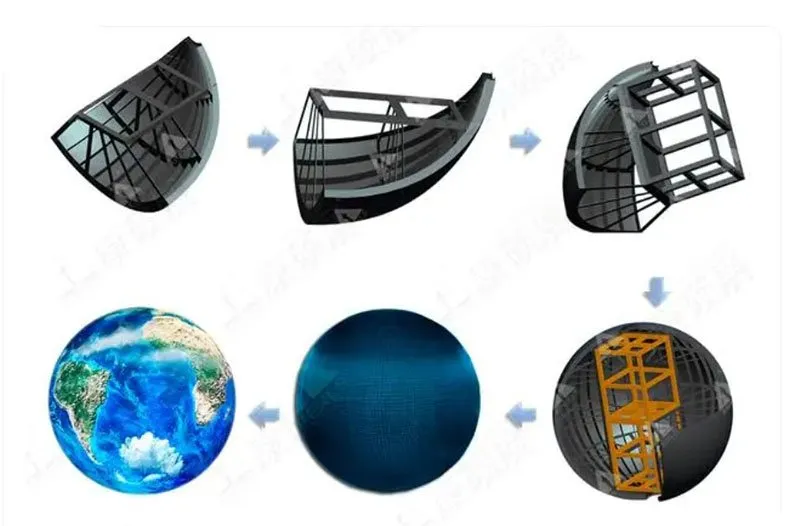
You’ll find LED sphere screens in these diameters: 1m, 1.5m, 2m, 3m, 5m, 6m, and 10m. Each size has its own advantages, and the differences depend on four big factors: display quality, coverage, installation needs, and cost.
Display Quality:
Here’s a secret: A spherical screen’s size and its pixel pitch work hand in hand to determine how sharp the image looks.
1m–2m Smaller spheres are usually viewed up close. You can think a 1m sphere in a hotel lobby where people walk right up to it. For these, you need a tight pixel pitch like P2.5 or P3. Why? Because when you’re standing 3 feet away, gaps between pixels become obvious. A P2.5 screen keeps the image smooth, showing fine details like product photos or text clearly.
5m–10m Bigger spheres are used for from far away, like a 10m sphere in a stadium. Here, you can get away with a larger pixel pitch like P6 or P8. At 50 feet, those gaps disappear, and the screen still looks crisp.
In addition, larger spheres have more surface area, so they can display bigger, more immersive content. A 10m sphere showing a rotating Earth? It’ll make you feel like you’re staring at a planet, whereas a 1m version would feel more like a model.
Size also affects “wow factor.” A 20m sphere dwarfs a 10m one, making scenes feel broader and more immersive. If you want to leave people gasping, size matters, but only if it fits your space.
Related:
What is the Optimal Pixel Pitch for LED Sphere Screen?
Coverage:
A sphere’s size directly determines how much space it can “cover”. Both in terms of physical area and how many people can see it at once.
The math is simple:
Surface area (S) of a sphere = πD², where D is diameter. So a 1m sphere has about 3.14 square meters of display space. A 10m sphere? A whopping 314 square meters. That’s 100 times more area to show content.
What does that mean for you? A 1m sphere in a small boutique might catch the eye of shoppers as they walk in, but it won’t draw a crowd.
A 5m sphere in a plaza, though, can grab attention from across the street, pulling in passersby from all directions. A 10m sphere in a stadium? It’ll be visible to thousands of fans, So, it is perfect for live scores or sponsor ads.
1m–2m Smaller spheres work best in tight spaces where visibility is limited to a few people at a time. 5m+ Larger ones thrive in open areas where you need to reach a big audience.
Installation:

Installing a spherical LED screen isn’t like hanging a picture,it’s a team effort, and size makes a huge difference in how much work it takes.
1m–2m Small spheres are lightweight and compact. You can hang them from a ceiling with sturdy ropes or a simple bracket, no need for heavy machinery. We’ve seen a 1.5m sphere installed in a museum in under 4 hours: two workers lifted it, secured the brackets, and plugged it in. They even had time to test the visuals before the museum opened.
6m–10m Bigger sphere Displays are a whole different beast. A 10m sphere LED display can weigh tons, so you need to check if the floor or ceiling can support it. However, Outdoor models require custom steel frames to withstand wind and rain.
For example, installing a 6m outdoor sphere LED display screens involve a crane, a team of engineers to calculate loads, and days of work to align the modules perfectly. One wrong move, and you could end up with gaps between panels or, worse, a safety hazard.
Pro tip:
Please always hire a specialized team for anything over 3m. They’ll handle the structural checks, lifting, and alignment. It can save you from costly mistakes.
Cost:
Let’s talk money. Spherical screens aren’t cheap, and size is the biggest driver of cost.
A 1m–2m P3 indoor sphere display might run you under 20,000 USD. It uses fewer LED modules, simpler installation, and less material overall.
Jump to a 10m outdoor P6 sphere display, and you’re looking at over 600,000 USD. Why? It needs thousands more LED beads, weatherproofing, heavy-duty structural support, and specialized engineering to keep the sphere round and the image seamless.
Keep in mind:
Pixel pitch adds to the cost too. A 2m P2.5 pitch sphere display will cost more than a 2m P4 sphere model. But for small spheres, skimping on pixel pitch ruins the effect, people will notice the fuzziness up close.
Related:
How Much Does LED Sphere Display Cost?
How to Choose: 4 Key Factors

Now that you know the differences, let’s figure out which size fits your needs. You can ask yourself these four questions:
Where Will It Go?
Tight spaces: Mall kiosks, hotel lobbies, small galleries. You can choose for 1m–2m. They fit without overwhelming the room.
Medium areas: Exhibition halls, plaza corners, concert stages. 3m–5m works here. It is big enough to stand out but not too big for the space.
Wide-open spaces: Stadiums, large parks, city squares. 5m–10m is the first choice. They’ll dominate the area and draw crowds from far away.
How Far Will People Be When They Watch It?
Close-up (3–5m):
You can choose a 1m sphere in a retail store where shoppers stop to look. Pick 1m–2m P2.5 or P3 pitch LED display for details display.
Medium distance (6–20m): A 3m sphere in a museum where people stand a few meters back. You can try 3m–5m P4, P5, or P6 pitch LED sphere.
Far away (20m+): A 10m sphere in a stadium. 6m+ P6, P8, or P10 pitch works good. Because you won’t notice the pixel gaps from far off.
What Content Will You Show?
Fine details: High-res product photos, text-heavy ads, or museum exhibits. 1m–2m Smaller spheres with small pixel pitches keep details sharp.
Big, bold visuals: Action videos, large-scale ads, or immersive scenes. 5m+ Larger spheres make these pop. Of course, You can also think a 10m sphere showing a fireworks display.
What’s Your Budget?
Tight budget: Stick to 1m–2m with a larger pixel pitch like ,P3 or P4. You’ll get the spherical effect without overspending.
Flexible budget: 3m–5m with mid-range pixel pitch ,like P4–P6 balances size and detail.
No budget constraints: You can choose 6m–10m and P5–P6 LED sphere display for a showstopping display that wows everyone.
Final Thoughts:
LED spherical screen Size isn’t about picking the largest or smallest. It’s about matching size to your space, audience, and content. A 1m sphere in a tiny café can be just as impactful as a 10m sphere in a stadium, as long as it fits the scenario.
If you’re still unsure, you can start with measurements: How much space do you have? How far will viewers stand? What’s the main message you want to convey? When you have these questions, ask a professional LED display manufacturer, such as Doitvision. If you need a spherical LED display solution, please feel free to contact us.