 All-in-One COB LED TV
  Flexible LED Displays
  Transparent LED Displays
  Led Poster
  Circular LED Displays
  Creative & Custom LED Displays
 From museums cultural heritage to commercial interactive marketing, “immersion” is constantly reshaping the way people perceive the world. Among the many immersive presentation formats, the dome cinema has become one of the most popular option. Do you know what a dome cinema is? Today, Doitvision will provide a detailed introduction.
What is a dome cinema?

A dome cinema, also known as a dome or dome screen, is characterized by its hemispherical screen structure. Unlike the flat screen of a traditional cinema, a dome screen acts like a giant “bowl,” securely enveloping the audience. The viewer’s gaze, whether upwards or downwards, is completely encompassed by the screen image. It completely encompasses the audience’s horizontal and vertical perspectives, completely eliminating the sense of disconnection caused by “screen boundaries.”
Of course, achieving this “borderless” visual effect requires specialized content production and projection equipment.
First, the images must be captured and projected using an ultra-wide-angle fisheye lens. A fisheye lens can offer a viewing angle of 180 degrees or even wider, allowing it to capture vast scenes that traditional lenses cannot. Using Special projection technology , then projects the image onto a hemispherical screen, creating the visual effect of “the image extending with the line of sight.”
Second, the images in a dome theater are not only crisp and detailed, but more importantly, they achieve a sense of visual extension. As the camera moves, the audience feels as if they are truly “moving,” such as through a canyon, soaring through the sky, or diving into the deep sea.
Beyond visual immersion, the enveloping sound is also the soul of a dome theater. Domes are typically equipped with a surround sound system, with audio equipment strategically placed around the screen, beneath the audience seats, and even on the ceiling, allowing sound to be heard from all directions.
Compared to current mainstream giant-screen theaters, such as IMAX, dome theaters offer a far more impressive experience. While giant-screen theaters enhance visual impact by increasing screen size, they remain constrained by the limitations of a flat screen. However, Dome theaters transform audiences from “spectators” into “participants” through their “hemispherical” enclosure.
Notably, the recent LED dome technology has further transcended the limitations of physical space. LED dome screens utilize densely packed LED lamps to form a hemispherical screen. Without relying on traditional projection equipment, they can display unlimited information within the limited space of a dome.
Furthermore, LED dome display are relatively simple to install, requiring far fewer venues than traditional dome theaters. For example, they eliminate the need for complex projection rooms or screen calibration, yet the display quality remains comparable, even surpassing expectations in color saturation and brightness uniformity.
These characteristics have made dome theaters a favorite in scenic spots, science and technology museums, and other venues.
What is the display principle behind dome theaters?
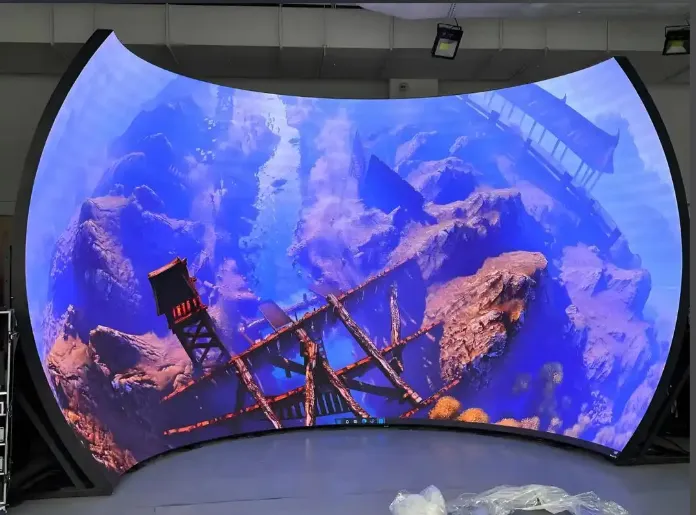
If the dome theater screen is the “stage,” then the display principle is the “director behind the scenes.” It determines how accurately the image is presented on the hemispherical screen, and how it provides the audience with a distortion-free, immersive experience. To understand the display principles, we need to consider three aspects: virtual reality technology, fisheye lenses, and projection methods.
Virtual Reality (VR) Technology
First, the core of a dome theater’s display is based on virtual reality (VR) technology. The essence of VR technology is to create a “virtual environment” through technical means and enable the user’s senses, such as vision, hearing, and touch, to interact with this environment.
While a dome theater doesn’t “isolate” reality like a VR headset, it creates a “semi-virtual environment” through its hemispherical screen and surround sound. The audience’s vision and hearing are fully immersed in this environment, creating the illusion of being “inside a virtual scene.”
As a professional dome theater provider, Doitvison’s dome theater systems utilize VR technology to create a 360-degree virtual world, making the audience feel as if they’re “stepping into the film.”
360-degree wide viewing angle
Secondly, achieving a “360-degree wide viewing angle,” such as exceeding 180 degrees, requires a fisheye lens. Traditional lenses typically have a viewing angle of 50-120 degrees, which is insufficient to cover the expansive area of a hemispherical screen. Fisheye lenses can reach 180 or even 220 degrees, enabling a “panoramic” image.
However, images captured with a fisheye lens will produce distortion. This is similar to the stretching or compression effect seen at the edges of a photo taken with a mobile phone’s fisheye mode.
However, if this distortion is projected directly onto a dome, the viewer will see a distorted scene, severely impacting the immersive experience. Therefore, the dome theater’s display system must “correct” the images captured by the fisheye lens before projecting them onto the screen to ensure they conform to the human eye’s visual preferences.
Image Correction
Finally, for both image correction and projection, dome theaters typically use equidistant fisheye images, rather than orthogonal ones. The core difference between these two projection methods lies in the distribution of pixels on the sphere:
Orthographic fisheye imagery:
This projection method projects points in three-dimensional space onto a two-dimensional plane using a “vertical projection” method. Its characteristic is that pixels in the zenith (the top of the image) are stretched, while pixels in the equator (the center of the image) are compressed.
Simply put, the top of the image becomes larger, while the center becomes smaller. If used in a dome theater, this projection method can cause severe distortion of the “sky” seen by the audience, such as stars being stretched into “lines,” which is detrimental to the viewing experience.
Equidistant fisheye imagery:
This projection method uses the principle of “equidistant mapping,” meaning that the distance from every point on the 3D sphere to the center of the sphere is the same on a two-dimensional plane.
Consequently, the pixels are evenly distributed across the sphere. The image’s proportions remain consistent across the zenith, the equator, and the horizon, without noticeable stretching or compression.
It is perfectly suited to the hemispherical screen of a dome theater, allowing viewers to see distortion-free images from any viewing angle, enhancing the sense of immersion.
Moreover, it has become the “standard projection method” for dome theaters. In practice, service providers such as Doitvision use computer graphics technology to further refine the image. For example, they adjust the resolution and color based on the screen size and curvature to ensure that the edges of the image are perfectly aligned with the screen, avoiding “black edges” or “overlapping.” Furthermore, they incorporate 3D technology to create customized 3D content, giving the image a three-dimensional, layered feel.
What are the components of a flying theater?
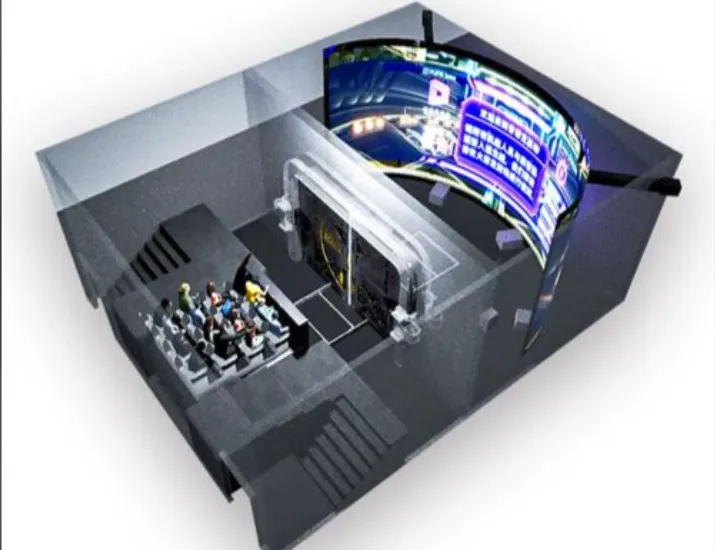
So, what exactly is the structure of a flying theater? We can break it down into four core systems:
Dome Theater System:
The dome theater system is the “eyes” of the flying theater. It determines the image quality the audience sees. Doitvision’s flying theaters utilize its own proprietary dome LED screen. Compared to traditional projection domes, our dome LED system offers three major advantages:
Higher Clarity:
High-pixel density LEDs offer far greater pixel density than traditional projection screens, enabling the display of exquisite image detail.
More Uniform Brightness:
Traditional projection domes are prone to edge brightness falloff. However, the brightness of each LED is precisely controlled, achieving brightness uniformity of over 95% across the entire screen, eliminating uneven brightness and darkening.
Faster Response Speed:
The LED response speed is measured in microseconds, enabling perfect rendering of high-speed motion, such as rapid turns and dives during flight, without artifacts.
In addition to the LED dome, the dome theater system also includes customized 3D content and a surround sound system. The 3D content must be custom-produced for the flight scenario. The surround sound system needs to precisely match the action on screen. For example, when the seat simulates acceleration, the sound transitions from the rear to the front, simulating the whistling of wind, allowing the audience to “hear” the speed of flight.
4D Seating System:
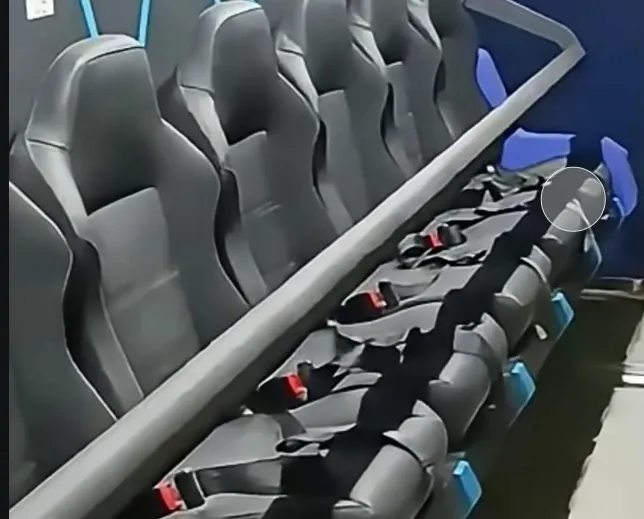
If the dome system is the “visual” element, then the 4D seating system is the “tactile” element. By simulating the various movements of flight, it allows the audience to “feel” the reality of flight. Doitvison’s 4D seating system utilizes six degrees of freedom (DOF). These six degrees of freedom allow the seat to move in six directions: up and down, left and right, forward and backward, pitch, roll, and yaw. This allows it to accurately simulate the acceleration, deceleration, turns, dives, and pitching of a flight.
Depending on the drive method, 4D seats are categorized as either hydraulic or electric. Each has its own advantages:
Hydraulic Drive:
The core of hydraulic drive is to control seat movement through changes in hydraulic oil pressure.
Advantages:
- Low cost, suitable for small and medium-sized flying theaters.
- Hydraulic drive offers powerful power, capable of simulating a “strong turbulence,” such as the vibrations of an aircraft traveling through air currents.
- Relatively simple structure, low maintenance costs, and a low failure rate.
Disadvantages:
Relatively low motion precision
it suitable for applications requiring less precise movements.
Electric Drive:
The core of electric drive is to control seat movement through servo motors.
Advantages:
- High motion precision enables millimeter-level motion control, such as simulating delicate movements like “slow climbs” and “slight turns,” making the flight experience more realistic.
- Lighter and easier to install.
- They are quieter, ensuring no disruption to the audience’s auditory experience.
- Maintenance is simpler, with no need for regular hydraulic oil changes.
Disadvantages:
Relatively high cost
It is suitable for medium and large flying theaters.
Mechanical Lift System:
The mechanical lift system is the “elevator” of the flying theater. It lifts the audience from the ground level to the center of the dome, aligning their view perfectly with the dome image while simulating the experience of “lifting off.” Doitvison offers two mechanical lift methods: mechanical and hydraulic. Each is suitable for venues of different sizes.
Mechanical Lift:
The mechanical lift utilizes a “gear + guide rail” structure. A motor drives the gears, which in turn raise and lower the seat platform along the guide rails.
Advantages:
Low price and low initial investment;
Simple structure and easy installation, suitable for small and medium-sized venues (such as science museums and small theme parks).
Disadvantages:
- Limited load capacity, typically only able to accommodate 5-10 people.
- Relatively slow lifting speed, resulting in a less effective simulation of “rapid lift.”
Hydraulic Lift:
The hydraulic lift utilizes a “hydraulic cylinder + scissor fork” structure. Hydraulic oil propels the cylinder, which in turn extends and retracts the scissor fork structure, raising and lowering the seat platform.
Advantages:
- It has a strong load capacity, with a maximum load of over 20 tons, and can accommodate a large seating platform for 30-50 people.
- It is suitable for large theme parks, cultural and tourist attractions, and other venues.
- It also offers exceptional safety
- even in a power outage, hydraulic locks secure the seating platform in place, preventing the risk of a fall.
- It has a fast lift speed, simulating a “rapid takeoff” effect and enhancing the flight experience.
Disadvantages:
It is relatively expensive and slightly more difficult to install and maintain.
Of course, the design of the mechanical lift system also needs to consider the audience’s field of view. When the seating platform reaches its highest point, the audience’s line of sight should be roughly aligned with the dome’s “equator” to ensure complete coverage of the screen and avoid seeing off-screen scenes.
Therefore, the lift height of the mechanical lift system must be precisely calculated based on the dome’s diameter. For example, for a 15-meter diameter dome, the lift height of the seating platform typically needs to be 5-6 meters.
Safety Control System:
Safety is the lifeline of a flying theater. Because the seats must move at high speeds and rise and fall at high altitudes, the safety control system must be foolproof. Doitison’s safety control system utilizes a dual-security approach combining active and passive control to ensure the safety of every spectator.
Passive Safety Control System:
The core of the passive safety control system is prevention.
Specifically, once a spectator sits in a seat, pressure sensors automatically detect whether a spectator is seated, while seatbelt sensors check whether the spectator is buckled. If any spectator is not buckled, the sensor immediately transmits a signal to the control system, rendering the experience completely inoperable until all spectators are buckled.
Furthermore, the seatbelts automatically lock during the experience, preventing any attempt to unbuckle. This design eliminates safety risks caused by spectator error. Throughout the flight experience, spectators remain securely secured.
Active Safety Control System:
The core of the active safety control system is emergency response. The operator can pause the experience at any time based on the specific situation.
Doitvison’s active safety control system features an emergency stop button on the console and infrared sensors installed in the seat area. If an abnormality is detected, such as unusual seat movement or sudden discomfort, the operator can immediately press the emergency stop button. The seat will stop within one second and slowly lower to the ground, ensuring the safety of the audience.
In addition, the active safety control system includes a fault self-diagnosis function. Before each day’s ride begins, the system automatically performs a comprehensive inspection of the seat, lift system, and safety devices.
If any fault is detected, such as a hydraulic oil leak or motor anomaly, an alarm will be immediately issued, prohibiting the ride from starting until the problem is resolved.
3D flying dome theaters Types
Depending on the size and installation method of the theater, they can be categorized as vertical, tilted, or horizontal.
Vertical flying dome theaters
They are the most popular. Dynamic seats, arranged in layers and arranged in a vertical coordinate system, secure the audience. The audience is then moved forward and pushed into the dome, where their feet hang freely in the air, ultimately entering a fully dynamic and immersive ride.
Tilted dome flying theaters
They are used in planetariums and are also suitable for entertainment venues. However, because the front of the screen is close to the ground, the viewing experience for those in the front rows is suboptimal, which can be annoying for other patrons. This makes tilted domes unsuitable for exhibitions/galleries, art installations, and events held within the dome.
Horizontal dome flying theaters
They are suitable for immersive art installations in exhibitions and festivals, such as in planetariums. They use tilted, dynamic seats with omnidirectional or directional tiers to ensure a full view of the screen. However, the use of LED domes requires a viewing angle of 10 meters.
Summary:
In short, immersive dome theaters has grown rapid on the market. Of course, a dome theater system is highly challenging. It requires comprehensive design, manufacturing, construction, and final experience. As a professional dome theater provider, Doitvision offers comprehensive services. If you require information on immersive dome theater solutions, please feel free to contact us.