 All-in-One COB LED TV
  Flexible LED Displays
  Transparent LED Displays
  Led Poster
  Circular LED Displays
  Creative & Custom LED Displays
 LED displays have become an important device in modern display technology. However, its display quality is affected by many factors. Among them, ghosting, bad pixel crosses, and low gray color cast are particularly common, especially in the small-pitch LED displays application. These problems are often closely related to the design of constant current driver chips and row drivers. Doitvision will deeply analyze the causes of these problems and explore corresponding solutions.
Ghosting phenomenon on LED displays

Causes of ghosting phenomenon
The ghosting problem of LED displays mainly occurs when the scanning screen changes lines. Since the opening and closing of the PMOS tube switch and the charge discharge on the row line parasitic capacitor (Cr) require a certain amount of time, the unreleased charge on the previous row is discharged through the conduction path, forming the LED hidden light phenomenon. The specific process is as follows:
Charge accumulation during row switching:
When a row (Row_n) is turned on, the row parasitic capacitor Cr is charged to the VCC potential.
Charge discharge at the moment of row switching:
When switching to the next row (Row_n+1), due to the potential difference between Cr and OUT, the charge is discharged through the LED lamp beads, resulting in the phenomenon that the pixels in the previous row light up briefly, that is, ghosting.
Solution
For the ghosting problem, we can mainly optimize it through row tube blanking technology.
Row driver chip with integrated blanking function:
When switching rows, add a pull-down circuit to discharge the charge on the parasitic capacitor Cr in advance, thereby reducing the ghosting effect.
Optimize the blanking voltage (VH):
The lower the VH is set, the faster the charge discharge of Cr is, and the less ghosting phenomenon is. Usually, VH<VCC-1V can effectively eliminate ghosting.
LED display screen bad pixel cross phenomenon
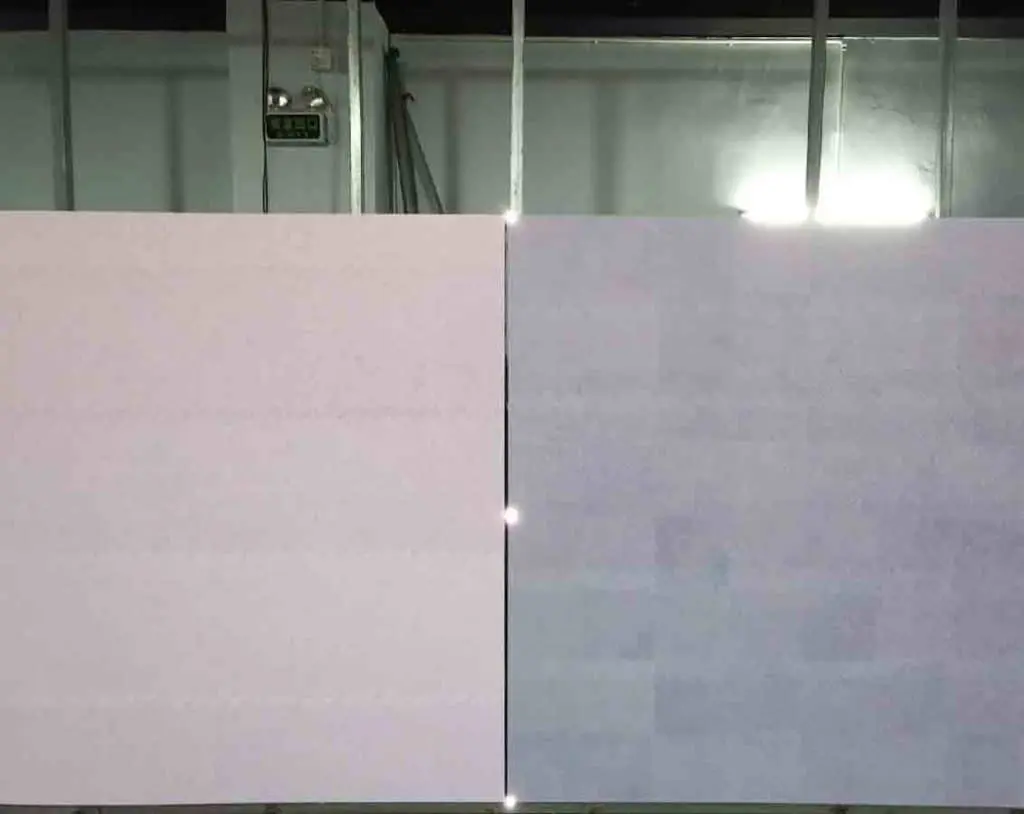
Causes of bad pixel cross
The bad pixel cross is mainly caused by short circuit or open circuit of LED lamp beads.
“Short circuit caterpillar” caused by short circuit
The short circuit caterpillar phenomenon is manifested as a column of LED lamp beads always on. It usually caused by short circuit of LED lamp beads. When the LED is short-circuited, a new path is formed in the column. If the potential difference from VLED to the short-circuit point is greater than the LED lighting voltage VF, the LED in the column will continue to light up.
“Open cross” caused by open circuit
When a certain LED lamp bead is open-circuited and the point is lit, the OUT channel voltage is pulled down (<0.5V), and through the coupling effect of parasitic capacitance, other LED lamp beads in the same row appear dimmed, thus forming an abnormal bright spot in the shape of a “cross”.
Solution
Short-circuit caterpillar problem:
We can increase the row tube blanking voltage VH so that VLED-VH<VF.
For example, if the red LED lamp bead VF≈1.4V, then VH needs to be greater than VCC-1.4V to completely eliminate the short-circuit caterpillar phenomenon.
Open cross problem:
We can appropriately reduce the blanking voltage VH. Usually VH<1.4V can effectively suppress this problem. However, it should be noted that reducing the blanking voltage may increase the reverse voltage of the LED lamp beads and affect their lifespan, so we need to make a comprehensive trade-off.
Low gray color cast phenomenon of LED display

Causes of low gray color cast
Low gray color cast usually occurs when displaying low brightness images, mainly due to high contrast coupling.
Under a low brightness background, if a part of the high brightness image appears, the low brightness part of the same line may have color shift or reduced brightness. Its formation mechanism is as follows:
Due to the voltage fluctuation of the row tube during scanning, the LED pixels of the same line may be affected.
The LED driving current in the low brightness area is small, which is easily disturbed by the current fluctuation of the high brightness part, resulting in color cast, especially low gray and red.
Solution
Optimize the row drive circuit design:
By adjusting the clamping voltage, the row tube is kept at a certain level after the discharge is completed, reducing voltage fluctuations and reducing coupling effects.
Adjust the blanking voltage VH:
Appropriately reducing the blanking voltage can alleviate the high contrast coupling problem to a certain extent, but it may cause the LED reverse voltage to be too large, resulting in short-circuit caterpillar problems, so a trade-off design is required.
Effect of LED lamp beads with large VF value
Problems with large VF value
Some LED lamp beads have large VF value (forward voltage), which may cause the column to be always on.
For example, the VF of green LED is usually 2.4~3.4V, and in some cases, a voltage difference of 1.8V is enough to light up the LED. When the row tube blanking voltage VH is too high, it will cause the LED column to be always on.
Solution
In order to avoid the column always on problem caused by large VF value, we need to ensure that VH<VCC-1.6V. That is, We can appropriately reduce the blanking voltage to avoid misconduction of column channels.
High contrast coupling problem of LED display
Causes of high contrast coupling
The high contrast coupling phenomenon refers to the fact that the same part of the high brightness area will appear color cast or dark under the low brightness background. The main reason is that the voltage fluctuation of the row tube affects the LED lamp beads of the same row, causing the driving current of the low gray part to be disturbed.
Solution
Optimize the blanking voltage of the row drive:
Reducing the blanking voltage can reduce the interference of the row tube and improve the high contrast coupling problem.
Reasonable selection of blanking voltage VH:
Generally, VH between 3V~3.4V (VCC=5V) is a reasonable choice. It can comprehensively optimize ghosting, bad pixel cross, low gray color cast and other problems.
Doitvision HD small pitch LED display solution
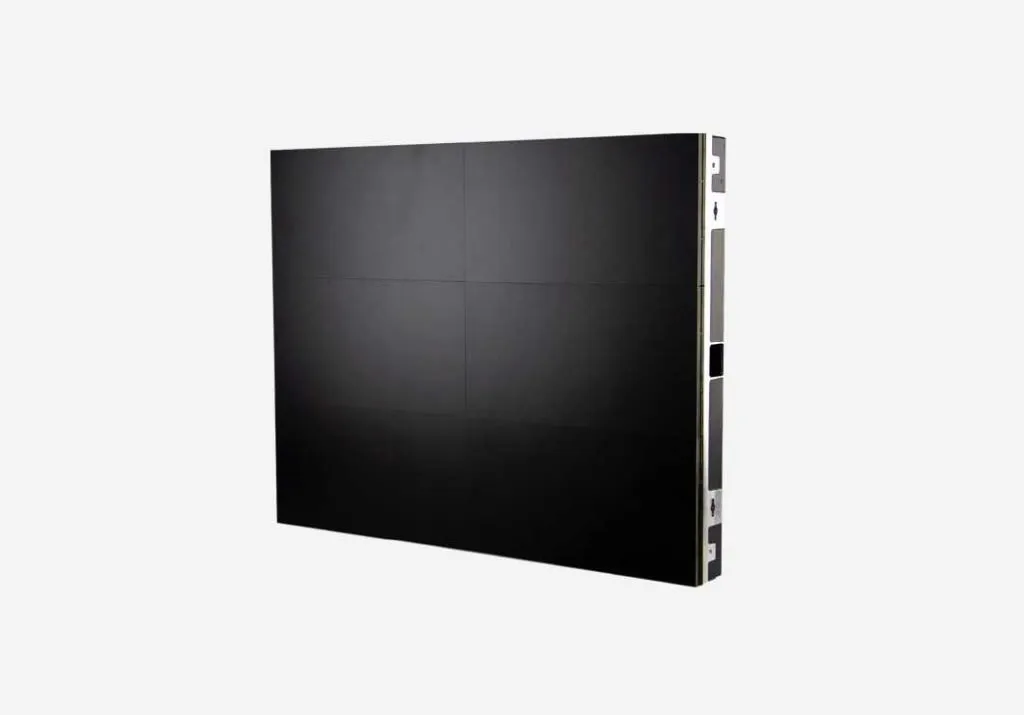
In response to the above problems, the new generation of small pitch COB LED screen developed by Doitvision can effectively solve this series of problems.
The DOIT VISION COB Beta LED Display redefines visual excellence with cutting-edge COB technology. This product will deliver unmatched clarity, durability, and versatility for indoor applications. Designed to replace traditional SMD LED displays, this advanced solution combines superior image quality with user-friendly installation and maintenance, making it ideal for corporate, retail, control room, and creative environments.
Key Features:
Ultra-High Contrast (10,000:1):
Achieve stunning vibrancy and detail with a 10,000:1 color contrast ratio. Black coating technology and a non-reflective surface enhance dark uniformity, capturing intricate visuals even in low-light conditions.
Perfect Grayscale & Color Precision:
Enjoy seamless color transitions and true-to-life imagery with 3840Hz refresh rates, 60Hz frame rates, and adjustable color temperatures (3000K–9300K).
Versatile Pixel Pitches (1.5mm/1.86mm):
Choose between 422,753 pixels/m² (1.5mm) or 288,906 pixels/m² (1.86mm) to balance resolution and viewing distance needs. Both options deliver 160° wide viewing angles and 600–1000 nits brightness for crisp visibility.
Modular & Flexible Design:
320x160mm LED Modules:
Effortlessly assemble into a 640x480mm panel frame for a lightweight (7.5kg/unit), high-density display.
Magnetic Front Service:
Strong, adjustable magnets ensure quick, seamless installation and maintenance. Electronic suction tools simplify module handling while maintaining a flat, uniform surface.
Seamless 90° Corner Installation:
Bevel-edged modules enable flawless right-angle displays, perfect for creative LED cubes or pillars.
Direct Wall Mounting:
Fully front-serviceable panels can be mounted directly on walls or plywood using included positioning frames, saving space and streamlining setup.
Robust Performance:
- IP54/IP31 Rating: Built to withstand dust, moisture, and indoor environmental challenges.
- 100,000-Hour Lifespan: Engineered for reliability with 24-month warranty coverage.
- Energy-Efficient: Consumes just 90W/㎡ at peak performance, compatible with 110V/240V AC power.

The COB Beta LED Display merges innovation with practicality. It offers a future-proof solution for immersive, high-impact visual experiences. From boardrooms to artistic installations, it’s the smart choice for those demanding precision, flexibility, and durability.
Specifications:
- Pixel Pitch 1.5mm/1.86mm
- Brightness 600–1000 nits
- Refresh Rate 3840Hz
- Unit Size 640x480x59mm
- IP54/IP31
- 24-Month Warranty.
Conclusion
The display quality of LED display is closely related to the design of row driver and constant current driver chip. We should reasonably select blanking voltage VH (3V~3.4V) and combine it with circuit optimization to effectively improve these problems and enhance the display effect of LED display.
With the development of small pitch LED technology, the requirements for row driver are getting higher and higher. As a Professsional LED display manufacturer, Doitvision can further optimize the display quality through more advanced driving technologies, such as intelligent blanking algorithm and precise constant current control, and bring users a better visual experience.