 All-in-One COB LED TV
  Flexible LED Displays
  Transparent LED Displays
  Led Poster
  Circular LED Displays
  Creative & Custom LED Displays
 With the development of display technology, there are various types, such as LED, LCD, OLED, and Mini-LED Technology. Do you know their principles? Today, Doitvision will introduce you to these details.
What is LED?

LED is a semiconductor electronic component. It can convertselectrical energy into light energy. LEDs are widely used in modern society and can be broadly categorized into three types:
- Lighting: LED lamps replace traditional incandescent bulbs ,such as household lights, automotive lights.
- Display: Used in screens of terminal electronic devices ,such as,smartphones, tablets, computers, TVs, monitors.
- Communication: Primarily serve as light sources for low-to-medium data rate (<1 Gb/s), short-to-medium distance (<10 km) fiber optic communication systems, with infrared LEDs being the most common application.
Since Mini-LED technology is primarily used in display applications, we focuse on display technology.
Screen Display Mechanism:
LED Display screens operate by combining light emission from LED beads with color filters. The core component of LED light emission is the LED chip. An LED bead has two electrodes ,includig anode and cathode. Higher current flow through the electrodes results in higher brightness. By controlling the brightness and on/off state of the beads,it can produce various patterns and text.
However, a single LED bead can only emit one color. To achieve full color display, it needs additional green and blue LED beads for each pixel point. Multiple RGB (Red, Green, Blue) beads together form a display capable of showing color.
Concepts Related to Mini-LED
There is currently no official standardized definition for Mini-LED. They vary slightly among manufacturers but are primarily based on chip size. According to the general technical specifications for commercial Mini-LED displays, Mini-LED refers to LEDs with a chip size ranging from approximately 50 to 200 micrometers (μm).
They are positioned between fine-pitch LEDs and Micro-LEDs in terms of chip size and pixel pitch. It is also considered an extension of fine-pitch LED technology and a transitional step towards Micro-LED.
In terms of display performance, Mini-LED represents a new display technology product. They can offer better visual quality than LCD, lower cost and longer lifespan than OLED, and upgraded version of traditional LCD display technology.
Mini-LED Technology
Current mainstream display technologies are broadly classified into LCD and OLED. Mini-LED technology itself branches into two directions:
- LCD Backlight Enhancement
- Direct Display
Therefore, We will introduce LCD and OLED technologies first.
Mini-LED & LCD Technology
1) LCD Technology Principle

A display screen consists of numerous pixels, each containing an LCD structure. The pixel structure of an LCD can be broken down into the following layers/modules:
- Backlight Layer: LCD panels do not emit light themselves and require an external light source, the “backlight unit” (BLU). Initially using Cold Cathode Fluorescent Lamps (CCFL), backlights transitioned to LED-based backlights after 2008.
- Polarizer Layer: Light passing through a vertical polarizing filter allows only vertically oriented light waves to pass. When this light encounters a horizontal polarizing filter, no light passes through because there are no horizontally oriented components. Thus, two perpendicular polarizers completely block light.
- Liquid Crystal (LC) Layer: This layer sits between electrodes connected to positive and negative circuits.
- Without Voltage: Light passing through the first polarizer is rotated 90 degrees by the LC molecules. It aligns horizontally and passing through the second polarizer.
- With Voltage: The LC molecules align based on the applied voltage strength, controlling the amount of light rotation. It varies the amount of light passing through the second polarizer, thereby controlling the pixel’s brightness.
- Color Filter Layer: Light emerging from the LC layer is monochrome (shades of grey). A color filter array (CFA) is added, consisting of red (R), green (G), and blue (B) sub-pixel filters. By controlling the brightness of light passing through each R, G, and B sub-pixel, it can mix various colors.


Mini-LED in LCD Backlighting Application
The Mini-LED in LCD backlighting application involves replacing the traditional edge-lit or larger direct-lit LEDs with dense arrays of Mini-LED beads. With Mini-LED beads being significantly smaller , such as diameter ~50μm-200μm, many more can be embedded into the LCD’s backlight layer.
- Higher overall screen brightness.
- More uniform brightness distribution.
The ability to divide the backlight into many more independently controllable Local Dimming Zones (LDZs).
When displaying a black image segment, the corresponding Mini-LED zone can be turned off completely. It allows LCDs to achieve much deeper blacks and significantly higher contrast ratios. The increased number and precision of LDZs greatly enhance local contrast and dynamic range. Therefore, It makes LCDs achieve display quality approaching that of OLED.
During LCD evolution, advancements like ultra-low viscosity LC mixtures and blue-phase LC materials have been incorporated to improve response times. Mini-LED complements this by enhancing the backlight structure to dramatically improve contrast.
Mini-LED & OLED Technology
Because early LED lamps were large in size, the number of lamps that could be installed per unit area as screen display materials was small, resulting in poor clarity. Therefore, manufacturers began to research micro-LEDs, with the first research direction being OLED.
2) OLED Technology Principle
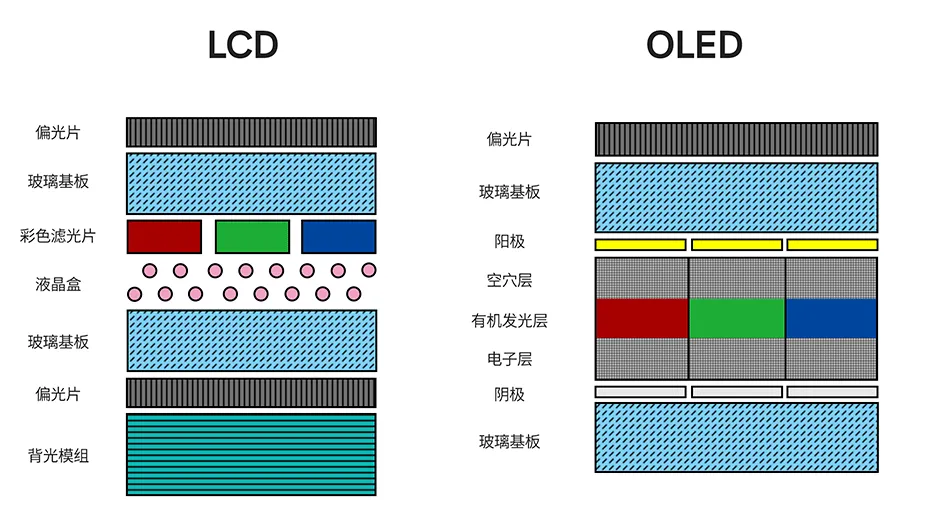
OLED is a self-emissive display technology. Its structure differs significantly from LCD by eliminating the LC layer, color filter layer in some types, and the separate backlight layer. Instead, organic light-emitting materials are sandwiched between a cathode and anode.
Display Principle:
When voltage is applied, electrons are injected from the cathode and “holes” (positive charge carriers) from the anode into the organic layers. These electrons and holes meet within the emissive layer, recombine, and release energy in the form of photons . Different organic materials emit specific colors (R, G, B).
Because each OLED pixel emits its own light, no need separate backlight. Individual pixels can be turned completely off to display perfect black, theoretically giving OLED infinite static contrast ratio. Each pixel’s brightness and color can be controlled independently.
Disadvantages:
The organic materials have limited lifespans and are susceptible to degradation (aging). The R, G, and B materials degrade at different rates. If a pixel displays a static bright image for prolonged periods, that specific sub-pixel material degrades faster, leading to permanent brightness loss in that area. This manifests as visible image retention or uneven color, commonly known as “burn-in.”
3) Mini-LED Direct Display Principle
To mitigate OLED burn-in, LED manufacturers developed technologies like W-OLED using white OLED + color filters and QD-OLED using blue OLED + quantum dot converters. However, these still fundamentally rely on organic materials and face inherent aging and lifespan limitations.
The ultimate solution requires switching to inorganic materials, leading to next-generation LED display technologies: Mini-LED & Micro-LED Direct Emission.
This involves making inorganic LED diodes extremely small and then transferring and bonding them onto a display substrate.
This technology inherits all the advantages of OLED,such as:
- self-emissive
- perfect blacks
- high contrast
- wide viewing angles
- fast response
while eliminating burn-in and offering potentially longer lifespans and higher brightness. While LEDs can be manufactured at micro scales (Micro-LED <50μm), the challenge lies in precisely transferring and interconnecting millions or billions of these microscopic LEDs onto the control circuitry. It is a process known as Mass Transfer Technology. The high cost and complexity of mass transfer currently prevent Micro-LED from large-scale commercialization.
Mini-LED direct display faces challenges due to its larger chip size (50-200μm) and packaging limitations. The smallest achievable pixel pitch is currently around 0.5mm. If you create a 4K resolution screen with this pitch, it need a >85 inches large screen size. Furthermore, the enormous number of LEDs required ~24 million for 4K.
Summary of Mini-LED Technology Application Status
Micro-LED represents the pinnacle of display technology potential , but mass transfer hurdles prevent commercial mass production. Mini-LED is a practical transitional technology.
For direct display applications, Mini-LED’s minimum 0.5mm pitch limitation, Therefore, it is unsuitable for consumer electronics screens ,such as phones, laptops, TVs. While potentially suitable for large outdoor commercial displays, its high manufacturing cost has also hindered widespread adoption.
Consequently, Mini-LED currently finds its primary and most successful application in the backlighting enhancement of LCD panels. This leverages mature LCD production lines, offers significant picture quality improvements at a lower cost relative to OLED or direct Mini-LED.
In the direct display part, it is primarily used for large outdoor commercial advertising screens. According to TrendForce predictions, Mini-LED backlighting is the dominant current application trend, with its market size expected to grow at a CAGR of 164% from 2020 to 2025.
As LED technology matures, Doitvision has developed a growing range of fine-pitch LED screens, such as our COB LED displays, for commercial advertising applications.
Doitvision COB LED Wall Recommendations

Doitvision’s COB LED displays are an excellent choice for high-resolution video walls. We offer pixel pitches from P0.7 to P1.8, supporting 2K, 4K, and 8K.
Superior Visual Quality
From 0.62mm to 1.87mm, our COB display achieves higher pixel density. It allows viewers to stand closer to the display without noticing individual pixels.
Exceptional Grayscale and Contrast
With a remarkable color contrast ratio of up to 10,000:1, these displays deliver vibrant, true-to-life images. The adoption of black coating technology brings a non-reflective surface and supreme black uniformity even in low-light conditions.
16:9 Aspect Ratio for Universal Compatibility
With 16:9 aspect ratio, it is the standard for modern devices like TVs, computer monitors, mobile devices, and digital video cameras. This format supports 1080p (2K), 2160p (4K), and 4320p (8K) resolutions.
Energy-Efficient Flip Chip Technology
Combined with a common cathode circuit design, it can enhance display performance while reduce energy consumption by up to 40%.
Precision Color Calibration
Color calibration technology brings consistent color output across all LED modules. It can eliminate issues like moiré patterns and maintain uniform color temperature and balanced white tones.
Direct Wall-Mounted Design with Full Front Maintenance
It is a 100% front-serviceable design with magnetic LED modules. The panel frame can be directly mounted onto walls or plywood using screws, with included frame bars for precise positioning and easy installation.
Technical Specifications
- Pixel Pitch Options: 0.62mm, 0.78mm, 0.93mm, 1.25mm, 1.5mm, 1.87mm
- LED Package: COB for all models
- Contrast Ratio: Up to 10,000:1 for vibrant visuals
- Aspect Ratio: 16:9, compatible with 2K, 4K, and 8K resolutions
- Maintenance: 100% front service with magnetic modules
- Energy Savings: Up to 40% with flip chip technology
- Installation: Direct wall mounting with included frame bars
Conclusion:
We have introduced the different display development and principles. As a professional LED display manufacturer, if you require HD LED displays for commercial, please feel free to contact us.