All-in-One COB LED TV
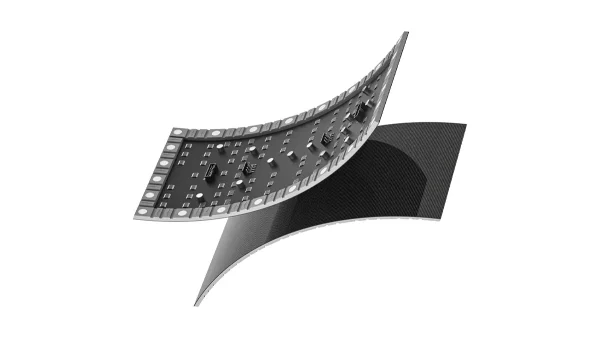
  Flexible LED Displays
  Transparent LED Displays
  Led Poster
  Circular LED Displays
  Creative & Custom LED Displays
 A 360° cylindrical LED display wrapping a 1.53-meter column, 3.2 meters tall, using 240×120mm P1.5 GOB modules with magnetic snap-on mounting. Ten modules per ring, three hours of module mounting time. Here’s exactly how it was done — the brief, the specs, the assembly steps, and why GOB was non-negotiable.

A 360° LED Column in a Public Retail Space

A retail client in Lisbon needed a cylindrical LED display wrapping an architectural column in the center of the store. The display had to deliver sharp close-view content — customers walk within one meter of the surface — while withstanding accidental contact from shoppers and cleaning staff. The column was 1.53 meters in diameter, a structural element that could not be modified.
Three constraints drove the specification: close viewing distance demanded fine pixel pitch; public accessibility demanded GOB protective coating; and the cylinder geometry required a module that could maintain a consistent curve around a 2,400mm circumference.
Fine pitch: P1.5 at 1 meter viewing distance delivers visually seamless resolution — no visible pixel grid. GOB (Glue on Board): The modules are in a public retail area with close pedestrian traffic, cleaning crews with mops, and occasional accidental contact. P1.5 modules are particularly vulnerable to impact damage at this fine pitch — GOB encapsulation absorbs impact without damaging individual LEDs or bond wires. Standard uncoated P1.5 modules in this environment would accumulate dead pixels within weeks.
The Numbers That Made This Work

| Parameter | Value |
|---|---|
| Pixel Pitch | P1.5 GOB (Glue on Board) |
| Module Size | 240 × 120mm |
| Column Diameter | 1,530mm |
| Column Circumference | 4,806mm (1,530 × π) |
| Modules per Ring | 10 (240mm × 10 = 2,400mm — filler strip covers the balance) |
| Display Height | 3,200mm |
| Rows per Column | 26 (3,200 ÷ 120 ≈ 26.7, rounded) |
| Total Modules | 260 (plus 13 spares at 5%) |
| Display Area | ~15.4m² |
| Refresh Rate | 3,840Hz |
| Control System | Novastar |
| Mounting Method | Steel frame + neodymium magnetic snap-on |
| Protection | GOB encapsulation (impact + moisture) |
From Steel Frame to Finished Cylinder in Under 3 Hours of Module Mounting
A cylindrical steel frame with an outer diameter of 1,530mm was welded to spec. The frame consisted of horizontal ring sections at 600mm intervals joined by vertical ribs, with mounting surfaces faced to the specified curve. The frame was shipped to the site pre-assembled in two half-cylinder sections for transport.
The two half-cylinder frame sections were positioned around the existing column, bolted together, and anchored to the floor and ceiling with M10 expansion bolts. A laser level confirmed the cylinder was plumb within ±1mm over the 3.2m height.
Power (230V AC) and data (Cat6 Ethernet to the Novastar controller) were routed behind the frame. Power and signal cables were separated by at least 50mm throughout the run to prevent electromagnetic interference.
260 P1.5 GOB modules were snapped onto the steel frame using the pre-installed neodymium magnets — no tools required. Alignment pins on every module edge registered each module to its neighbor automatically. Where the welded frame surface had minor variations (1–2mm), the height-adjustable magnets were rotated to compensate. A few modules needed thin shims at the frame contact points — standard practice for iron frames — to achieve a perfectly flush display surface.
Ribbon cables were connected between modules. The Novastar controller was loaded with the factory-provided configuration file that included pixel mapping for the cylindrical geometry. A full-screen test pattern confirmed every pixel was lit and color-uniform. The content mapping file was loaded onto the media server.
Total on-site time: ~7 hours. Two technicians. No specialist LED experience required — one AV integrator and one local installer. The frame welding was done at a local metal shop; the module mounting was magnetic snap-on; the calibration was pre-loaded on a USB drive.
Why GOB Was Non-Negotiable for This Project

GOB (Glue on Board) encapsulation adds a transparent protective layer over the entire LED surface of each module. It costs more than standard modules and some clients question whether it’s necessary. For this project it was non-negotiable for three reasons:
1. Public contact. The cylinder sits in a retail space with close pedestrian traffic. Shoppers touch surfaces. Cleaning crews wipe surfaces daily with damp cloths. Without GOB, a P1.5 module would accumulate dead pixels within weeks from electrostatic discharge and mechanical contact.
2. Fine pitch vulnerability. At P1.5, the gap between LEDs is extremely small — approximately 1.5mm center-to-center. The LED bond wires and driver ICs are physically close to the surface. A light impact that a P4 module shrugs off can kill multiple pixels on a P1.5 module. GOB spreads impact force across the entire module surface instead of concentrating it on individual LEDs.
3. Installation handling. Magnetic snap-on mounting is fast, but it involves handling 260 individual modules by hand. GOB prevents accidental finger pressure damage during installation — when the installer presses a module onto the frame, the force goes into the GOB layer, not into the LEDs.
The GOB upcharge paid for itself in avoided maintenance within the first year. For a staff-only back-of-house installation where nobody touches the surface, standard modules would have been sufficient — but not here.
Read the full GOB decision guide to determine when GOB is necessary for your project.
19 years in LED display engineering. I specified the P1.5 GOB module for this project after the client’s first enquiry described the column location — directly in a pedestrian aisle with cleaning access. That single detail made GOB mandatory. Every module in this project was aged for 72 hours in its bent configuration before shipping, which is standard procedure for flexible LED at DOIT VISION.
Send the column diameter, the wrap height, and a photo. We’ll return a feasibility drawing, module count, and quote within 24 hours.