 All-in-One COB LED TV
 Flexible LED Displays
 Transparent LED Displays
 Led Poster
 Circular LED Displays
 Creative & Custom LED Displays
Are COB LED displays worth the investment? Let’s use five-year maintenance costs as a benchmark. First, it is essential to understand the fundamental differences between the COB and SMD technical approaches.

- → Permanent installation, 2+ years in service
- → Complex logistics: multi-floor, tight site access
- → Boardroom, control room, lobby — callbacks carry reputational cost
- → North America / EU where field labour is USD 50–150/module
- → Experienced installation crew, proven low failure record
- → Budget-constrained project, client purchase price is primary driver
- → Colour-critical broadcast at scale (>30m²)
- → Novastar / Brompton integration requiring specific driver ICs
- → Temporary installation under 24 months
- → Exhibition, pop-up, short-term rental deployment
- → TCO model does not apply — savings need time to accumulate
The Wrong Question Costs More Than the Right Answer
The standard integrator question is “how much more does COB cost?” It’s the wrong question. The right question is: “what does SMD’s lower purchase price actually buy you over five years?”
At current DOIT VISION ex-works pricing for P1.2 products, the COB premium over professional-grade SMD is USD 30 per m². On an 18m² conference room wall, that’s USD 540 total. In North America, a single field service call — one technician, one module, one attendance — runs USD 50–150 in labour alone, before parts.
The USD 540 purchase premium is recovered the first time a service call doesn’t happen.
| Product | Cabinet Size | Price per m² (EXW) |
|---|---|---|
| COB Pro P1.2 | 600×337.5mm | USD 1,530 |
| Professional SMD P1.2 | 600×337.5mm | USD 1,500 |
| Economy SMD P1.2 | 600×337.5mm | USD 1,200 |
Economy SMD at USD 1,200/m² uses standard open-face packaging with no protective resin over the die — the same construction that accounts for the majority of transit and installation damage we document. Comparing COB against economy SMD on purchase price is comparing different risk profiles, not equivalent products. The valid comparison is COB Pro vs professional-grade SMD: a USD 30/m² gap.
Why the Construction Difference Is the Cost Difference

COB (Chip-on-Board)
COB bonds LED chips directly onto a PCB substrate, then encapsulates the entire die array under a continuous layer of epoxy resin or silicone — bypassing the discrete LED bead stage entirely. The result is a sealed, continuous light-emitting surface with no exposed die face and no individual bond wire accessible to physical impact.
Engineering consequence: the failure mode shifts from mechanical fragility to electrical. Electrical failures are rarer and more predictable than mechanical failures. When COB modules do fail, the cause is typically a component fault — not handling damage.
SMD (Surface Mount Device) Fine-Pitch
SMD encapsulates red, green, and blue LED chips into a single lamp bead, then solders the package onto a PCB via reflow. Fine-pitch refers to pixel pitch below 2.5mm. Each die is protected by a thin epoxy lens — a discrete, exposed component that is the primary vulnerability in the construction.
Engineering consequence: physical contact sufficient to crack the lens or dislodge the bond wire can occur during normal cabinet handling. The majority of SMD failures we document occur before the wall is ever powered on.
| Parameter | COB Pro | Professional SMD Fine-Pitch |
|---|---|---|
| Packaging | Chip-level, continuous resin encapsulation | Surface-soldered discrete lamp beads |
| Impact resistance | High — resin layer absorbs contact without die damage | Low — lens crack or bond wire failure from minor impact |
| Colour consistency | Good on walls under ~30m²; variance visible at larger scale | Excellent — individual die binning before assembly |
| Primary failure mode | Electrical (predictable, rare) | Mechanical (unpredictable, handling-dependent) |
| Purchase price (P1.2) | USD 1,530/m² | USD 1,500/m² (pro grade) |
| Best application | Permanent installations: control rooms, boardrooms, lobbies | Colour-critical broadcast; budget-constrained fixed; rental |
| Long-term maintenance cost | Lower — near-zero module replacement in field records | Higher — 3–5 modules/year on 18m², 6–10 on 50m² |
Field Records, Not Estimates

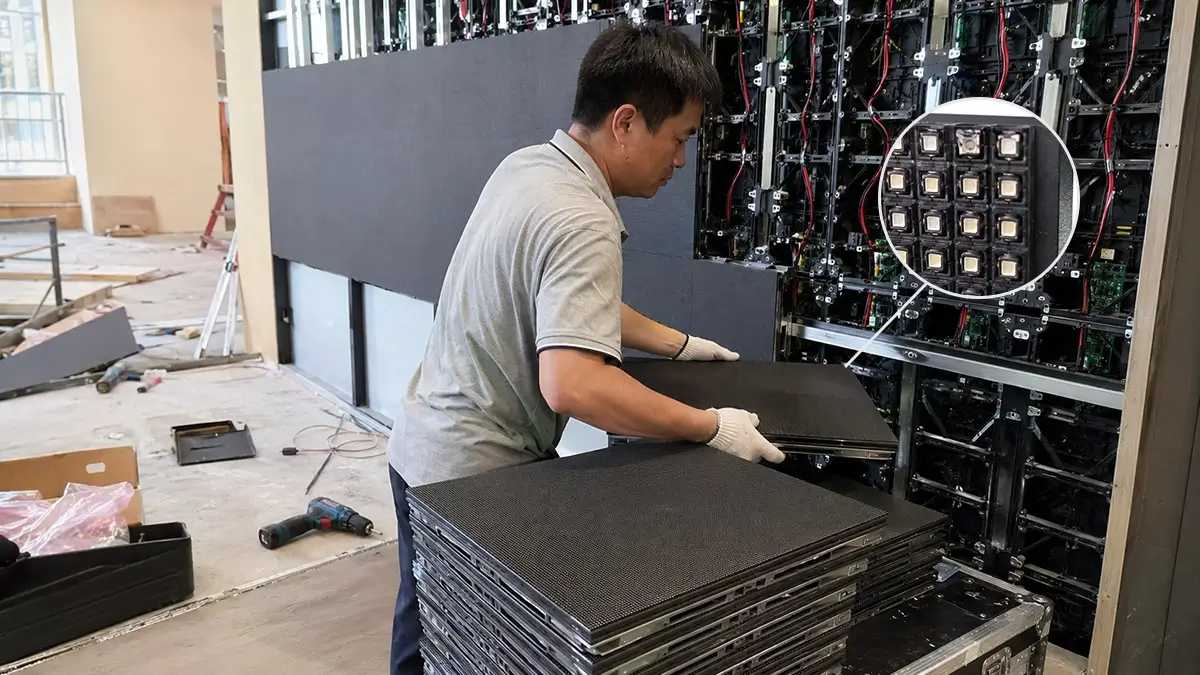
The failure pattern between COB and SMD follows a predictable mechanical logic. Standard SMD construction leaves the die face exposed, protected only by a thin epoxy lens. Physical contact during cabinet handling, transportation, or on-site tiling is sufficient to crack the lens or dislodge the bond wire. In practice, the majority of SMD failures we document occur before the wall is ever powered on.
COB’s continuous resin layer absorbs incidental contact without die damage. The failure mode shifts from mechanical to electrical — a type of failure that is both rarer and more predictable in its timing.
DOIT VISION Project Records
- Module replacements: zero
- Field service calls: zero
- Remote interventions: zero
- Module replacements: zero
- Field service calls: zero
- Remote: one firmware update for display calibration — no physical intervention
SMD installations at equivalent usage: average 3–5 module failures per 18m² per year; 6–10 per 50m² per year. The majority are traceable to transit and installation handling, not operational wear. These are averages across projects — experienced installation crews with careful handling protocols produce failure rates at the low end of this range.
The Repair Cost Model
In North America, a field service call for LED display repair carries a fully-loaded labour cost of USD 50–150 per module, inclusive of technician time on site. This is labour only — parts are additional. For professional SMD P1.2, module parts cost approximately USD 82 per unit. For COB Pro P1.2, it is approximately USD 37.35 per unit.
| Wall Size | SMD Failures/Year | Labour Cost/Module | Annual Labour Cost (SMD) | Annual Labour Cost (COB) |
|---|---|---|---|---|
| 18m² | 3–5 modules | USD 50–150 | USD 150–750 | USD 0 |
| 50m² | 6–10 modules | USD 50–150 | USD 300–1,500 | USD 0–150 |
COB’s continuous resin encapsulation prevents per-die colour binning at the module level. On larger walls — roughly above 30m² in our project experience — this can produce subtle colour uniformity variance across the surface that individually-binned SMD dies do not exhibit to the same degree. For broadcast studios, virtual production volumes, and colour-critical applications at that scale, this is a genuine engineering consideration, not a marketing footnote. MIP technology is worth evaluating for those specific applications.
The 5-Year Model Starts at Handover. Installation Doesn’t.
The TCO model above starts at handover. It does not capture the cost difference that occurs during installation — where the majority of SMD damage actually happens.
A standard SMD cabinet installation sequence involves unpacking, staging, lifting into frame, tiling, cable management, and on-site calibration. Each handling transition is a damage opportunity: a cabinet dropped from 30cm, a corner catching a door frame, two cabinets knocked together during staging — any of these is sufficient to crack SMD dies. The failure is often invisible until the wall is powered on for the first time.
The practical consequence is a commissioning day that runs longer than scheduled. Damaged modules must be identified, logged, and either swapped from spares inventory or ordered. On a 50m² SMD installation, it is not unusual to spend two to four hours on post-power-up module replacement before client sign-off.
COB’s continuous resin layer absorbs incidental contact without die damage. Post-power-up module replacement on our COB installations is typically zero. On-site calibration is still required for tiled COB walls — this is not a time saving — but the absence of damage-related callbacks is.
On-Site Spares Cost Comparison — 50m² Installation
| Spares Category | Professional SMD P1.2 | COB Pro P1.2 |
|---|---|---|
| Recommended spares on site | 8–12 modules | 2–4 modules |
| Module unit cost (parts only) | USD 82 | USD 37.35 |
| Total spares cost | USD 656–984 | USD 75–150 |
| Delta vs COB baseline | +USD 506–834 | Baseline |
COB’s spares advantage is double: fewer modules needed on site, and a lower unit cost per module. The USD 506–834 delta on a single 50m² project is a direct reduction in working capital tied up in spares inventory — before any labour or operational maintenance is counted.
COB Pro cabinets integrate the power supply, hub card, and receiving card into a single internal assembly with minimal wiring. Standard SMD cabinets require separate components with inter-cabinet cabling — more connector points, more potential failure locations. On a 50m² SMD installation, internal component failures (PSU, receiving card, hub card) add an estimated USD 100–300 in parts replacement over five years, plus associated labour. COB cabinets have a near-zero connector-related failure rate.
All Cost Categories, Two Wall Sizes
Model assumptions: Professional SMD P1.2 at USD 1,500/m² vs COB Pro P1.2 at USD 1,530/m². Both 600×337.5mm cabinets, ex-works pricing. North America installation labour rates (USD 50–150/module). Module replacement parts: SMD USD 82/unit, COB USD 37.35/unit.
18m² Wall — 5-Year TCO
| Cost Item | Professional SMD | COB Pro |
|---|---|---|
| Purchase price | USD 27,000 | USD 27,540 |
| Installation spares (modules) | USD 328–492 | USD 75–150 |
| Module replacement labour — Year 1–5 | USD 750–3,750 | USD 0 |
| Internal component failures (PSU / cards) | USD 50–150 | USD 0 |
| Firmware / remote support | USD 0 | USD 0 |
| 5-Year Total (low estimate) | USD 28,128 | USD 27,615 |
| 5-Year Total (high estimate) | USD 31,392 | USD 27,690 |
| COB saving over 5 years | USD 513–3,702 | Baseline |
50m² Wall — 5-Year TCO
| Cost Item | Professional SMD | COB Pro |
|---|---|---|
| Purchase price | USD 75,000 | USD 76,500 |
| Installation spares (modules) | USD 656–984 | USD 75–150 |
| Module replacement labour — Year 1–5 | USD 1,500–7,500 | USD 50–300 |
| Internal component failures (PSU / cards) | USD 100–300 | USD 0 |
| Firmware / remote support | USD 0 | USD 0 |
| 5-Year Total (low estimate) | USD 77,256 | USD 76,625 |
| 5-Year Total (high estimate) | USD 84,284 | USD 76,950 |
| COB saving over 5 years | USD 631–7,334 | Baseline |
Client downtime and callback reputational exposure are real costs, and neither is easily quantified. Any integrator who has managed a callback on a live broadcast installation, or a boardroom that went dark before an executive presentation, will recognise the value of a wall that simply does not fail. These costs are not in the model — they make the COB case stronger, not weaker.
Send us your wall size, pixel pitch, and installation environment. We’ll run the numbers on your specific project.
The COB Case Is Real. It’s Also Incomplete Without This.
This analysis has made a clear case for COB on 5-year economics. That case is real — and incomplete without stating the conditions under which SMD remains the more rational choice.
Temporary and Short-Cycle Installations
If the wall will be in service for less than 24 months — a temporary exhibition, a pop-up retail environment, a short-term rental deployment — the TCO model does not apply. The maintenance savings that justify COB’s purchase premium require time to accumulate. For installations with a defined end date, economy SMD is the correct procurement decision.
Colour-Critical Applications at Large Scale
COB’s continuous resin encapsulation prevents per-die colour binning at the module level. On walls above approximately 30m², this produces visible colour uniformity variance across the surface. It is subtle under normal viewing conditions, but detectable under broadcast camera or in controlled lighting. For broadcast studios, virtual production volumes, and colour grading suites, this is a genuine limitation. MIP technology — which retains individual die binning while offering improved physical protection over standard SMD — is worth evaluating for these applications at scale.
Budget-Constrained Projects With Experienced Installation Crews
The SMD failure rate data in this guide reflects average field conditions. An experienced installation team will produce SMD failure rates at the low end of the documented range. For an integrator with a proven installation crew and a client whose primary constraint is purchase price, economy SMD on a well-managed installation remains a defensible choice.
COB is not universally correct. It is the better long-term engineering decision for permanent installations in environments where callbacks carry real cost — financial or reputational — and where the installation involves any logistical complexity. Where those conditions do not apply, the case is weaker. The data in this guide supports both conclusions.
Translating Engineering Data into Client Conversations
The integrator’s challenge is not understanding the TCO model — it’s translating it into language a facilities manager, marketing director, or CFO will act on. The following framings are drawn from how our engineering team addresses this question in project conversations. The data behind each statement is in this article.
“The purchase price difference on an 18m² wall is around USD 540. A single service call in this market costs more than that. We’re not selling you a premium product — we’re selling you a wall that doesn’t generate service calls.”
“That quote is real. The difference is what happens after installation. SMD dies are exposed — they’re vulnerable during shipping and fitting. Most of the failures we document happen before the wall is even powered on for the first time. COB encapsulates the die under a resin layer. In two years of operation across our North American installations, we have had zero module replacements on COB walls.”
“If your priority is the lowest number on the purchase order, SMD wins by a small margin. If your priority is the lowest number at the end of year five, COB wins. The gap widens every year the wall is in service.”
“Every time a cabinet is handled — unloaded, staged, lifted, tiled — SMD has a failure risk. COB doesn’t. On a project with elevator access, multiple floors, or a tight site, that risk compounds. We’ve seen 50m² SMD installations where the crew spent half a day on post-power-up module replacement before client sign-off. That doesn’t happen with COB.”
Questions to Answer Before Specifying COB vs SMD
- How long will this installation be in service?Under 24 months: economy SMD is the correct procurement decision — TCO savings don’t have time to accumulate. Over 24 months: COB’s maintenance economics apply and the purchase premium is typically recovered within the first 12–18 months.
- What is the installation complexity — access, floors, handling transitions?Complex logistics (elevator access, multiple floors, tight site, restricted staging area) significantly increase SMD failure risk, because every handling transition is a damage opportunity. COB’s resin layer is indifferent to incidental contact. On complex sites, the high-end failure rate assumption applies.
- What is the wall’s total area?Under 30m²: COB’s colour uniformity is excellent and the TCO case is straightforward. Above 30m²: the colour uniformity limitation becomes a consideration for colour-critical broadcast or virtual production applications. For standard corporate AV, it is not a practical constraint.
- Is this a colour-critical broadcast or virtual production application?If the wall will be used for broadcast camera, virtual production volume, or colour grading, per-die colour binning matters. Professional SMD or MIP technology is the correct specification for these applications at scale above 30m².
- What is your installation crew’s experience level with fine-pitch LED?Experienced crews with proven fine-pitch protocols produce SMD failure rates at the low end (3 modules/year on 18m²). Less experienced crews or crews new to fine-pitch work produce rates at the high end (5+ modules/year). Factor this honestly into the TCO calculation.
- What does a service call actually cost in your market?The USD 50–150/module figure in this model is North America. EU rates are typically EUR 60–120. APAC rates vary significantly by market. Adjust the labour cost figures for your specific geography — the payback period changes accordingly.
- How does the client weight reputational risk vs purchase price?For a boardroom that hosts client presentations, a control room in continuous operation, or a lobby display in a flagship location, the cost of a callback is not only financial — it is reputational. This cost is deliberately excluded from the TCO model because it is not quantifiable. It strengthens the COB case wherever it applies.