 All-in-One COB LED TV
  Flexible LED Displays
  Transparent LED Displays
  Led Poster
  Circular LED Displays
  Creative & Custom LED Displays
 Doitvision is one of the earliest representative companies focusing on COB technology in China. For a long time, we have been committed to promoting the advancement of COB LED screen technology. Every year, Doitvision CEO Kris will express unique insights on industry trends to point out the direction for industrial development.
In recent years, COB technology has experienced rapid development, and 2023 has ushered in the “hurricane” era. At that time, there was fierce price competition in the industry. Kirs called on the market to treat it rationally and avoid disorderly competition. After entering 2024, COB LED display prices have stabilized, the market has gradually returned to rationality, and has shown clear growth potential.
In 2025, Kirs reiterated in the latest industry dialogue that COB technology will continue to maintain vigorous vitality in the next 5-10 years. This achievement is hard-won, and manufacturers and users need to cherish and promote technology to a higher level.
COB industry status and market development

Industry phenomenon and market changes
From the market performance in the first quarter of this year, COB LED display screens have truly become one of the mainstreams of the small-pitch LED display market. And it has entered a stable development stage. However, there are still some challenges and regrets in the industry as a whole, which are specifically manifested in the following aspects:
Nowadays, almost all LED display companies involved in small-pitch LEDs, whether they are self-developed or purchased products, which shows that the acceptance of COB technology has greatly increased.
The overall level of COB LED display continues to improve, especially in terms of surface consistency and display integrity. The number of LED display with bad pixels has significantly decreased, and reliability has improved.
COB P1.2 and below have become the absolute main force in the market,which are widely used in high-end display scenarios.
However, quality and reliability still need to be further improved. Some companies have encountered market setbacks due to product quality problems (such as leakage, ink color consistency, etc.), which reflects that the industry still has room for improvement in manufacturing processes and quality control.
Market pattern after price war: from “price difference” to “quality difference”
The dialectics of cost reduction and competition
In 2023, the COB industry experienced a round of fierce price wars. The sharp drop in raw material costs has led to a sharp drop in the prices of terminal products, and some companies are in trouble due to inventory backlogs. However, Kris believes that price wars are a necessary stage for the popularization of technology: “Substantial cost reduction has opened the channel for COB to enter the mainstream market, allowing more customers to afford this technology.”
Doitvision’s way out
In the face of price wars, Doitvision chose to respond to “cost involution” with “technology premium”:
- Narrowing the “price difference”: We bring product prices closer to the industry average through large-scale production and process optimization;
- Expanding the “quality difference”: Strengthening core technologies such as surface treatment and optical design to make display effects and reliability leading.
“In the past, customers thought that Doitvision LED display were ‘good but expensive’, and now we have to prove that they are ‘good and worthwhile’.” Kris emphasized that this strategy makes Doitvision more competitive in the market after the price war.
Overcapacity: Pains and opportunities during the ramp-up period
Dynamic balance of capacity
At present, the COB industry presents a “two-sided” situation:
The capacity utilization rate of small and medium-sized factories is insufficient, and the monthly average capacity of 1,000 square meters is idle;
The leading enterprises are still expanding production, and new production lines are put into production one after another.
Kris interprets this phenomenon as “the natural alternation of the industry’s ramp-up period”: “Excess capacity will be gradually digested, and the new capacity will target future demand. The key lies in whether enterprises can take the lead in technology iteration.”
The risk of price war is controllable
Although overcapacity may trigger local competition, Kris believes that the probability of a full-scale price war is low:
Demand-side support: The demand for micro-pitch LEDs in fields such as ultra-HD display and virtual production continues to grow;
Technical threshold improvement: As the pitch moves below P0.9, low-end production capacity is difficult to participate in high-level competition.
Technical route competition: upward expansion or downward penetration?
Two-track parallel industry selection
Currently, COB enterprises have differentiated into two technical paths:
- Break through P1.5+ upward: reduce costs through large-scale production, seize mass markets such as conference rooms and outdoor advertising;
- Deepen P1.2- downward: focus on high-end scenes such as control rooms and XR virtual shooting, and pursue higher profits.
Doitvision’s “micro-pitch strategy”
Currently, the development of COB technology in the industry presents a “two-track parallel” trend:
- One is to develop in the direction of large pitch above P1.5 to reduce production costs and expand the scope of market application.
- The other is to develop in the direction of P0.9 and smaller pitches to increase product profits and maintain technological leadership.
Doitvision prefers the latter- focusing on the small pitch market of P1.2 and below. Kirs believes that although the company has the ability to provide various products, the price pressure of P1.2 and below LED display is relatively small, and COB occupies a dominant position in this market. As the cost gap between COB and SMD narrows, the application of COB in P1.5, P1.8 and even outdoor products will be further expanded.
- High technical barriers: micro-pitch has exponentially higher requirements for chip transfer accuracy and packaging technology;
- Large single-screen output value: The unit area price of P0.9 products can reach more than 3 times that of P1.8 products;
- Irreplaceable scenes: The demand for pixel density in fields such as film and television production and medical imaging cannot be compromised.
It is worth mentioning that Doitvision’s P0.3 COB screen has been mass-produced, marking the COB technology’s move towards the “Micro level”.
Technological breakthrough: define the future by solving pain points
Breakthrough of key bottlenecks
In 2024, Doitvision will achieve product upgrades through three major innovations:
- Brightness enhancement technology: maintain brightness while reducing power consumption by 30%, or double brightness without changing power consumption;
- Ink color consistency optimization: we use nano-level surface treatment technology to eliminate panel color difference;
- Reliability revolution: completely solve the “caterpillar” problem through material innovation, and the failure rate is reduced to less than 5/10,000.
Inspiration from the new COB Pro series
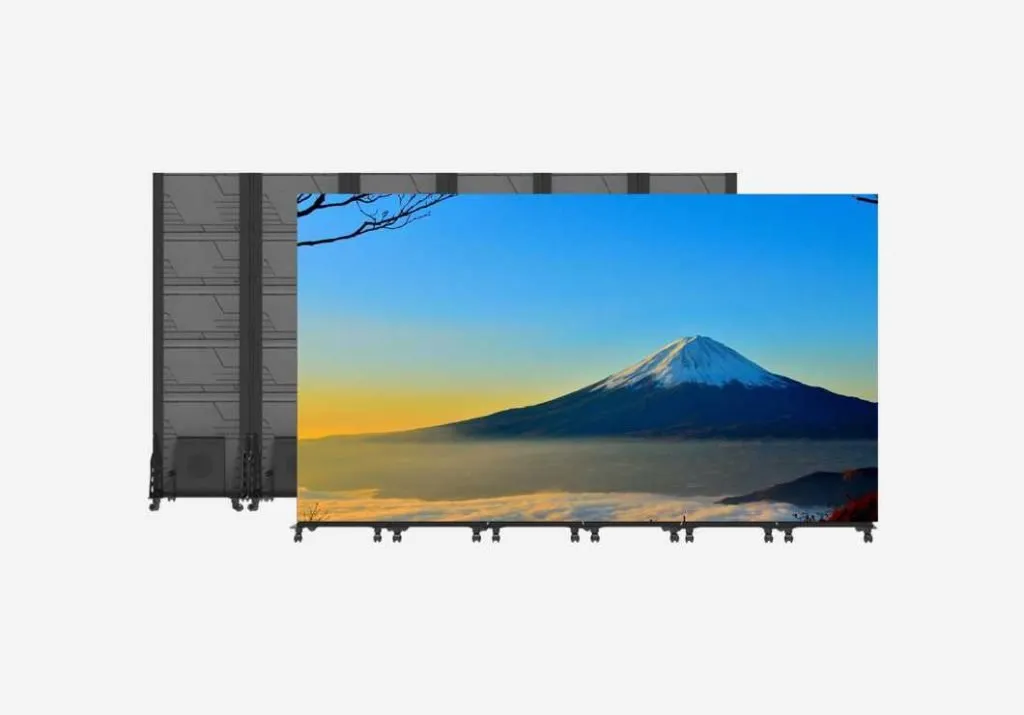
Take the newly released Doitvision COB display Pro series as an example:
- Power consumption advantage: 40% energy saving compared with traditional products, meeting the European energy label A++ standard;
- Environmental adaptability: can operate stably in extreme environments from -30℃ to 85℃;
- Visual experience upgrade: support 20-bit color depth, and color transition smoothness is improved by 300%.
These breakthroughs not only consolidate the technical advantages of Doitviison’s COB, but also pave the way for its application in 8K ultra-high definition, HDR and other scenarios.
The competitive relationship between COB and MiP
MiP technology has been developing in recent years. Some COB LED display manufacturers have even launched MiP products. However, Kirs believes that COB and MiP are not completely alternative, but complementary to a certain extent.
At present, COB mainly uses flip-chip Mini LED chips, which are directly bonded to PCB or carriers, while MiP forms independent devices through secondary packaging. The two have different process paths. Although MiP technology has certain advantages, its cost problem has not been effectively solved, and large-scale mass production still faces challenges.
On the other hand, the existing bonding equipment of COB manufacturers is compatible with the back-end process of Micro-level MiP devices. Therefore, once MiP achieves large-scale production, COB manufacturers can quickly enter this field and gain a competitive advantage.
Conclusion
After years of development, COB technology has become one of the core solutions for the small-pitch LED market. In the next 5-10 years, COB LED screen will continue to maintain its vitality and provide better solutions for the display industry.
Kirs called on manufacturers and users to cherish the current highlight of COB technology development, adhere to healthy competition, and jointly promote the industry to a higher level. Only by continuously optimizing product quality and improving technological innovation capabilities, which can the COB industry achieve more sustainable development and occupy a more important position in the future LED display market.