All-in-One COB LED TV
 Flexible LED Displays
 Transparent LED Displays
 Led Poster
 Circular LED Displays
 Column LED Screens
 Creative & Custom LED Displays
How to choose the right flexible LED display for your project — from pixel pitch and bend radius to indoor/outdoor ratings, control systems, and real cost. Written by an engineer who has designed and shipped flexible LED modules to 55+ countries.

- Flexible LED pitch ranges from P0.9 to P4 — tighter pitch means tighter possible bend and closer viewing distance, but higher module cost per square meter
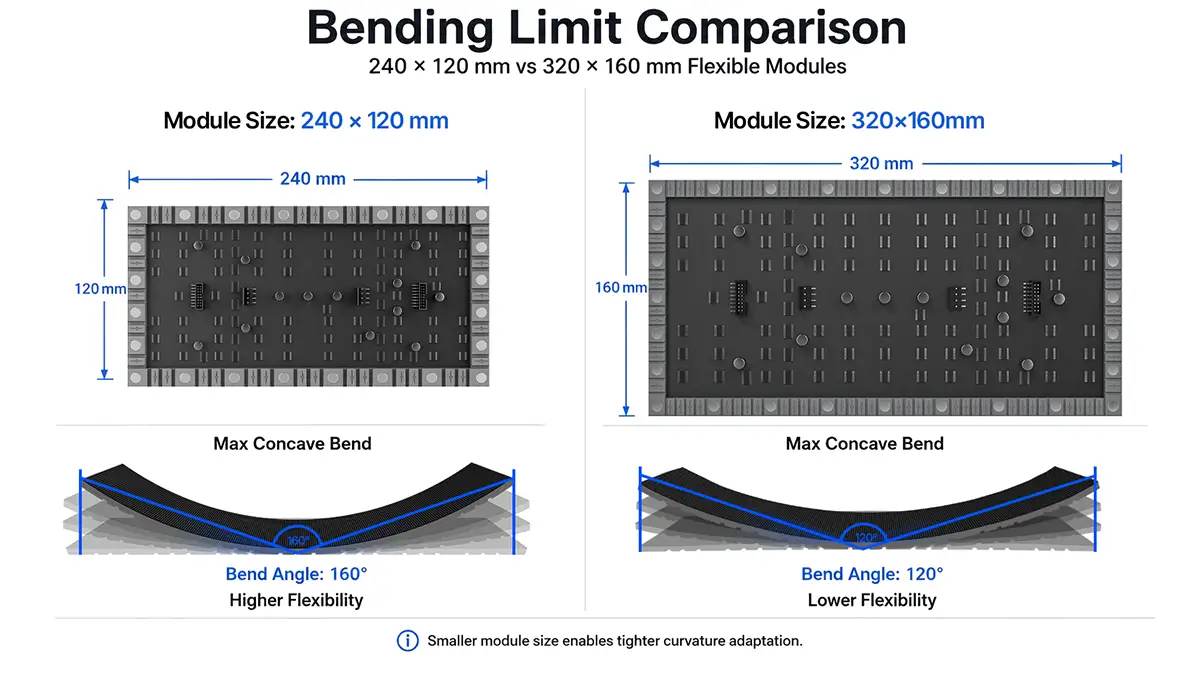
- DOIT VISION flexible LED modules span P0.9 to P4 pixel pitch. Bend limits are specified by minimum cylinder diameter — 764mm for 240×120mm modules and 815mm for 320×160mm modules — determined by physical module size, not pixel pitch. Bending angle reaches 145° to 165°.
- Outdoor flexible LED needs IP65 front and rear — the encapsulation must remain sealed even when the module is bent
- Factory-direct flexible LED from DOIT VISION ships in 20–30 business days with a 2-year warranty and magnetic front-access modules
What Pixel Pitch & Module Size Do You Need?
Pixel pitch on a flexible LED module is the center-to-center distance between adjacent LED pixels in millimetres. The math is straightforward: minimum viewing distance ≈ pixel pitch × 1,000. A P2.5 module needs at least 2.5 metres of viewing distance. Get closer than that and the pixel grid becomes visible.
But on a flexible module, your pixel pitch choice also determines which module size you can use — and the module size controls your bend limits. DOIT VISION manufactures flexible LED in seven distinct module sizes, each available in specific pitch ranges.
The two most common module sizes — 240×120mm and 320×160mm — cover most indoor curved applications from P0.9 to P4. The other five sizes (256×128, 300×168.75, 250×125, 200×150, 192×192) cover specialized pitch ranges. Choose your module size based on the available pitches you need, then confirm bend radius compatibility with your curve geometry.
Module Size: 320×160mm
Available pitches: P1.25 / P1.53 / P1.56 / P1.667 / P1.86 / P2 / P2.5 / P3 / P4
| Model | Pitch | LED | Brightness | Resolution | Refresh |
|---|---|---|---|---|---|
| SFA-1.25 | P1.25 | TOP-1010 | 500–600cd | 256×128 | 3840Hz |
| SFA-1.56 | P1.56 | SMD1212 | 500–600cd | 204×102 | 3840Hz |
| SFA-1.667 | P1.667 | SMD1212 | 500–600cd | 192×96 | 3840Hz |
| SFA-1.86 | P1.86 | SMD1212/SMD1515 | 500–600cd | 172×86 | 3840Hz |
| SFA-2 | P2 | SMD1515 | 500–600cd | 160×80 | 3840Hz |
| SF-2.5 | P2.5 | SMD1515 | 1000–1200cd | 128×64 | 3840Hz |
| SF-3 | P3 | SMD1515 | 500–600cd | 104×52 | 3840Hz |
| SF-4 | P4 | SMD2121 | 500–600cd | 80×40 | 3840Hz |
Module Size: 240×120mm
Available pitches: P0.9375(COB) / P1.25(COB) / P1.25 / P1.579 / P1.875 / P2 / P2.5 / P3 / P4
| Model | Pitch | LED | Brightness | Resolution | Refresh |
|---|---|---|---|---|---|
| SFB-0.9375 (COB) | P0.9375 | COB | 700–1000cd | 256×128 | 3840Hz |
| SFB-1.25 (COB) | P1.25 | COB | 700–1000cd | 192×96 | 3840Hz |
| SFB-1.25 | P1.25 | TOP-1010 | 500–600cd | 192×96 | 3840Hz |
| SFB-1.579 | P1.579 | SMD1212 | 500–600cd | 152×76 | 3840Hz |
| SFB-1.875 | P1.875 | SMD1212 | 500–600cd | 128×64 | 3840Hz |
| SFB-2 | P2 | SMD1515 | 500–600cd | 120×60 | 3840Hz |
| SFB-2.5 | P2.5 | SMD1515 | 500–600cd | 96×48 | 3840Hz |
DOIT VISION also manufactures flexible LED in five other sizes: 256×128mm (P2, P4), 300×168.75mm (P1.875), 250×125mm (P1.25–P1.838, up to 7680Hz), 200×150mm (P1.25), and 192×192mm (P3). Flex Panels (die-cast aluminium) available in P0.9–P1.67 for the most demanding fine-pitch applications. Contact engineering for the full specification sheet.
Bend Limits — Minimum Cylinder Diameter by Module Size
Flexible LED modules are bendable — but they are not indestructible. Every module has a mechanical limit on how tightly it can curve. DOIT VISION specifies this constraint as a minimum cylinder diameter — the smallest cylindrical structure you can wrap the modules around without causing permanent damage.
| Module Size | Min Cylinder Diameter | Equivalent Radius | Max Bend Angle | Smallest Column It Can Wrap |
|---|---|---|---|---|
| 240×120mm | 764mm | 382mm | 145–165° | 764mm diameter column |
| 320×160mm | 815mm | 407.5mm | 145–165° | 815mm diameter column |
If your architect specifies wrapping a 600mm-diameter column, neither module size can do it — the minimum cylinder diameter is 764mm. This is the single number that determines whether a flexible LED project is technically feasible. Check it before you order a single module.
- Stretch copper traces → micro-cracks
- Dead pixels or flickering
- PCB delamination at stress points
- Not covered by warranty
- Flexible PCB: Polyimide (PI) film, not rigid FR-4 fiberglass
- Copper traces: Serpentine/zigzag pattern allows stretch
- Soft chassis: Silicone rubber base, not hard plastic
- Ultra-thin: 5–10mm thick vs 15–20mm rigid modules
- Designed to bend ONCE into a shape and stay
- Repeated back-and-forth bending = metal fatigue
- Use rigid modules for deployable/reconfigurable setups
Indoor or Outdoor — The IP Rating Decision
Indoor flexible LED modules are rated IP43 — protected against solid objects larger than 1mm and light water spray. They operate at 1,000 nits brightness, which is more than sufficient for controlled indoor lighting. Outdoor flexible LED modules need IP65 front and rear — fully dust-tight and protected against water jets from any direction. The brightness jumps to 4,500–6,500 nits to compete with direct sunlight.
The engineering challenge with outdoor flexible LED is maintaining the IP65 seal when the module is bent. A rigid outdoor module has a static seal — once it is in place, the gasket does not move. A flexible outdoor module’s seal must remain intact through repeated bending and unbending during installation. At DOIT VISION, we test every outdoor flexible module in its curved configuration for 72 continuous hours before it leaves the factory.
| Parameter | Indoor Flexible | Outdoor Flexible |
|---|---|---|
| IP Rating | IP43 | IP65 front + rear |
| Brightness | 1,000 nits | 4,500–6,500 nits |
| Available Pitch | P0.9–P4 | P2.5–P4 |
| Module Weight | ~0.4 kg/module | ~0.6 kg/module |
| Lead Time | 20–25 business days | 25–30 business days |
Covered outdoor areas like shopping arcades, stadium concourses, and semi-open atriums sit between indoor and outdoor. These spaces are not exposed to direct rain but experience humidity, temperature swings, and indirect UV exposure. We typically recommend outdoor-rated modules for any installation that is not fully climate-controlled — the cost difference of roughly 20–30% is cheaper than replacing water-damaged indoor modules after one rainy season.
Control System Compatibility — Novastar, Colorlight, Linsn, or Brompton
Flexible LED modules need a control system that can handle curved-surface calibration. Standard flat-panel calibration assumes a uniform pixel grid. On a curved surface, pixels near the outer edge of a curve are slightly further apart than pixels at the centre — the control system must compensate for this geometric distortion.
- Our default recommendation
- Strong curved-surface calibration
- Industry standard — widest availability worldwide
- Receiving cards: A5s / A8s (pre-installed at factory)
- Software: Novastar LCT (free download)
- Cost-effective alternative to Novastar
- Good for large-format installations
- Receiving cards: 5A-75B / i5A-907
- Software: Colorlight LEDVision
- Multi-window support
- 4K processing card
- Budget-friendly
- Widely available in Asia
- Dynamic calibration
- Broadcast & virtual production
- HDR support
- Industry standard
All three systems are supported with pre-configured receiving cards from the DOIT VISION factory. We ship a configuration file on a USB drive with your order — connect the sending card, load the file in the control software, and the display is calibrated to your curve geometry. No manual pixel-by-pixel mapping required on site.
DOIT VISION flexible modules maintain 3840Hz refresh rate (7680Hz on select 250×125mm models) and 14–16bit grayscale (up to 18bit on certain configurations) even when bent to the maximum angle. This matters for broadcast and camera-facing installations — 3840Hz eliminates flicker on camera, and 16-bit grayscale prevents colour banding when the screen is dimmed. Precise pixel alignment is achieved through the high dimensional accuracy of the modules and precise bonding through the PCB itself — eliminating the “grid lines” common when splicing curved surfaces with flat panels.
What’s the Real Cost? — Three Pricing Tiers Explained
Flexible LED pricing varies dramatically depending on whether you are buying bare modules, hardware-only, or a full turnkey solution. Understanding these tiers prevents sticker shock — and stops you from comparing a module-only quote to a competitor’s all-in price.
| Pricing Tier | What You Get | Price Range | Who It’s For |
|---|---|---|---|
| DIY — Individual Modules | Flexible LED modules only — you build the frame, wire power, configure control | $18–$100 per module (240×120mm or 320×160mm) |
Experienced AV integrators with in-house fabrication |
| Hardware-Only — Panels | Modules + receiving cards + cabling — no frame, no installation | $700–$1,200/m² | Projects with local structural fabrication |
| Full Turnkey Solution | Modules + control system + structural frame + shipping + installation | $1,500–$5,000/m² | Projects wanting a single supplier from factory to lit screen |
Full Turnkey Cost by Pixel Pitch (per m²)
| Pixel Pitch | Typical Application | Estimated Cost (per m²) |
|---|---|---|
| P1.2–P1.5 | High-end retail, close-up viewing, museum | $1,800–$3,500+ |
| P2.0–P2.5 | Corporate lobbies, exhibitions, retail | $800–$1,500 |
| P3.0–P4.0 | Shopping malls, stage backdrops, curved facades | $400–$800 |
| P5.0–P10 | Large outdoor signage, stadium, long-distance viewing | $250–$600 |
- Outdoor adds 30–50% to indoor pricing
- IP65 weatherproofing required
- Brightness: 5,000+ nits vs 500–1,200 nits indoor
- Galvanised steel frame adds weight and cost
- Flexible PCB costs 2× standard rigid PCB
- Limited back space → higher-performance ICs
- Slower pick-and-place assembly on flexible substrate
- 72-hour bent-configuration aging test per batch
- Video Processor: $500–$3,000
- Specialized crating & shipping: $300–$800/m³
- Content creation for curved surfaces: $2,000–$15,000
- Curvature complexity may add 40–60% to structural cost
Some suppliers quote module-only prices and leave the structural frame, control system, video processor, wiring, and content mapping as hidden costs. Ask for a line-item quotation that separates all components. If a supplier refuses to break it down, that is a red flag. DOIT VISION provides transparent line-item quotes — every nut, bolt, and cable is on the sheet.
Installation, Maintenance & Warranty
DOIT VISION flexible LED modules use a magnetic front-access design. Each module attaches to the structural frame with neodymium magnets — no screws, no tools required for module installation or replacement. A technician can swap a failed module in under 30 seconds from the front, without accessing the rear of the structure.
Front-access matters more for curved walls than flat ones. A rear-access curved wall means your technician needs to navigate a non-linear service corridor behind a curved structure. We have seen installation teams spend 20 minutes just to reach a module that would take 30 seconds to swap from the front.
- 2 years on all flexible modules
- Covers LED failure and delamination
- Control system warranty included
- Spare modules: 3–5% of total count
- Remote video support during install
- WhatsApp access to engineering team
- Printed installation guide included
- On-site support available (quoted per project)
- Anti-static cloth cleaning every 3–6 months
- PSU inspection every 6 months
- No recalibration needed after module swap
- Replacement modules ship within 48 hours
Pre-Purchase Checklist — 12 Questions to Answer Before You Order
Every flexible LED project starts with these twelve questions. Answer them before you send a quotation request and you will get an accurate price and lead time on the first response, not the third.
-
What is the total display area (width × height in metres)?This determines the module count, control system capacity, and shipping volume.
-
What pixel pitch do you need?Based on your minimum viewing distance. P0.9 for under 1m, P1.5 for 1.5m, P2.5 for 2.5m, P3–P4 for 3m+.
-
What is the target curve radius?Measured in mm. Concave or convex? This is the single most important geometric parameter.
-
Indoor or outdoor installation?Climate-controlled indoor = IP43. Any outdoor exposure, even covered = IP65.
-
What control system do you prefer?Novastar (default), Colorlight, Linsn, or Brompton. Let us know if you have existing infrastructure.
-
Do you need content mapping files?Included by default for all curved configurations. Specify your media server software if known.
-
Front or rear access for service?Front-access magnetic is standard on DOIT VISION flexible modules. Rear access requires additional structural clearance.
-
What is your installation timeline?Standard lead time is 20–30 business days. Rush production is available — let us know your deadline.
-
What is the shipping destination port?Sea freight to major ports worldwide. Air freight available for urgent orders (higher cost).
-
Do you need spare modules?We recommend 3–5% of total module count. Included in the quotation by default.
-
Do you need on-site installation support?Remote video support is included. On-site engineering support quoted per project — typically 3–7 days.
-
Do you have a reference image or sketch?A photo of the installation site, a sketch of the curve, or a reference image of a similar project is enough to start the engineering review.
Buying Decisions — Questions Integrators Actually Ask
Do I need flexible LED, or will curved rigid panels do the job?
Rigid cabinets can approximate a curve by angling each cabinet, but the result is a faceted polygon with a visible joint line at every angle change — acceptable beyond 5m viewing distance, obvious up close. Specify flexible LED when the curve must read as a true curve at close range, when the radius is tight enough that faceting would show, or when you are wrapping a cylinder. Specify rigid when the curve is a gentle arc over a long span viewed from distance, because rigid modules cost 30–50% less per m². The cost crossover: rigid stops being the cheaper option once custom angled bracket fabrication exceeds roughly $3,000.
How do I choose the right pixel pitch for a flexible LED display?
Match pixel pitch to minimum viewing distance: P0.9 for viewing from 0.9m, P1.5 for 1.5m, P2.5 for 2.5m, P3–P4 for 3m+. Tighter pitches support higher resolution but bend limits are determined by module size — minimum cylinder diameter is 764mm for 240×120mm modules, 815mm for 320×160mm modules — not by pixel pitch. For outdoor installations at 3m+ viewing distance, P3–P4 delivers the same visual quality as P2.5 indoors at one-third the module cost.
What information does a supplier need from me to quote a flexible LED project accurately?
Six items. (1) Screen dimensions — or, for a column wrap, the column diameter and the wrap height. (2) Minimum viewing distance, which determines the pixel pitch. (3) Indoor or outdoor, which determines IP rating and brightness. (4) The curve geometry — a photograph or a drawing beats any written description. (5) Whether you need the control system and structural frame, or hardware only. (6) Destination port and incoterms. Omitting items 1 and 4 is the reason most first quotations come back as a single per-m² figure that cannot be compared against anything.
How do I verify a flexible LED supplier is a real manufacturer and not a trading company?
Ask four things a trading company cannot answer quickly. (1) Request a live video call from the production line showing modules in the aging test rack. (2) Ask for the minimum cylinder diameter of the specific module being quoted — a trader gives a generic bend radius, a manufacturer states the figure per module size. (3) Ask who signs off engineering changes, then ask to speak to that person. (4) Ask for the CE, FCC, RoHS and CB certificates issued in the supplier’s own company name, not a third party’s. DOIT VISION has manufactured in Shenzhen since 2013 with 15 in-house engineers, and our Co-Founder takes technical calls directly.
What should I check in a flexible LED quotation before I sign?
Line items, not a lump sum. Confirm the quotation separates modules, receiving cards and cabling, video processor, structural frame, spare modules, export crating, freight, and installation. Then check the four things most commonly left out: the spare module percentage (order 3–5% for on-site replacement), whether receiving cards are pre-configured for your specific curve geometry, whether the 72-hour aging test is performed with the modules in their bent configuration, and the warranty term together with what voids it. A quotation that reads only “$X per m²” is not comparable to a competing quotation.
Which specifications should I write into a tender document for flexible LED?
Eleven lines cover it: pixel pitch, minimum viewing distance, screen area (or column diameter and wrap height), module size, the minimum cylinder diameter the modules must achieve, brightness in nits, IP rating front and rear, refresh rate (specify 3,840Hz or higher to prevent on-camera flicker), colour depth, compatible control system, and warranty term. Writing minimum cylinder diameter instead of “bend radius” is what stops suppliers quoting modules that physically cannot wrap your column.
What are the most common mistakes buyers make when specifying flexible LED?
Four, in order of how often we see them. (1) Specifying a bend radius without checking module size — bend capability comes from module dimensions, so a 320×160mm module cannot wrap a column under 815mm diameter regardless of pixel pitch. (2) Choosing a pitch tighter than the viewing distance requires, which can double the module cost for resolution nobody can resolve. (3) Budgeting for modules only, then discovering the video processor, freight and content add another 20–30%. (4) Treating flexible modules as reusable rental kit — they are engineered to be bent once into a fixed shape, and repeated flexing causes metal fatigue in the copper traces.
This guide covers how to decide. For the underlying numbers: bend mechanics and column feasibility are in bend limits explained, full price bands are in the cost guide, and per-module specifications are on the Flexible LED Series product page. Wrapping a column? Check it against the column diameter feasibility chart before you quote.
19 years in LED display engineering. Reviews flexible LED specifications and quotations for AV integrators in 55+ countries. The price bands in this guide are the bands we actually quote — not market averages copied from a directory.
Answer the 12 questions above, send them to our engineering team, and get a line-item quotation with technical feasibility assessment within 24 hours. No commitment, no deposit — just an engineer-level response.