 All-in-One COB LED TV
  Flexible LED Displays
  Transparent LED Displays
  Led Poster
  Circular LED Displays
  Creative & Custom LED Displays
 VR has transcended traditional immersive experiences to become a “smart interactive system. Driven by digital twin, metaverse, and AI integration, this technology now are used for education industry.
By combining real-time digital twin engines, multimodal interaction tools, and cloud-based collaborative platforms, we’ve created a computable, interactive, and traceable virtual training environment Below, Doitvision will guide you a comprehensive 3D LED display system solution.
Requirements Analysis
Ultra-high-definition immersive virtual-real fusion environment
- The display system supports 8K ultra-high-definition resolution + HDR10 + wide color gamut.
- It can achieve seamless visual integration between virtual scenes and real environments, with a visual immersion of ≥120°
- Supports 24/7 unattended operation, with intelligent fault self-diagnosis ,such as redundancy backup, power hot switching.
- It can eliminate the need for periodic consumable replacement, and an annual failure rate of ≤0.5%;
- Adaptive brightness adjustment (0-1000 nits), adapting to different lighting scenarios such as daytime teaching and nighttime scientific research.
- With a color reproduction deviation of <2ΔE, it can meet the detailed display needs of aircraft paint, component color differences, etc.
Digital Twin Prototype Full-Process Review
- Supports real-time model import and lightweight processing from mainstream CAD software such as CATIA V6R and SolidWorks.
- It can preserve the design tree structure and parameter associations;
- Provides a full-process review tool encompassing”walkthrough-measurement-annotation-sectioning-interference detection
- With the walkthrough mode adding customized modes such as “cabin first-person perspective” and “component disassembly path following.
- It can achieve a measurement accuracy of ±0.1mm, meeting multi-dimensional verification needs at the aircraft prototype, sample, and finalization stages.
Multimodal First-Person Interactive Experience
- Integrates eye-tracking + haptic feedback + voice control multimodal interaction. Eye-tracking enables “selection upon eye focus,” haptic handles simulate physical feedback, such as bolt tightening torque and cable insertion/removal resistance. Voice commands support operations such as “zooming in on the wing skin” and “hiding hydraulic lines”;
- The scene editing end supports “real-time parametric adjustment” ,such as modifying cabin seat material and adjusting engine blade angles,
- It can automatically generate adjustment records, facilitating iterative teaching schemes.
High-fidelity virtual aircraft assembly and maintenance:
Constructs a 1:1 virtual aircraft cockpit. It can support full-scenario “component disassembly and assembly – fault simulation – maintenance process assessment,” such as simulating engine surge fault troubleshooting and landing gear hydraulic system maintenance;
Flexible body multiphysics coupling simulation:
- Breaks through the limitations of traditional single mechanical simulation.
- It can realize multiphysics coupling simulation of “flexible cables + fluid + temperature,” such as simulating the bending deformation of cables under high-altitude and low-temperature environments and the impact of hydraulic oil flow on pipe joints;
- Supports real-time collision detection of concave and convex polygons (response time <1ms)
- With cable interaction accuracy reaching 0.5mm, it can meet the refined requirements of aircraft wiring design and wire harness bundling protection.
Cross-Terminal Collaborative Display and Review
- Breaking the limitations of the traditional “single viewpoint” .
- it supports cross-device collaboration between “LED screen + VR headset + tablet terminal”.
- For example, four teachers and students can collaboratively assemble equipment remotely using headsets, while viewers can view the “third-person global view” or “first-person view from any headset” in real time on the LED screen;
- The collaborative process supports “hierarchical operation permissions”.
- It can automatically record the collaborative process for easy post-class review.
Open Application Development and Expansion
Provides API interfaces , which can connect to the Civil Aviation Administration’s “Aircraft Maintenance Training Cloud Platform” 。
It can achieve integration of virtual training data with the credit system and skills certification system;
Natively supports standardized teaching modules such as
- Ring inspection
- Landing gear maintenance
- Reserves development space for extended scenarios such as “drone inspection” and “airport baggage sorting simulation.”
LED Display System Construction
This project is based on the “Digital Twin + Virtual-Real Fusion” technical architecture. It is divided into 6 core subsystems.
| Subsystem Name | Core Function | Key Equipment/Technical Points |
|---|---|---|
| Small-Pitch LED Display System | Ultra-HD immersive image output, supports 3D/2D mode switching | P0.9375 pitch, resolution 7680×2880, new AI image enhancement technology |
| Graphics Generation System | Multi-node collaborative rendering, supports 8K ultra-HD + multi-physics field simulation | CPU: Xeon W-3495, Graphics card: RTX A6000, Memory: 128GB DDR5 |
| Position Tracking System | High-precision tracking, supports simultaneous positioning of multiple targets | Tracking accuracy 0.1mm, delay <5ms, supports 30 targets simultaneously |
| Collaborative Display System | Cross-terminal collaborative interaction, achieves linkage of “large screen + helmet + tablet” | New eye-tracking + 120Hz refresh rate, paired with Vive Tracker 3.0 |
| Sound System | 3D spatial sound effects, reproduces cockpit environmental sounds (e.g., engine noise, radio communication sounds) | Supports Bluetooth 5.3, new environmental sound noise reduction function |
| Graphics Management Software | Full-process support for model import, virtual interaction, and data management | New AI model lightweighting, digital twin data对接 (connection) function |
LED Display System
Based on the goals of “practicality, reliability, and advancement,” the following additions are made:
Intelligence: Supports AI image quality self-optimization and intelligent energy consumption control;
Display System Design Diagram


Core Parameters:
• Pixel Pitch: 0.9375;
• Display Size: 7.2m (W) × 2.7m (H);
• Display Area: Approximately 20㎡;
• Physical Resolution: 7680 × 2880;
• Brightness: ≥0-1000 nits;
• Contrast Ratio: ≥10000:1;
• Color Gamut: ≥99% DCI-P3;
• Protection Rating: ≥IP54. 3.2.4 Key Technologies of the LED Display System
Mini or COB LED + AI Image Enhancement Technology
Utilizes Mini LED or COB LED display to achieve pixel-level brightness control, improving the reproduction of dark scene details
Built-in AI image quality chip supports “dynamic contrast optimization” and “adaptive color saturation,” such as automatically enhancing the metallic texture of aircraft skin and the texture of engine blades.
Dual Backup Redundancy Design
Power Redundancy:
Dual power supply switching with hot backup; switching time <10ms in case of single power supply failure, ensuring no black screen;
Signal Redundancy:
Employs dual links; automatic switching in case of signal interruption ensures uninterrupted collaborative review;
AI Point-by-Point Luminance and Color Correction
Traditional point-by-point correction requires manual operation. After the upgrade, through “AI visual camera + automatic correction algorithm,” the correction time for a 20㎡ screen is shortened from 8 hours to 1 hour, with a correction accuracy of ±0.5ΔE, ensuring the overall screen color uniformity >98%.
Low Brightness, High Gray Optimization:
Utilizing frame rate control technology, it maintains 16384 gray levels even when brightness drops to 100 nits, avoiding “color banding” in nighttime scenes, resulting in more delicate gradient effects for dashboard indicator lights.
Dustproof and Anti-static Upgrades:
The PCB uses nano-conformal coating, with an IP54 dustproof rating and anti-static ratings of ±8kV contact discharge and ±15kV air discharge. It is suitable for dry environments in northern regions.
3D Display System Topology Diagram

Dedicated 3D Playback Server:
- A GPU server supporting 8K 120Hz 3D signal output;
- 3D Video Stitching Processor: Supports lossless transmission of 8K signals;
- 3D LED Signal Controller: Supports “active shutter + polarization” dual 3D mode switching, adaptable to different glasses types.
3D Display System Solution Principles
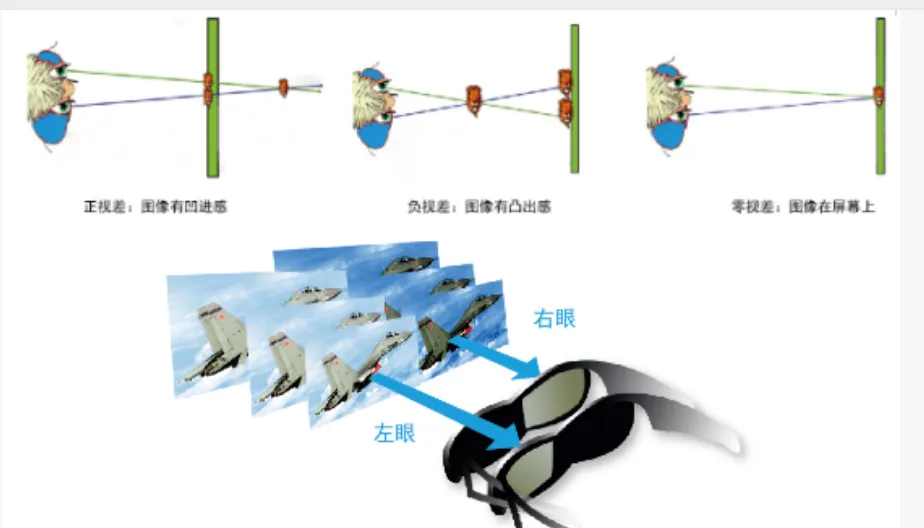
Added “Eye Tracking Synchronization”: Through eye tracking, the field of view of the 3D screen is adjusted in real time to avoid “eye fatigue”;
3D signal source expansion:
Supports dual-source input of “3D real-scene shooting ,such as aircraft test flight video + AI-generated 3D ,such as virtual fault scene” to meet different needs of teaching and scientific research. Main Parameters of Display System
Computer and Network System
| No. | Item | Parameters |
|---|---|---|
| 1 | Monocular Frame Refresh Rate | 120Hz |
| 2 | Full-Screen Frame Refresh Rate | 240Hz |
| 3 | Monocular Refresh Frequency | 7680Hz |
| 4 | 3D Technology | Active Shutter + Polarized Dual Mode |
| 5 | Synchronization Technology | Standard Wi-Fi 6E (Delay < 2ms) |
| 6 | Visual Features | Eye Tracking + Infrared Charging Glasses |
| 7 | Effective 3D Distance | 1.5-15m |
| 8 | 3D Viewing Angle Range | H:170°; V:170° |
| 9 | Color Gamut | 99% DCI-P3 |
| 10 | HDR Support | HDR10+ |
Graphics Workstation
- Model:CPU: Intel Xeon W-3495 (36 cores, 72 threads);
- Graphics card: NVIDIA RTX A6000 (48GB GDDR6);
- Memory: 128GB DDR5-5600;
- Hard drive: 2TB NVMe SSD + 8TB HDD; Synchronization card: NVIDIA Quadro Sync III ;Supports simultaneous operation of 16 workstations;
- Operating System: Windows 11.
Advantages:
- A single workstation can smoothly render 8K 3D scenes;
- Multi-node collaborative rendering latency is <5ms.
- It can meet the real-time interaction requirements of complex aircraft models.
Position Tracking System
Core Equipment Upgrade
Tracking Camera:

Infrared resolution 2448×2048, frame rate 240fps, tracking accuracy 0.1mm, supports simultaneous tracking of 30 targets;
Interactive Handle: Added haptic feedback , 6 programmable buttons, 12h battery life;
Tracking Target: Lightweight, weight <5g, supports tracking of multiple parts such as head, hands, feet, and aircraft components;
Software:
Supports AI occlusion compensation; when the target is occluded, tracking is maintained through prediction algorithms to avoid interruption.
Camera Layout
Four ARTtrack6 cameras are distributed in the four corners of the demonstration area, expanding the coverage area to 10m×8m, ensuring no tracking blind spots in the “full cabin area + maintenance station”;
A new “bottom camera” has been added to solve the problem of obstruction when “looking down to operate parts” ,such as hand tracking when disassembling or assembling landing gear.
Audio System

Sound Effect Optimization
| No. | Equipment Name | Parameters |
|---|---|---|
| 1 | Full-range Speaker | Frequency response: 50Hz-20kHz, Sensitivity: 98dB, Power: 1500W |
| 2 | Power Amplifier | 1500W@4Ω, Efficiency: 92% |
| 3 | Audio Mixer | 32-channel input, supports Bluetooth 5.3, built-in effects processor |
| 4 | Equalizer | Signal-to-noise ratio > 100dB, Frequency band: 20Hz-20kHz |
| 5 | Wired Microphone | With switch, stronger anti-interference |
| 6 | Wireless Microphone | UHF band, Transmission distance: 100m, Anti-interference (similarly) |
Added “3D Spatial Sound Effect”:
Constructs a “cabin surround sound field” through 8 speakers. It can restore engine noise, landing gear retraction and extension sounds, radio communication sounds, etc., enhancing immersion;
Supports “Sound Effect Scene Presets”: such as “Maintenance Scene” , “Review Scene”
Graphical Management Software

Core Function Additions and Optimizations
AI-Driven Model Lightweighting:
Automatically identifies key details of complex models ,such as engine blades, simplifies non-critical structures, reduces model size by 70% while maintaining accuracy, and loads in <30s;
Digital Twin Data Integration:
Supports integration with real-time aircraft operating data ,such as fuel consumption and engine speed, synchronously displaying the real state in the virtual model to meet scientific research verification needs;
Multi-CAD Software Compatibility:
Adds support for the latest versions of SolidWorks 2025, CATIA V6R2025, and UG NX 2312, retaining the design tree and parameter association;
Virtual Maintenance Assessment System:

Built-in CCAR-145 maintenance standard question bank, automatically scores and generates assessment reports;
Cloud Collaboration:
Supports remote teams accessing via browser to jointly review models, with latency <100ms (based on 5G/edge computing).
Collaborative Display System
Virtual Reality Headset: 2448×2448 resolution per eye, 120Hz refresh rate, supports eye tracking (0.5° accuracy), facial tracking, 2.5h battery life;
Tracker:
35g weight, can be attached to aircraft parts (such as engine models) to achieve precise alignment of “virtual parts and real gestures”;
Collaborative Software:
Supports simultaneous collaboration of 4 people, can share 3D model annotations, record the collaborative process, and export MP4 format review videos.
UPS Power Supply
Model:
Three inputs and three outputs, 96% efficiency, supports hot-swapping;
Battery:
12V-100AH LiFePO4 lithium battery, 10-year lifespan, supports intelligent charge and discharge management;
Backup Time:
1 hour at full load, meeting the requirements for data saving and normal system shutdown during power outages;
Intelligent Functions:
Supports remote monitoring and automatic battery health detection.
System Application Modes
Ultra-High-Definition Immersive Interactive Display and Presentation
Users enter a “virtual field/cabin” through a helmet, and eye tracking enables “focusing on the gaze to view details” . Haptic handles allow users to “touch” aircraft components and experience their texture.
The LED screen simultaneously displays a “third-person global perspective,” and viewers can switch to “any user’s first-person perspective” via a tablet terminal, significantly enhancing interactivity.
Intelligent Review of Digital Twin Prototypes
After importing the latest aircraft design model, AI automatically generates a “review checklist” .
Multi-team remote collaboration:
The design team accesses the cloud and collaborates with faculty and students on campus to annotate “wing skin thickness optimization suggestions,” with the annotations synchronized to all terminals in real time.
High-Fidelity Virtual Assembly and Maintenance Training
Simulates aircraft engine fault repair:
The entire process from “power off – disassembling the fairing – checking sensors – replacing components – power-on testing” is implemented. Voice prompts are triggered when errors occur .
A “Maintenance Capability Report” is generated after the training, including operation time, step accuracy rate, and key error points, and is integrated with the civil aviation maintenance skills certification system.
Flexible Body Multiphysics Coupling Simulation
Simulates the deformation of aircraft cables under “high altitude, low temperature (-50℃) + airflow impact” conditions:
Cable bending angle and tension are calculated in real time, and “whether the cable touches high-temperature components” is visualized, providing a basis for wiring design.
Cross-Terminal Collaborative Presentation and Reporting
Four teachers and students collaboratively complete “Aircraft Landing Gear Assembly”:
1 person is responsible for installing the bracket, 2 people are responsible for connecting the hydraulic lines, and 1 person is responsible for testing;
The “Global Assembly Progress” is displayed on an LED screen, and viewers can zoom in on “hydraulic joint installation details” on a tablet. Teachers can pause and mark “Incorrect Installation Sequence” on their end.
Open Application Development
Integration with the Civil Aviation Administration’s “Smart Training Cloud Platform”:
Training data completed by students in the virtual system is automatically synchronized to the cloud platform and used as a basis for credit recognition;
Development of an “Unmanned Aerial Vehicle (UAV) Airport Inspection” extension module:
Access to UAV simulation models via API interface to achieve integrated training of “virtual UAV + real LED scene”.
Graphic Design Rendering

Interior Design Requirements.
Environmental Conditions
Temperature: 18-25℃, automatically regulated by a temperature control system; Humidity: 40-60% RH, non-condensing; Cleanliness
Air quality: ISO Class 8, ≥0.5μm particles ≤100,000 per cubic meter, equipped with an air purifier;
Equipment adaptation period: 72 hours before installation to shorten the construction cycle. 6.2 Ground requirements:
Load capacity: ≥300kg/㎡, suitable for heavy equipment such as workstations and UPS battery cabinets;
Anti-static floor: thickness ≥30mm, resistance value 10^6-10^9Ω, with a “25G fiber optic + gigabit network cable” cable tray laid under the floor for easy maintenance.
Lighting requirements:
- Use “zone-dimmable LED lights”: brightness ≤50lux in the experience area (to avoid affecting the 3D effect), brightness ≥300lux in the operation area;
- Windows are equipped with “electric blackout curtains + anti-glare film”, response time <10s. 6.4 Power Supply and Wiring
- Power Supply: 380V/220V dual circuit, total peak power consumption approximately 8kW;
- Cable Spacing: Power and low voltage cable spacing ≥80cm to avoid interference;
- Signal Cables: Fiber optic cables to ensure lossless 8K signals.
Equipment Heat Generation and Cooling
Heat Generation Calculation:
According to the formula “Heat Generation (BTU) = Equipment Power (Watt) × 3.41”, the total heat generation is approximately 27500 BTU;
Cooling: Utilizes “ducted air conditioning + localized air cooling”, avoiding direct airflow to the LED screen, and automatically adjusting airflow through temperature control.
Project Budget List:
| No. | Product & Service Description | Model/Configuration | Quantity | Unit Price (¥) | Subtotal (¥) |
|---|---|---|---|---|---|
| I. Computer System | |||||
| 1 | Graphics Workstation System | Xeon W-3495, RTX A6000, 128GB DDR5, 2TB NVMe + 8TB HDD (with NVIDIA Quadro Sync III) | 10 | ||
| II. LED Display System | |||||
| 2 | LED Display Screen | P0.9375 (7.2m×2.7m, 20㎡, 7680×2880) | 1 | ||
| 3 | Active Stereo Glass | 40 | |||
| 4 | Active Stereo Emitter | 10 | |||
| III. Sound System | |||||
| 5 | Full-range Speaker | 4 | |||
| 6 | Power Amplifier | 2 | |||
| 7 | Audio Mixer | 1 | |||
| 8 | Equalizer | 1 | |||
| 9 | Wired Microphone | 4 | |||
| 10 | Wireless Microphone | 2 | |||
| 11 | Cable Accessories | 1 | |||
| IV. Graphics Management Software | |||||
| 12 | MakeReal3D VSP 6.0 | 1 | |||
| V. Interaction System | |||||
| 13 | Tracking Camera | 4 | |||
| 14 | ATC Controller + DTrack4.0 Software | 1 | |||
| 15 | Interaction Handle | 1 | |||
| 16 | Passive Tracking Target | 1 | |||
| 17 | Warranty & Accessories | 3-year warranty, installation accessories | 1 | ||
| VI. Collaborative Display System | |||||
| 18 | Virtual Reality Glass | 4 | |||
| 19 | Collaborative Workstation | i9-14900K, RTX 4090, 64GB DDR5, 2TB NVMe | 4 | ||
| VII. UPS Power Supply | |||||
| 20 | Including 12V-100AH LiFePO4 Battery (16 units), Battery Cabinet, Connecting Cables | 1 | |||
| VIII. Content Development Part | |||||
| 21 | Customized Development of Circumferential Inspection + Virtual Disassembly + Flexible Wiring | 1 | |||
| 22 | Simulated Flight Application Stereo Display Supporting 8K Signal Output | 1 | |||
| 23 | Model Stereo Display Model Lightweighting + Interaction Development | 1 | |||
| Total Project Price | |||||