 All-in-One COB LED TV
  Flexible LED Displays
  Transparent LED Displays
  Led Poster
  Circular LED Displays
  Creative & Custom LED Displays
 As LED display development, ultra-long and ultra-tall LED screens have become increasingly common across government halls, commercial entrances, queue-management systems, and retail environments.
These LED display often require point-to-point playback of text, images, or video without distortion. However, traditional control systems struggle to achieve it. Today, Doitvision will guide you a complete solution cases.
Application Background
With industry development, ultra-long full-color strip LED screens are gradually replacing traditional monochrome message boards. These full-color strip displays usually have extremely long width, it is far beyond the maximum resolution supported by a standard computer monitor and limited height. Their main function is to display long scrolling text.
However, conventional control systems face several problems:
- Computer monitors cannot output resolutions wide enough for ultra-long displays.
- Traditional methods require multiple sending cards combined with a splicer, resulting in stretched and distorted images.
- Splicing equipment significantly increases cost and still fails to meet end-user expectations.
To address these issues, Doitvision provides an optimized solution. They are perfect point-to-point display of text, images, and video on ultra-long or ultra-tall screens. The method is simple, cost-effective, and widely applicable to full-color strip LED displays, queue-calling screens, ultra-tall showcase screens, and more.
Case Study: Ultra-Long LED Screen Project

Using the example shown, the project faced several challenges:
- The screen is extremely long, exceeding the loading capacity of standard sending devices.
- Traditional splicing solutions are expensive. It offers low effective visual area, and cause poor image quality due to scaling.
- Content limitations: Only text or very simple content can be displayed, the images and video become unusable.

Technical Breakdown of the Ultra-Long Screen Case
In this project, the longest government service center screen measures 6400 × 128 pixel. It is made of P4 256×128 indoor modules.
To solve this, the screen is handled using the sending card’s horizontal folding feature:
Computer resolution available:
1920 × 1080
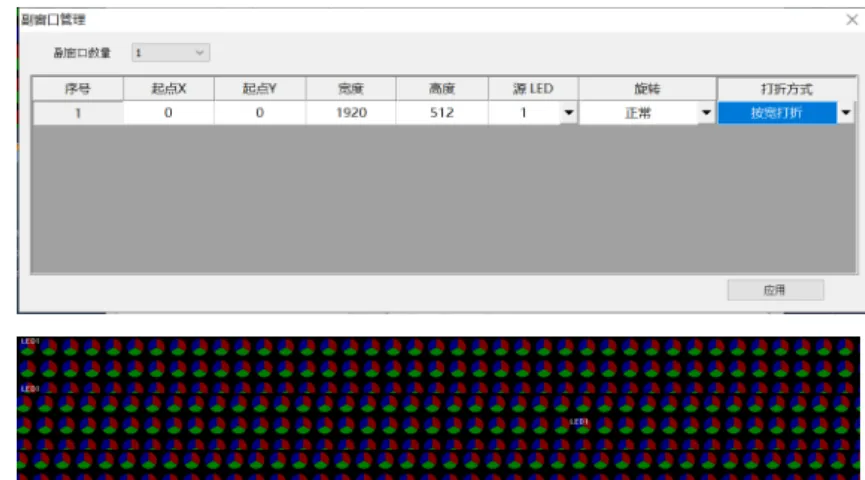
6400 ÷ 1920 ≈ 3.333 → use 4 folds
When width is reduced, height increases proportionally:
→ Height becomes 128 × 4 = 512
After configuration, the desktop mapping appears as shown in the referenced diagram.
Technical Advantages of Ultra-Long or Ultra-Tall LED display Screen Solution
- Massive loading capacity: up to 16384 pixels in width in synchronous mode.
- Simple and reliable: no need for complex splicing equipment.
- Display-type flexibility: supports both full-color and dual-color screens.
- Content-type flexibility: supports text, images, and video playback.
- Real-time point-to-point display: no delay, no distortion.
- Low cost with excellent results.
Sub-Window Folding (Horizontal / Vertical Folding) Overview

In the example shown, the main window resolution is 1024 × 192.
When performing 2-fold horizontal scaling:
Width is halved
Height is doubled
Sub-window size becomes 512 × 384
Folding method set to “Horizontal Folding”
Applicable scenarios:
Point-to-point display is required on ultra-long or ultra-tall screens.
Ultra-tall screen configuration follows the same principle as ultra-long screens.
Features of Full-Color LED Entrance or Storefront Screens
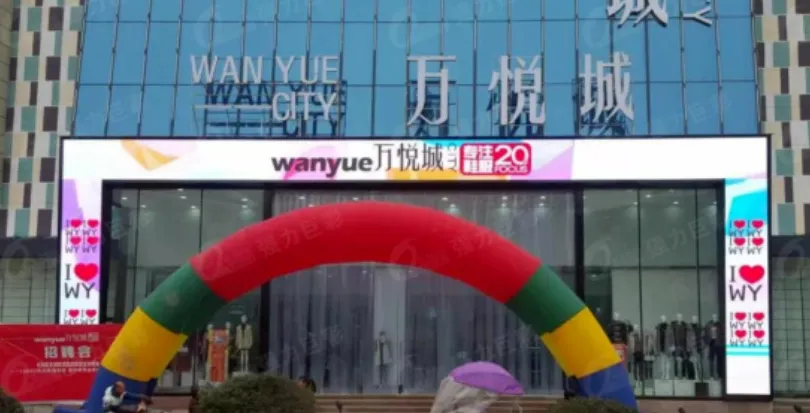

With economic development, storefront LED displays are now widely used. Compared with traditional monochrome single-line signs, full-color LED screens are now the mainstream because:
- Viewing distance is short
- requires small pixel pitch
- High refresh rate and grayscale are necessary
- Some customers require unique shapes or unconventional structures
Therefore, storefront screens may appear simple but often have hidden complexities.

Storefront Full-Color Screen
Synchronous Control Topology

(Topology diagram referred to in the source text.)
- Storefront Full-Color Screen
- Asynchronous Control Topology
- Operates without a computer
- Multiple publishing options
- Simple and convenient operation
Storefront Screen Solution
Since the total pixel count is 4264, exceeding the 4096-pixel width limit of the X3 controller, folding is required.
The screen is divided into 3 parts:
- Line 3 carries 11 modules in width
- Lines 1 & 2 carry 15 modules each
- Desktop mapping is set to 4680 pixels (45 modules)
During content publishing, the program window is shifted 4 modules to the right
Queue-Calling System Display Project Features

With rapid economic development, long queues in service halls have become rare:
- Point-to-point display
- No distortion
- Very long width and very low height
Two Methods to Implement Queue-Calling Screens
Method 1:
- Customer has no queue-calling software
- Data is retrieved directly via the control software.
Method 2 :
Customer already has queue-calling software- The sending card captures the desktop content from the PC running the queue software.
- (Requires configuration of receiving-card loading and capture position.)
Supported Data Types for Queue-Calling Systems
1. Database Types
- Oracle
- Access
- MySQL
- ODBC
- SQL Server
2. Text Types
- TXT
- RTF
Example: Desktop Capture for Queue-Calling Screen
Project Overview

Outdoor P3
- Total screen resolution: 15360 × 128
- Hardware: 32 × 5A-75B receiving cards + 1 × X4S
- Each network port loads 3840 × 128; four ports are used.
Implementation
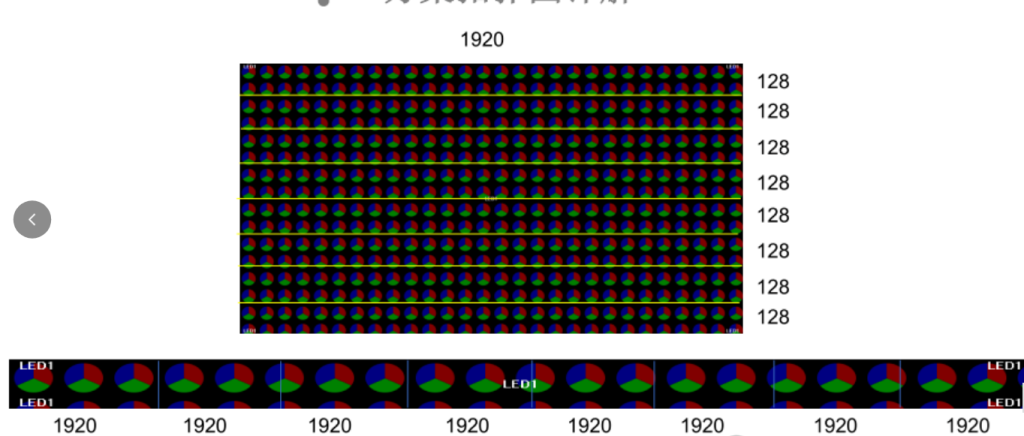
The 15360 × 128 screen is divided into 8 segments. each usses 4 receiving cards and 4-fold scaling.
Each segment corresponds to a 1920 × 128 area on the PC desktop.
Software Configuration

Connection diagram configured as 8 rows × 4 columns
The rightmost receiving card uses 3-fold scaling

Desktop capture software maps each window to its corresponding display area
Conclusion
Ultra-long and ultra-tall LED display screens have unique challenges due to extreme aspect ratios and high pixel widths. Traditional splicing methods are costly. In addition, it often lead to distorted or stretched images. With Doitvision’s sub-window folding technology, these LED screens can achieve real point-to-point, distortion-free playback at significantly lower cost.
Our solution is simple, stable. They are suitable for storefront screens, queue-calling systems, government service centers, and many other ultra-wide or ultra-tall display scenarios. If you are interested, please feel free to contact us.