 All-in-One COB LED TV
  Flexible LED Displays
  Transparent LED Displays
  Led Poster
  Circular LED Displays
  Creative & Custom LED Displays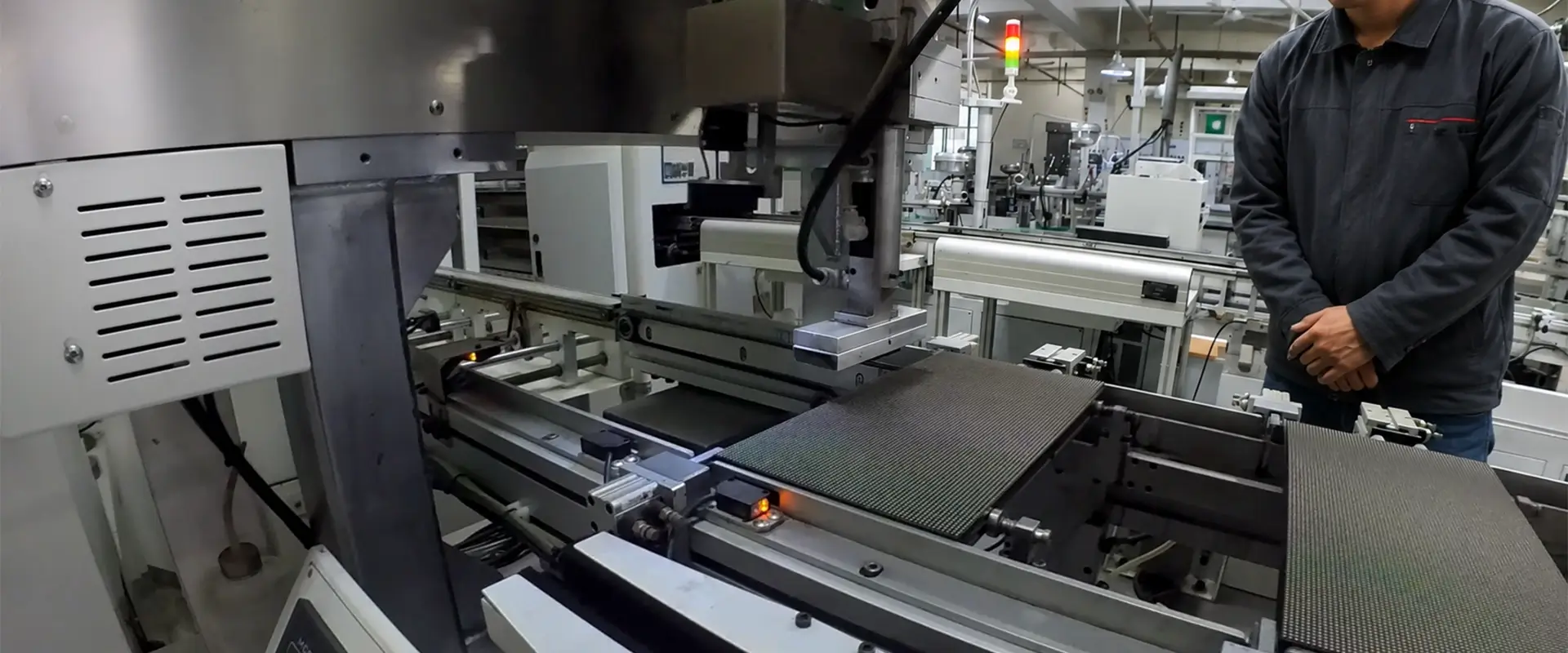
YOUR DISPLAY,
OUR CONTROLLED PROCESS.
From material inspection to 48-hour burn-in — every step is managed by our engineering team. We tell you exactly who does what, and how we make sure it’s done right.
You don’t need the biggest factory. You need a process you can trust.
An LED display is only as good as the production process behind it. The question isn’t “how big is your factory” — it’s “who controls each step, and how do you prove it?” We answer both questions on this page. Transparently. Some steps happen at certified partner facilities — because the right equipment at the right specialist matters more than owning everything under one roof. What we own is the quality outcome.
We tell you who does what.
SMT, potting, and screw assembly at certified partners. Material control, module assembly, aging, and QC in our 2,000m² facility. Full transparency — no hiding behind vague “in-house production” claims.
QC isn’t a department — it’s three gates.
IQC checks every incoming batch. IPQC samples every 2 hours during assembly. OQC runs a full-panel pixel test before crating. Nothing ships without passing all three.
Every panel burns in before it leaves.
48-hour mandatory aging test. 72 hours for outdoor and rental. This single step separates real manufacturers from trading companies — you can’t fake a burn-in log.
You can watch it happen. Live.
Book a 15-minute video walkthrough of our QC floor. See the aging racks, the inspection stations, the packing area — in real time, no staging. That’s how we build trust.
EIGHT STEPS. EVERY ONE CONTROLLED.
From component sourcing to final inspection — here is exactly how your LED display comes together, who executes each step, and how we verify quality at every handoff.
| Production Stage | Executed By | How We Control Quality |
|---|---|---|
| 01Material Procurement | In-House | Brand-specified LED chips, driver ICs, and power supplies only. Every component batch traceable to manufacturer lot number. No unbranded substitution — ever. |
| 02SMT Placement | Certified Partner | Three certified SMT partners, each for specific product lines — mainstream indoor, outdoor (specialist potting line), and custom-shaped PCB. Our engineer is stationed on-site for QC. Every batch returns with an inspection report. |
| 03Potting & Sealing | Certified Partner | Outdoor modules go through a dedicated potting line with IP65/IP68-grade encapsulation. Batch test reports — including waterproof and thermal cycling data — accompany every delivery to our facility. |
| 04Screw Assembly | Certified Partner | Precision screw fastening for module-to-frame assembly. Torque specifications per product type. Incoming inspection verifies mechanical integrity before modules enter our assembly line. |
| 05Module Assembly | In-House | 2,000m² assembly floor in Tangxiawi Industrial Zone, Guangming, Shenzhen. IPQC sampling every 2 hours during production — checking LED alignment, solder joints, and color consistency under calibrated lighting. |
| 06Cabinet Integration | In-House | Modules mounted into cabinets, power supplies and receiving cards installed, internal wiring routed and secured. Full inspection on every cabinet — no sampling at this stage. Cabinet flatness, connector alignment, and grounding all verified. |
| 07Aging Test | In-House | 48-hour minimum burn-in on every panel. 72 hours for outdoor and rental. Real-time monitoring logs temperature, current draw, and pixel anomalies. Panels run through color cycles, gradients, and full-white stress patterns. Any dead pixel or flicker = rework, not ship. |
| 08OQC Final Inspection | In-House | Per-panel pixel-by-pixel test using calibrated cameras. Brightness uniformity measured across the full surface. Color temperature verified against spec. Connectors, cabling, and packaging all checked. Only then does a panel get crated for shipment. |
Three Gates. No Exceptions.
Most manufacturers talk about “rigorous quality control.” We can show you the checklist. Here’s what happens at each gate — and what gets rejected.
IQC
Incoming Quality Control. Before a single component enters our assembly line, it passes inspection. LED chips checked for bin consistency. Driver ICs tested on sample boards. PCB substrates verified for thickness and copper weight. Power supplies load-tested. Batch that fails? Returned to supplier — no exceptions.
IPQC
In-Process Quality Control. Every 2 hours during a production run, our QC engineer pulls samples off the line. LED alignment checked under a microscope. Solder joint integrity verified. Color consistency measured with a spectrometer. If a sample fails, production pauses until the root cause is found and fixed.
OQC
Outgoing Quality Control. Every finished panel — not a sample, every single one — goes through a calibrated camera pixel test. Brightness uniformity mapped across the full surface. Dead pixels, flicker, color shift — all flagged automatically. A panel with a single dead pixel in the central zone gets reworked. No exceptions.
48 Hours of Proof Before It Ships.
Before any panel leaves our facility, it runs on our aging racks for a minimum of 48 continuous hours. Outdoor and rental panels get 72. We log temperature, current draw, and pixel status in real time. If a pixel fails during burn-in — which does happen, and that’s exactly the point — it gets reworked before it ever reaches you.
This isn’t a marketing claim. It’s the single most reliable way to tell a manufacturer from a middleman. Trading companies don’t have aging racks. We do.

- 0148 hoursStandard for indoor fine pitch & rental panels
- 0272 hoursFor outdoor and high-IP rated panels
- 03Real-time monitoringTemperature & current draw logged continuously
- 04Stress patternsFull-white, color cycling, gradient tests
- 05Auto-detectionCamera array catches every pixel anomaly
- 06Per-panel loggingEvery panel individually tracked — not batch sampling
Certifications You Can Rely On.
CE
European conformity — mandatory for EU market access. Covers EMC and LVD directives.
EMC
Electromagnetic Compatibility Certification.
RoHS
Restriction of Hazardous Substances — lead-free, mercury-free, compliant for global distribution.
CB
IECEE CB Scheme — internationally recognized safety certification. Accepted in 50+ member countries.
Book a 15-Minute Video Walkthrough of Our QC Floor.
No polished marketing video. No staging. We’ll walk you through our assembly line, aging racks, and QC stations — live, via WhatsApp video. You ask questions, our engineer points the camera at whatever you want to see. It’s the closest thing to an on-site visit without leaving your desk.
- ✓ Assembly floor — see modules being built in real time
- ✓ Aging racks — watch panels under burn-in right now
- ✓ QC stations — pixel tests, brightness mapping, inspection tools
- ✓ Packaging area — how your order gets crated for shipping
What Buyers Ask About Our Process.
We do both — and we’re transparent about it. SMT placement, potting, and screw assembly are handled by three certified partner facilities, each specialized for specific product lines (mainstream indoor, outdoor with potting, and custom-shaped PCB). Material procurement, module assembly, cabinet integration, aging test, and QC are all done in our 2,000m² facility in Tangxiawi Industrial Zone, Guangming, Shenzhen. The key point: our engineers oversee quality at every stage, regardless of where the step is executed.
Three layers of control. First, our SMT partners are long-term certified facilities — we don’t shop around for the cheapest bid. Second, our engineer is stationed on-site during production runs for real-time QC. Third, every batch that arrives at our facility goes through IQC — incoming quality control — before it touches our assembly line. Batch inspection reports accompany every delivery. If a batch fails, it’s returned. Period.
We currently have no minimum order quantity — whether you need a single panel for evaluation or a full video wall for a stadium, we’ll work with you. Standard lead time is 15–25 days from order confirmation. Custom and complex projects typically take 4–6 weeks after design approval. Rush production is available for time-critical projects — contact us with your deadline.
A trading company buys finished panels from a factory, adds a margin, and ships them to you. They have no control over quality, no aging racks, no QC engineers, and no ability to fix problems at the source. We have a 2,000m² assembly and QC facility where every panel goes through three QC gates and 48–72 hours of burn-in before shipping. You can video-call us right now and we’ll show you the aging racks with panels running on them. A trading company can’t do that.
Every single panel — not a sample batch — goes through a minimum 48-hour continuous burn-in. Outdoor and rental panels get 72 hours. During aging, panels cycle through full-white stress, color gradients, and pattern tests. Temperature, current draw, and pixel status are logged in real time. Any panel showing a dead pixel or anomaly gets reworked and re-tested before it can ship. This is non-negotiable.
Yes — both. If you’re in Shenzhen, we welcome on-site visits to our facility at Tangxiawi Industrial Zone, Ma Tian Street, Guangming, Shenzhen. If you’re overseas, book a 15-minute live video walkthrough via WhatsApp. Our engineer will take you through the assembly floor, aging racks, QC stations, and packaging area in real time — no staging, no polished marketing video. Just the real production environment.
Yes. We support full OEM/ODM with renamed spec sheets, white-label datasheets, OEM-branded packaging, and OEM serial numbers. Your end client does not need to know our identity. Custom mechanical design, PCB shape modifications, and bespoke cabinet configurations are all within our capability — this is what our 15-person engineering team does on a daily basis.
Standard warranty is 2 years with options to extend to 3–5 years depending on the product line and project scale. After-sales includes remote troubleshooting via WhatsApp (same-day response), spare parts dispatch within 48 hours for critical failures, and on-site engineer support for large-scale installations. Every shipment includes configuration files, calibration data, and a spares kit with commonly replaced components.