 All-in-One COB LED TV
  Flexible LED Displays
  Transparent LED Displays
  Led Poster
  Circular LED Displays
  Creative & Custom LED Displays
 Purchase prices for all three sizes (108″, 135″, 163″), a five-year total cost of ownership comparison against 4×55″ LCD video walls and 10,000-lumen laser projectors, and every cost a quote might leave out. Written by the factory that builds them.

Blogs
Updated August 26, 2026
Purchase prices for all three sizes (108″, 135″, 163″), a five-year total cost of ownership comparison against 4×55″ LCD video walls and 10,000-lumen laser projectors, and every cost a quote might leave out. Written by the factory that builds them. Key Takeaways Factory-direct pricing ranges from $8,700 (108″ P1.25) to $26,400 (163″ P0.93 4K). The
DV
DOIT VISION Engineering Team
15 core engineers · Shenzhen, China Last reviewed:
August 26, 2026
Purchase prices for all three sizes (108″, 135″, 163″), a five-year total cost of ownership comparison against 4×55″ LCD video walls and 10,000-lumen laser projectors, and every cost a quote might leave out. Written by the factory that builds them.
Three variables determine the price of an All-in-One LED TV: screen size, pixel pitch, and optional add-ons. Below are factory-direct (EXW Shenzhen) prices for every standard configuration. All prices include the display, built-in Android 13 system, speakers, wall-mount bracket, and wooden crate export packaging. The mobile stand and flight case are optional add-ons.
| Configuration | Resolution | Price Range (USD, EXW) | Best For |
|---|---|---|---|
| 108″ P1.25 | 1920×1080 (2K) | $8,700–$9,000 | Executive boardroom (6–10 seats) |
| 135″ P1.56 | 1920×1080 (2K) | $11,000–$11,400 | Most popular — standard conference (12–25 seats) |
| 135″ P1.25 | 2400×1350 | On request | Conference rooms needing sharper text |
| 163″ P1.56 | 1920×1080 (2K) | $15,200–$15,800 | Large training room, budget-conscious |
| 163″ P0.93 | 3840×2160 (4K) | $25,500–$26,400 | Flagship auditorium, lecture hall |
All prices are per-unit EXW Shenzhen. Prices include display, built-in Android 13 system (4GB/32GB on 2K, 8GB/64GB on 4K), built-in speakers, wall-mount bracket, and wooden crate packaging. Mobile stand and flight case are optional; shipping, customs duties, and local installation are additional.
EXW (Ex Works) means the price at our factory gate. You are responsible for freight, insurance, customs clearance, and delivery to your site. Add approximately 8–18% on top of the unit price for international shipping and import duties depending on your destination. If you’re comparing quotes from different suppliers, confirm the Incoterm — a CIF price that includes freight will look higher than an EXW price that doesn’t, even when the unit itself is cheaper.
The price gap between the 163″ P0.93 (4K) and the 163″ P1.56 (2K) is roughly 60%. For most corporate conference rooms, the visual difference between 2K and 4K at standard viewing distances (2–5 meters) is negligible — but the cost difference is real. Put the savings from choosing P1.56 over P0.93 into room acoustics, lighting, or furniture — those upgrades will have more impact on meeting quality than the extra pixel density.
Purchase price is only chapter one. A meeting room display runs 2,000–3,000 hours per year. Over five years, consumables, energy, and maintenance compound — and that’s where the three technologies diverge.
The comparison below uses a 135″ P1.56 All-in-One LED TV (~$11,200 mid-range) versus a 2×2 55″ LCD video wall (110″ equivalent, ~$10,000 panels + $1,000 controller + $500 mount) versus a 10,000-lumen laser projector (~$12,000 mid-range). Energy costs are calculated at the US commercial average of $0.12/kWh. Usage: 8 hours/day, 250 operating days/year.

| Cost Factor | 135″ All-in-One LED TV | 4×55″ LCD Video Wall | 10K-Lumen Laser Projector |
|---|---|---|---|
| Initial Purchase | ~$11,200 | ~$11,500 | ~$12,000 |
| Installation | $0–$800 | $500–$1,500 | $500–$1,200 |
| 5-Year Energy (@ $0.12/kWh) | ~$1,740 | ~$1,200 | ~$960 |
| Consumables / Lamps | $0 | $0 | $1,500–$4,000 |
| 5-Year Maintenance | $0–$300 | $200–$1,000 | $400–$800 |
| 5-Year TCO | ~$12,940–$14,040 | ~$13,400–$15,200 | ~$15,360–$18,960 |
At factory-direct pricing, the All-in-One LED TV’s 5-year TCO is actually the lowest of the three — lower than both the LCD wall and the projector. The LCD wall appears cheapest in upfront spend — but it has visible bezel gaps between the four panels, and its brightness degrades unevenly: after 3–4 years, the four panels drift apart in color, creating a visibly patchwork image. The projector’s real cost is in its lamps: at 8 hours daily use, a laser projector requires 1–2 lamp replacements per year ($300–$800 each). Over 5 years those lamps add $1,500–$4,000 — enough to erase the projector’s price advantage entirely. The All-in-One LED TV has zero consumables, zero lamps, and zero scheduled replacements. You pay once, and it’s still bright, still uniform, and still maintenance-free at year 5.
Tell us your room dimensions and daily usage hours. We’ll send you a line-item TCO comparison — All-in-One LED TV vs LCD Wall vs Projector — customized to your scenario.
Every DOIT VISION All-in-One LED TV ships as a complete, ready-to-use system. When you see a price in the table above, here’s exactly what that number covers.
Unbox the display. Mount it or roll it into position. Plug in one power cable. Turn it on. Content starts — from WiFi screen mirroring, USB, HDMI, or the built-in Android system. There is no external video processor, no sending card to configure, no signal distribution hardware to install. The “all-in-one” isn’t marketing — it’s the absence of everything a traditional LED wall needs that this display doesn’t.
Every All-in-One LED TV quote should make four additional cost categories explicit. A supplier who doesn’t mention these isn’t doing you a favor — they’re hoping you won’t ask until after you’ve paid the deposit.
Sea freight from Shenzhen to a US West Coast port: approximately $800–$1,200 per unit (LCL, 25–35 days). To East Coast: $1,200–$1,800. To EU ports: $1,000–$1,800. To Middle East/SEA: $600–$1,200. Air freight: $1,500–$2,500 per unit (5–7 days). The flight case is included in the unit price — you’re paying only for the freight. If you have an existing freight forwarder, we coordinate pickup at our Shenzhen facility.
US customs duties on LED display equipment are typically 0–2.5% under HTS 8528.59. EU imports: generally 0% duty on LED displays, but VAT (19–25%) applies at entry and is your responsibility as the importer. Always confirm the tariff classification with your customs broker before ordering — duty rates change and vary by country.
The wall bracket is included. The labor to mount it is not. Wall-mount installation requires 2–3 hours by a local AV team or contractor. The 108″ unit weighs ~80 kg, the 135″ ~156 kg, the 163″ ~188 kg. Two people minimum for wall mounting. We supply a printed mounting template and video guide for the installation team. Mobile stand setup is tool-free and free — one person, 30 minutes, no cost.
The wooden crate export packaging is included. Two optional upgrades: a mobile stand (≈$386–$482) for rooms where the display needs to move, and a flight case (≈$868) for rental and touring use where the display travels repeatedly. Both ship factory-installed if ordered with the unit.
Some suppliers — particularly on B2B marketplaces — quote display-only prices that exclude the Android system, bracket, stand, and crate. A 135″ P1.56 “display only” at $9,500 looks cheaper than our $11,000–$11,400 — until you add back the missing components. Always ask: “What’s included in this price?” If the answer is vague, ask for a line-item breakdown. A five-minute verification saves a four-figure surprise.
Single-unit buyers pay the standard price. For organizations outfitting multiple conference rooms, the economics improve at every tier.
You pay the standard factory-direct price as shown in the table above. This is the baseline for a single meeting room upgrade. Lead time: 10–15 working days for standard configurations.
Orders of 3 or more units trigger batch procurement pricing. Components are ordered in volume, production is batched, and testing is streamlined. Typical discount: 5–10% off the single-unit price. Common scenario: a company upgrading three conference rooms simultaneously — a main boardroom (135″), a medium conference room (108″), and a training room (135″).
Multi-room corporate deployments or multi-location rollouts. Dedicated production runs, optimized material flow, and negotiated component contracts bring per-unit costs down further. Contact us for a tailored volume quotation — pricing depends on the mix of sizes, pixel pitches, and any customization (corporate branding on the frame, custom packaging, white-label documentation).
Not all costs appear on the first quote. These four pitfalls surface after the order is placed — and by then, changing suppliers is expensive. Ask about each one before you commit.
Some suppliers quote a bare LED panel — no Android system, no bracket, no stand, no flight case. The price looks competitive until you discover that the Android module costs $800–$1,500 separately, the bracket another $300–$500, and the flight case $600–$900. Verify what’s included at the quoting stage. A complete All-in-One LED TV has eight components (listed in Section 03). If fewer than eight are itemized, something is missing.
A proper flight case adds $400–$800 to manufacturing cost. Some suppliers skip it to hit a lower quoted price — then ship the display in a cardboard box with foam inserts. The display arrives with impact damage, dead pixels from vibration, or a bent frame. Freight damage is the single most common cause of project delay in international LED display shipments. Insist on a custom-molded flight case. If the supplier can’t provide one, they don’t ship internationally regularly — and you’re about to pay for their learning curve.
When an LED module fails two years into operation, you need a replacement — fast. Suppliers without international service infrastructure may dispatch a replacement, but the process takes weeks, involves customs paperwork, and leaves your meeting room dark. Ask about the replacement module dispatch process before ordering. We ship replacement modules within 48 hours of fault confirmation during the warranty period, with pre-cleared customs documentation.
Some All-in-One LED TVs ship with a branded, locked-down Android build that prevents you from installing third-party apps. You’re stuck with whatever media player and screen mirroring app the supplier pre-installed — and you can’t add Zoom, Teams, or your company’s presentation software. Confirm the Android system is unlocked before ordering. Our units ship with standard Android 13 — install any app, connect any peripheral, use it like a standard Android device.
Return on investment for a meeting room display isn’t measured in direct revenue — it’s measured in time saved, frustration eliminated, and professional credibility gained. Here’s where the money comes back.
A room with a reliable, instantly-usable display gets booked more. A room where “the screen isn’t working” is a recurring calendar entry gets avoided. Corporate meeting rooms cost roughly $50–$200 per hour to operate (real estate, utilities, AV maintenance, support staff). If a reliable All-in-One LED TV increases room utilization by just 2 hours per week — because the display always works, no one fumbles with projector startup, no one waits for IT to troubleshoot a video wall controller — that’s $5,200–$20,800 per year in recovered room value. The display can pay for itself in recovered room utilization alone within 18–36 months.
A 10,000-lumen laser projector lamp replacement costs $300–$800 per cycle and is required every 2,000–4,000 hours. In a room used 8 hours daily, 250 days per year (2,000 hours), that’s 1 lamp replacement per year at minimum. Over 5 years: $1,500–$4,000 in lamp costs that the LED TV simply doesn’t have. Zero consumables. Zero scheduled replacements. Zero dimming.
Every “screen not working” ticket costs an IT department roughly $15–$50 in technician time (triage, walk to the room, diagnose, fix or escalate). In a company with 5 meeting rooms averaging 2 display-related tickets per room per month, that’s 120 tickets per year — $1,800–$6,000 annually in IT labor that could be redirected to productive work. An All-in-One LED TV eliminates the common failure points: no projector lamp to replace, no video wall controller to reboot, no signal distribution amplifier to troubleshoot. One device, one plug, one power switch.
When a client walks into your boardroom and sees a seamless, bright, 135-inch display — instead of a projector screen with visible washout or an LCD wall with bezel lines cutting through the presentation — that first impression has value. It signals competence, attention to detail, and investment in quality. For law firms, architectural practices, creative agencies, and financial services firms where client meetings drive revenue, the display is part of the pitch. Quantifying this is subjective — but if one additional client contract per year can be attributed to a stronger presentation environment, the display pays for itself on that deal alone.
Conservative scenario (135″ P1.56, ~$11,200): IT ticket reduction ($2,000/year) + lamp replacement elimination ($600/year) + 2 hours/week additional room utilization ($5,200/year) = $7,800/year in recovered value. Break-even: approximately 18 months. After that, every year of operation is net positive. Optimistic scenario (same display, higher room utilization): IT savings ($4,000/year) + lamp elimination ($600/year) + 5 hours/week room utilization ($13,000/year) = $17,600/year. Break-even: approximately 8 months. Your actual number depends on how often your meeting rooms are used and how much display-related downtime you experience today.
Tell us your room size, seat count, and preferred configuration. An engineer — not a sales rep — will reply with an EXW price and estimated freight within 24 hours.
Factory-direct pricing ranges from $8,700 (108" P1.25) to $26,400 (163" P0.93 4K). 135" P1.56 — the most popular configuration — costs $11,000–$11,400. All prices include the display, built-in Android 13 system, speakers, wall bracket, and wooden crate packaging. Mobile stand, flight case, shipping, and installation are additional.
For comparable sizes above 100 inches, yes. A 2×2 55" LCD video wall (110" equivalent) costs $8,000–$15,000 for the panels alone, plus a video wall controller ($500–$2,000), mounting frame ($300–$800), and professional installation ($500–$1,500). The All-in-One LED TV at $8,700–$9,000 (108") includes all of this in one unit, with no bezel gaps and higher brightness.
All-in-One LED TV TCO over 5 years is approximately $10,000–$30,000 depending on size. A laser projector system equivalent: $18,000–$35,000 (including 2–3 lamp replacements at $300–$800 each). An LCD video wall: $12,000–$25,000. The LED TV has the lowest maintenance cost — zero consumables, no lamp replacements, modular panel repair.
The wall bracket is included and the unit ships wall-mount ready. Wall-mount installation requires 2–3 hours by a local AV team ($300–$800). The optional mobile stand is tool-free to set up in under 30 minutes — one person, no cost.
Yes. Orders of 3+ units receive 5–10% discount. Multi-room corporate deployments (10+ units) receive volume pricing — contact us for a tailored quote.
Some suppliers quote display-only prices without the Android system, bracket, or stand. Verify what's included. Shipping ($800–$2,500) and customs duties are additional. Wall-mount installation requires a local contractor. Avoid suppliers that ship without a proper flight case — freight damage is the most common cause of project delays.
Break-even against a projector typically occurs within the first 18 months — often sooner. A 10,000-lumen laser projector costs $8,000–$15,000 upfront plus $300–$800 per lamp replacement every 2,000–4,000 hours. In a meeting room used 8 hours daily, that's 1–2 lamp replacements per year. The LED TV has zero consumables — the cost advantage compounds every year.
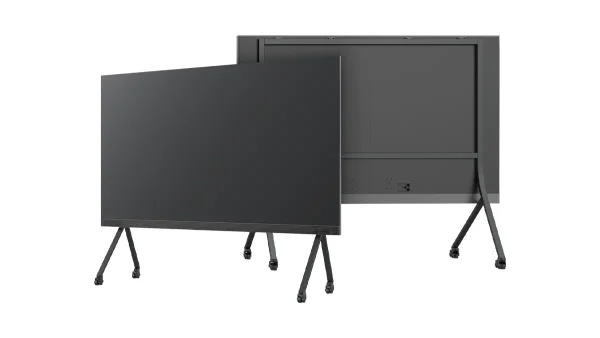
A fully integrated COB LED display system — screen, media player, Android OS, an...
View Specs