 All-in-One COB LED TV
  Flexible LED Displays
  Transparent LED Displays
  Led Poster
  Circular LED Displays
  Creative & Custom LED Displays
 In the packaging technology of LED display screens, you may have known SMD and DIP technologies. However, with the advancement of technology, a flip-chip COB packaging technology has been introduced. It is completely different from the traditional SMD packaging method. COB packaging can achieve smaller spacing LED screens, which is also called COB small pixel LED wall, but you may not understand what flip-chip technology is.
As an LED display manufacturer specializing in indoor small-pitch LED production, DOITVISION will guide you on what flip-chip COB technology is and how it differs from traditional packaging technology.
WHAT IS THE COB PACKAGING TECHNOLOGY?
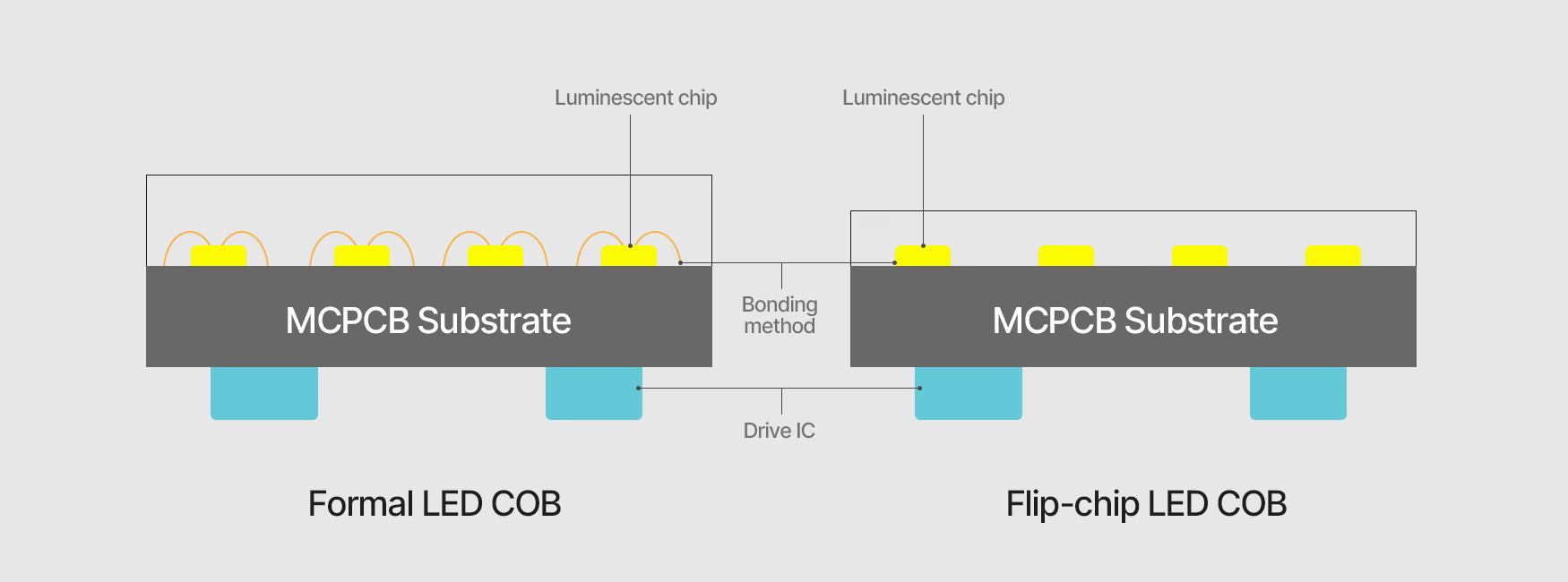
The full name of COB is CHIP ON BOARD, which refers to covering the placement point of the silicon wafer with thermally conductive epoxy resin on the surface of the substrate, then placing the silicon wafer directly on the surface of the substrate, heat treating until the silicon wafer is firmly fixed on the substrate, and then using the soldering method to establish an electrical connection directly between the silicon chip and the substrate.
There are two main forms of bare chip technology: COB technology and flip chip technology. In chip-on-board (COB) packaging, semiconductor chips are manually mounted on a printed circuit board. The electrical connection between the chip and the substrate is made by wire bonding and covered with resin to ensure reliability. Although COB is a simple bare-chip mounting technology, its packaging density is much lower than that of flip-chip soldering technology;
Therefore, the COB small-pitch LED display is a micro-pitch LED display composed of COB packaging, usually concentrated below P1.5. It can reduce the pitch of LEDs and improve the stability of the product by changing the packaging method. At present, small-pitch COB LED displays include: P1.5, P1.2 and P0.9.
WHAT IS THE COB FLIP-CHIP PACKAGING PROCESS?

Flip-chip refers to a chip-on-board packaging technology with a simpler structure. It packages the chip directly on the substrate, covers the silicon wafer with thermally conductive epoxy resin on the surface of the substrate, performs heat treatment, and uses wire welding to establish electrical connections.
Compared to face-up assembly, the flip-chip structure is simpler and more resistant to high temperatures. The manufacturing process is greatly simplified, with fewer gold or copper wire connections. Heat dissipation performance is better, stability is greatly improved, and the risk of dead or dropped lights is reduced. and the pitch can also be made smaller.
ADVANTAGES OF COB FLIP CHIP TECHNOLOGY
- The active layer is closer to the substrate, which shortens the heat flow path from the heat source to the substrate and has lower thermal resistance.
- Suitable for high current driving, higher light efficiency
- Superior reliability can extend product life and reduce product maintenance cost.
- The size can be smaller and the optics are easier to adapt.
THE DIFFERENCE BETWEEN FACE-UP AND FLIP-CHIP COB LED DISPLAY
Compared with face-up chips, flip-chip LED chips differ in the layout of electrode chips and the way electrical functions are realized. The electrodes of flip-chips face down and do not require the bonding and welding process of formal chips, which can greatly improve production efficiency. They have some important differences:
| Feature | Face-Up COB Technology | Flip-Chip COB Technology |
|---|---|---|
| Structural Complexity | More complex due to the use of gold or copper wire connections | Simpler, with direct chip packaging on the PCB |
| Thermal Management | Less efficient due to the distance between the heat source and heat sink | Superior, as the active layer is closer to the substrate, reducing thermal resistance |
| Manufacturing Process | Involves wire bonding, leading to potential reliability issues | Simplified process, reducing the risk of dead lights and improving stability |
| Pixel Pitch | Limited by the size of the LEDs and wire bonding, leading to larger pitches | Allows for smaller pixel pitches, improving display resolution |
| Durability and Reliability | Higher risk of LED fallout and dead pixels due to wire bonding | Reduced risk of LED fallout, enhancing long-term stability |
| Heat Resistance | May be susceptible to higher temperatures due to wire connections | More resistant to high temperatures, enhancing component lifespan |
| Cost | Generally lower, benefiting from established processes | Higher, due to the advanced manufacturing techniques required |
| Application | Suitable for applications where ultra-high resolution is less critical | Preferred for high-end display applications demanding high resolution |
IS FLIP-CHIP COB LED DISPLAY A TREND?
Absolutely. The advantages of flip-chip COB LED technology are perfectly aligned with the current needs of the display market: higher resolution, higher durability, and higher efficiency. As consumers and industries seek more advanced display solutions, the superior performance and reliability of flip-chip COB LEDs make them an emerging trend in commercial and residential applications.
INTRODUCTION TO OTHER LED PACKAGING TECHNOLOGY
In addition to COB packaging, LED display packaging technologies also include a variety of technologies, such as SMD and GOB packaging.
| Feature | SMD | GOB |
|---|---|---|
| Encapsulation | Encapsulates lamp cups, brackets, wafers, leads, and epoxy resin into lamp beads | Uses an advanced new transparent material to encapsulate the substrate and LED packaging unit |
| Assembly Process | Uses high-speed chip placement machines and high-temperature reflow soldering | Applies a special transparent glue to provide effective protection |
| Spacings | Can create display units with different spacings; small spacings typically expose the LED lamp beads or use a mask | Designed for small pitch applications with enhanced protection |
| Technology Maturity | Mature and stable technology with a significant share in the LED market | Relatively newer technology focusing on overcoming the limitations of traditional SMD |
| Manufacturing Cost | Low, due to mature processes and ease of assembly | Potentially higher due to the use of advanced materials and encapsulation processes |
| Heat Dissipation | Good, benefiting from the design and materials used | Ultra-strong, due to the thermal properties of the encapsulating material |
| Maintenance | Easy, as components are accessible and replaceable | May vary, depending on the design and how the encapsulating material affects access to components |
| Protection | Basic, with some vulnerability to environmental factors | High, offering moisture-proof, waterproof, dust-proof, anti-impact, anti-bump, anti-static, anti-salt spray, anti-oxidation, anti-blue light, and anti-vibration properties |
| Market Demand | High, but struggling to meet current demands due to its limitations | Increasing, as it addresses the flaws of SMD and adapts to harsh environments |
More:
MIP Vs. COB Small Pixel Pitch LED Display: Which is Better?
What are GOB LED Display and COB LED Display?
WHY CHOOSE A DOITVISION FLIP CHIP COB LED DISPLAY?

doitvision cob led displays
When you choose a DOITVISION flip-chip COB LED display, you are choosing a forefront LED technology. Here’s why:
Unparalleled Reliability: DOITVISION’s flip-chip COB technology utilizes a fully inverted lighting chip and a wire-free packaging process. This method increases the bonding area from a point to a plane, reducing solder points and enhancing product stability. The absence of wires in the packaging layer makes the package thinner and lighter, decreasing thermal resistance, improving light quality, and extending the display’s lifespan. Additionally, these screens offer exceptional protection against impacts, vibrations, water, dust, smoke, and static electricity.
Superior Display Quality: As an upgrade to traditional COB, DOITVISION’s flip-chip COB reduces the thickness of the packaging layer, effectively eliminating the issues of color lines and brightness differences between modules. With a 20,000:1 ultra-high contrast ratio and a peak brightness of 2000 cd/m², these displays offer deeper blacks, brighter highlights, and higher contrast. Support for HDR imaging technology ensures detailed perfection in both static and dynamic images.
Ultra-Fine Pixel Pitch: True chip-level packaging allows DOITVISION’s flip-chip COB displays to bypass the physical space constraints imposed by wire bonding, pushing the limits of pixel pitch and making it the preferred choice for products with a pixel pitch below 1.0.
Energy Efficiency and Comfort: DOITVISION’s flip-chip technology significantly reduces power consumption by 45% under the same brightness conditions. The active layer is closer to the substrate, shortening the thermal path from the heat source to the substrate and achieving lower thermal resistance. The smaller footprint of the flip-chip on the PCB increases the board’s open area, allowing for a larger light-emitting area and higher light efficiency. Consequently, the screen surface temperature is significantly lower by up to 10°C compared to conventional face-up COB LED screens under equivalent brightness levels.
More
COB Vs. SMD LED Displays:Why Choose Doitvision COB LED Screen?
IN SUMMARY
Flip-chip COB LED displays have many advantages over traditional LED displays. At present, COB LED screen is a relatively mature small-pitch LED display. It can not only make the pixel pitch of LEDs smaller, but also has very good stability, which greatly reduces the occurrence of dead light. If you consider large HD LED screen system, COB-encapsulated LED screens are a very good choice.
The COB LED screen cabinet introduced by DOITVISION is thinner and flatter, and the LED has stronger protection, lower failure rate, higher black screen consistency and softer image, which greatly improves the viewing and display effect of the screen.
Choosing a leader like DOITVISION, committed to quality, innovation and customer service, ensures that you are not only investing in the latest technology, but also creating a partnership that will brighten your space for years to come.