 All-in-One COB LED TV
  Flexible LED Displays
  Transparent LED Displays
  Led Poster
  Circular LED Displays
  Creative & Custom LED Displays
 With the rise of the Internet of Things, cloud computing, artificial intelligence, and other industries, China’s new LED display industry has seen some serious growth recently. The mini/micro LED display market is officially in the industrial boom stage.
Mini/micro LED display development Issues
As the mini/micro LED display market booms, the industry also has to tackle product issues like cost and process.
Process difficulty
As we move towards smaller pitch LED display modules, the production process is going to get more difficult and complex. For instance, a smaller pitch LED display means there’ll be more LED light-emitting chips in each unit area, which makes PCB drilling and LED display module production more challenging.
Production Cost Issue
As smaller pitches, the number of light-emitting chips needed in a display of the same size goes up. So do the layers of the PCB board. This means the production cost will go up too.
To tackle these issues, the LED display industry has introduced a virtual/sub-pixel LED screen design solution. This technology can create a higher resolution display with better visuals through dynamic sub-pixel rendering.
What is Dynamic Sub-Pixel Rendering Technology?
To get started with understanding Dynamic Sub-Pixel Rendering Technology, you first need to know what a sub-pixel is.

Simply put, each light-emitting unit on the LED screen is called a pixel. It’s a combination of RGB three-color light-emitting chips, and the individual color light-emitting chips in the pixel are called “sub-pixels.”
In a regular real pixel, the three RGB sub-pixels are usually lined up from top to bottom. Virtual/sub-pixel screens are different from regular real-pixel displays. They have one or two sub-pixels per pixel point. By borrowing sub-pixels from nearby pixel points, RGB pixel points can be combined to display images.
Right now, the most common types of virtual/sub-pixel screens in the LED display market are three-lamp, four-lamp, and some variations of those. Let’s look at the common four-lamp RGGB, three-lamp Delta1 vertical layout as an example.
Here is how a virtual/sub-pixel display using dynamic sub-pixel rendering technology works.
The four-lamp RGGB dynamic sub-pixel rendering technology works:
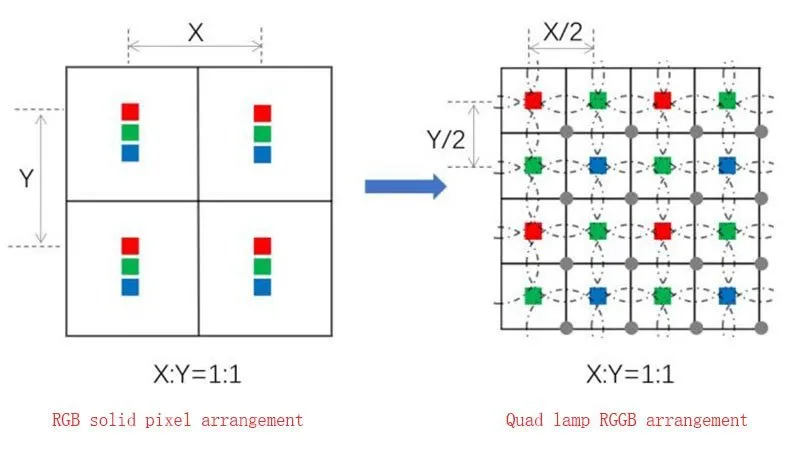
As you can see in the figure on the left, in a real pixel arrangement, the three RGB sub-pixels in each black box form a complete pixel for content display.
For the right figure above, in the four-lamp RGGB arrangement, there’s only one sub-pixel in each black frame. Thanks to the advanced dynamic sub-pixel rendering technology, surrounding sub-pixels can be borrowed flexibly based on the image content, allowing one sub-pixel to display the complete pixel content. In a four-lamp RGGB arrangement, each pixel (RGB) increases by one sub-pixel (G), which is a fourfold increase in display effect.
Three-lamp Delta1 Longitudinal Dynamic Sub-Pixel Rendering Technology Principle

As shown in the right figure above, using the three-lamp Delta1 vertical layout as an example, there are one or two sub-pixels in each black box.
The dynamic sub-pixel rendering technology lets us borrow surrounding sub-pixels flexibly, so one or two of them can display the complete pixel content in the corresponding position. Changing the position of the sub-pixels in each RGB pixel can double the display effect in both the horizontal and vertical directions, compared to what you’d get with real pixels.
What are the benefits of dynamic sub-pixel rendering technology?
Resolution Multiplication

With Dynamic Sub-Pixel Rendering Technology, you can achieve a smaller pitch and larger resolution display by changing the arrangement and number of sub-pixels, even though the screen size remains the same.
Process Simplification, Power Consumption Reduction
Let’s look at a common P0.9 COB LED display as an example. We can compare the number of light-emitting chips and driver ICs:
| Solution Type | Normal Pixel Layout | 3-Light Delta 1 Diagonal Layout | 4-Light RGGB Layout | 3-Light Virtual Layout |
|---|---|---|---|---|
| Layout Plan | ||||
| Actual Pixel Resolution | 4×4 | 4×2 | 2×2 | 2×2 |
| Dynamic Sub-Pixel Resolution | / | 4×4 | 4×4 | 4×4 |
| Number of Light Emitting Chips | 86400 | 43200 | 28800 | 21600 |
| Number of Driver ICs | 120 | 60 (reduced by 1/2) | 40 (reduced by 2/3) | 30 (reduced by 3/4) |
| Equivalent Power | 1 | 0.8 | 0.65 | 0.5 |
Under the same resolution, compared with real pixels, the number of light emitting chips and driver ICs used in the LED screen with dynamic sub-pixel rendering technology is greatly reduced.
At the same time, the complexity of PCB wiring and driver IC arrangement is improved, which helps to increase the manufacturing yield of the light board and reduce production costs. The temperature and power consumption of the LED display have also been significantly improved.
Display effect improvement
Even though the virtual/sub-pixel screen body cuts down on the number of light-emitting chips and driver ICs, it still has the benefits of a wide color gamut, high brightness, and high contrast of LED displays.
Conclusion:
The dynamic sub-pixel rendering tech can improve the resolution of LED screens. When you combine it with the special pixel enhancement algorithm and other picture quality algorithms, it can really improve the quality of virtual/sub-pixel screens.
Doitvision gives a variety of solutions to the development of COB LED display, if you are interested in COB LED display, feel free to contact us!