 All-in-One COB LED TV
  Flexible LED Displays
  Transparent LED Displays
  Led Poster
  Circular LED Displays
  Creative & Custom LED Displays
 With the development of LED technology, outdoor advertising is no longer limited to traditional tools such as posters and banners, but is moving towards a more intelligent direction.
You may have seen many conventional single-sided outdoor LED screens. But do you know about double-sided outdoor LED screens? What are their more benefits and how much does it cost? Doitvision will guide you the details.
What is a double-sided outdoor LED billboard?

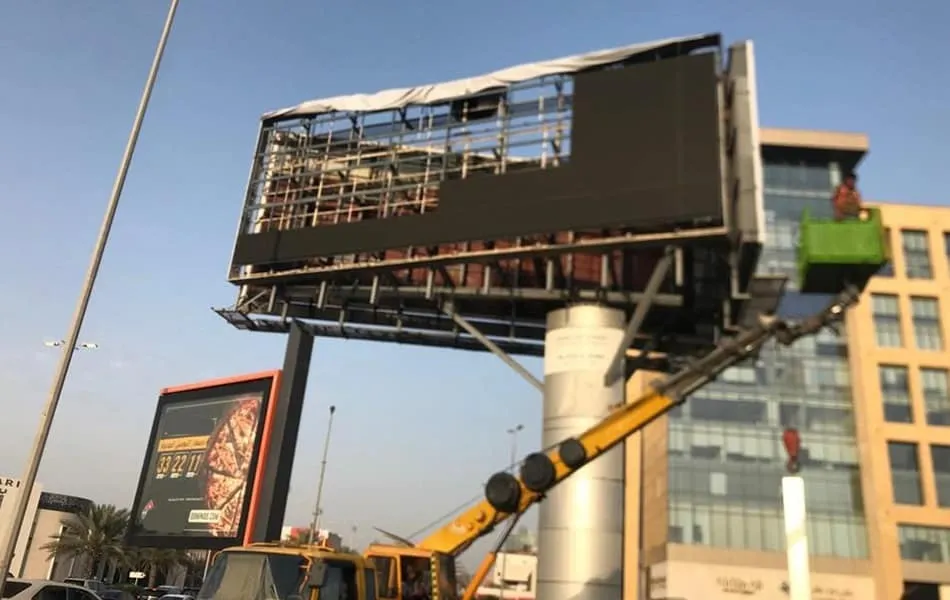
A double-sided outdoor LED billboard is an LED display that can display content in two directions at the same time. Its core structure is composed of two sets of LED modules back to back, and two-way synchronous display is achieved through a shared LED control system and a cabinet frame.
Compared with conventional single-sided screens, its biggest feature is the double-sided independent playback function, which can not only display the same picture synchronously, but also achieve differentiated content output through sub-control technology.
Common double-sided LED screens mainly include column double-sided screens, hanging double-sided screens, vertical double-sided screens, light pole double-sided screens, etc.
Technical principle:
- Adopting the “double-sided module” design
- Each cabinet integrates two independent sets of LED light panels encapsulated by a waterproof heat dissipation structure
- Supports vertical or horizontal installation.
Application:
- Urban main roads and commercial streets: set up at traffic intersections, double-sided display, covering two-way traffic.
- Bus stops/bus shelters: one side can display advertisements, and the other side can display arrival information, weather and other livelihood content.
- Gas station billboards: set up double-sided screens in the direction of vehicle entry and exit to increase advertising exposure.
- Scenic area/park entrances and exits: used for guide information, real-time broadcasting, etc.
- Building columns/three-dimensional walls: maximize the use of space resources through vertical installation.
Advantages of double-sided outdoor LED Display
High space utilization:
Double-sided screens can cover two-way traffic without additional land occupation. They are particularly suitable for narrow areas such as the center of the road and building corridors, which effectively improves space utilization.
Significant advertising benefits:
The exposure per unit area is increased by more than 50%.Therefore, they are also suitable for high-value scenarios such as brand chain stores and transportation hubs, which can significantly improve the effectiveness of advertising.
Energy saving and environmental protection:
The double-sided screen shares the power supply and control system. Compared with installing two single-sided screens, the energy consumption is reduced by about 30%, which is in line with the concept of green environmental protection.
The difference between double-sided LED screens and conventional outdoor LED screens
Compared with conventional outdoor LED screens, the most significant difference of double-sided LED screens is their double-sided display capability. This feature not only increases the dimension of information display, but also makes the advertising content more diverse and can better attract the attention of pedestrians.
In addition, the double-sided LED display screen has also been optimized in terms of structural design, heat dissipation system, control software, etc. to adapt to the higher requirements brought by double-sided display.
| Item | Double-sided Outdoor LED Screen | Single-sided Outdoor LED Screen |
|---|---|---|
| Viewing Angle | Bidirectional | Unidirectional |
| Cost Structure | Screen cost higher than single-sided, but structure, power supply, control can be shared | Screen and structure are completely independent |
| Display Area | Double display with same occupied area | Display area is the same as the occupied area |
| Installation Complexity | Slightly higher | Relatively simple |
| Advertising Value | Higher exposure efficiency | Limited exposure surface |
What do you need to know before building a double-sided outdoor LED display?

Environmental assessment:
- Measure the sunlight intensity at the installation location (recommended ≥6000nit brightness)
- Wind speed (must meet the requirements of 12-level typhoon resistance) and pedestrian flow lines.
Content planning:
- Select pixel spacing (P4-P10) according to viewing distance
- Recommended refresh rate for video content ≥1920Hz
Related:
Accessories selection:
- Lamp beads are preferred: CREE or Nationstar Optoelectronics, and the light decay is controlled within 5%/year.
- Cabinet material: die-cast aluminum box (IP65 protection) vs carbon steel (20% lower cost but requires regular rust prevention).
- Power supply solution: dual-channel redundant power supply, MEAN WELL series .
Installation and construction points:
- Column installation: foundation depth ≥1.5m, concrete grade C30 or above.
- Windproof design: add spoilers, wind pressure coefficient ≤0.6.
- Cooling solution: natural convection cooling channel spacing ≥15cm.
System debugging process:
- Automatic brightness adjustment: 2000-8000cd/㎡ self-adaptation is achieved through light sensor probe.
- Synchronous calibration: double-sided color difference ΔE<3, viewing angle compensation algorithm debugging.
Operation and maintenance management strategy:
- Remote monitoring: real-time monitoring of temperature, humidity, and voltage fluctuations.
- Spare parts management: It is recommended to reserve 5% redundant modules.
How much does double-sided outdoor LED screen cost?
The cost of double-sided LED display screen is about 600~2000 square meters. There are many factors that affect the price of a double-sided outdoor LED screen, mainly including pixel pitch, refresh rate, lamp brand, protection level, power configuration and special functions.
Here is the price reference for P4-P10 double-sided screens (unit: USD/㎡):
| Model | Basic Model (Basic LEDs) | Premium Model (High quality LEDs) | Special Model (Low Temperature/Salt Spray Resistant) |
|---|---|---|---|
| P4 | 1,200−1,500 | 1,800−2,200 | $2,500+ |
| P5 | 950−1,200 | 1,500−1,800 | $2,000+ |
| P6 | 750−950 | 1,200−1,500 | $1,800+ |
| P8 | 550−700 | 900−1,100 | $1,300+ |
| P10 | 400−550 | 700−850 | $1,000+ |
Pixel Pitch
Pixel pitch (Pitch) is an indicator to measure the physical distance between the pixels of an LED display screen, which directly affects the display effect and cost.
Cost difference:
P4 vs. P10: P4 pixel density is 6.25 times that of P10 (P4=4mm pitch, P10=10mm). P4 requires smaller lamp chip, more sophisticated SMT patch technology and more efficient heat dissipation design, resulting in increased material cost and production yield loss.
According to market industry prices, the cost of P4 screen is 2-3 times higher than that of P10, and the specific difference depends on the panel size, customization requirements and brand premium.
Refresh Rate
The refresh rate refers to the number of times the LED display screen updates the screen per second, which directly affects the smoothness and visual comfort of video playback.
Technical impact:
- High refresh rate (such as 3840Hz): Reduce screen smear, stroboscopic and motion blur by optimizing the driver IC algorithm and signal transmission protocol.
- Low refresh rate (such as 1920Hz): Low cost, but may produce slight flicker, not suitable for high-speed motion pictures.
Cost structure:
- Driver IC upgrade: A higher performance driver chip is required, and the price increases by about 10%.
- System optimization: Including increasing the number of PCB layers, optimizing the signal line width design, etc., the comprehensive cost increases by 15-20%.
Lamp bead brand and quality
Lamp beads are the light-emitting units of LED display screens, and their brand and quality directly affect the display effect and lifespan.
Imported vs. China:
Imported lamp beads (such as Cree, Nichia Chemical):
- Advantages: high luminous efficiency (>150lm/W), wide color gamut (NTSC>110%), low light decay (<5%/1000 hours).
- Cost: Due to patented technology, precision packaging and strict quality control, the price is 30-50% higher than that of domestic lamp beads.
Domestic lamp beads (such as Nationstar Optoelectronics and Mulinsen):
- Advantages: High cost performance, suitable for the mid-to-low-end market.
- Disadvantages: Light efficiency and stability are slightly inferior to imported brands.
Industry trends: With the breakthrough of domestic lamp bead technology, high-cost products are gradually narrowing the gap with imported brands.
IP Rating
IP defines the dust and water resistance of LED display screens, which directly affects the stability and life of outdoor applications.
Rating differences:
- IP54: Dustproof (no harmful dust accumulation), splashproof (no harm from splashing water in any direction), suitable for indoor or semi-outdoor scenes.
- IP65: Completely dustproof and water-proof (no harm from strong water spraying in any direction), suitable for outdoor all-weather environments.
Increase in cost:
Structural upgrade: It is necessary to use materials such as sealing strips, waterproof and breathable membranes, and corrosion-resistant shells, which will increase the cost by about $50/㎡.
Power supply configuration
The power supply configuration directly affects the power supply reliability and failure rate of the LED display screen.
Single backup vs dual backup:
- Single backup power supply: low cost, but high risk of single point failure, suitable for small indoor screens.
- Dual backup power supply: automatic switching between main and backup power supplies, seamless switching to backup power supply in case of failure, ensuring 7×24 hours operation.
Cost structure:
- Hardware increase: additional power supply module, switching switch and monitoring circuit are required, and the cost increases by about $20/㎡.
- System debugging: power redundancy design requires complex circuit layout and software coordination, and the comprehensive cost increases by $25/㎡.
Special functions
Special functions meet personalized application scenarios, but the cost will increase. For example, transparent screen, 3D display, remote control, intelligent dimming, etc.
Relaed:
Case specific: P6 24 m2 double-sided LED screen project calculation
Project parameters:
Size: double-sided 4m×6m (24㎡ per side, total area 48㎡)
Cabinet specifications: 960×960mm (standard outdoor die-cast aluminum box)
Calculation process:
Number of boxes:
Number of single-sided horizontal boxes = 4000mm ÷ 960mm ≈ 4.17 → round up to 5 columns
Number of single-sided vertical boxes = 6000mm ÷ 960mm ≈ 6.25 → round up to 7 rows
Total number of single-sided boxes = 5×7=35
Total number of boxes = 35×2 sides = 70
Cost estimate:
Hardware cost: 48㎡ × 850/㎡ = $40,800
Steel structure: about $6,000 (Q235 galvanized steel)
Control system: Nova processor ×2 → $1,500
Installation and commissioning: $2,000
Total budget ≈ $50,000
Dotision double-sided LED screen solution

As a professional manufacturer of LED display screens, Dotision provides a one-stop double-sided outdoor LED screen solution:
- Supports P4/P5/P6/P8/P10 multiple pixel pitch options
- Self-developed control card system, both synchronous and asynchronous playback on both sides
- Modular cabinet design, fast assembly and maintenance
- Free structural drawings, remote technical support
- Automatic brightness adjustment system
- Global delivery, complete CE/FCC/ETL certification
Conclusion
Double-sided outdoor LED screens are transforming from supplementary products to mainstream display solutions. The market penetration rate has reached 18.7% in 2023. They have become one of the popular choices for advertisers, brand owners, and city operators.
For advertising operators, the investment return period of double-sided screens can be shortened to 2.3 years (about 3.5 years for conventional screens). We recommend that you prioritize layout in traffic arteries, commercial complexes and other scenes to seize the commanding heights of visual marketing.
If you are considering building an outdoor double-sided LED screen, you should choose a reliable LED display manufacturer to provide an overall solution, which can greatly improve the efficiency and quality of the project.
If you need to customize double-sided LED screen solution, please contact us for professional advice and quotes!